
SaaS Workspace ONE UEM still needs inspectors to be the same people as in the city's directory. What third-party dependency remains?
Select an answer to reveal the explanation.
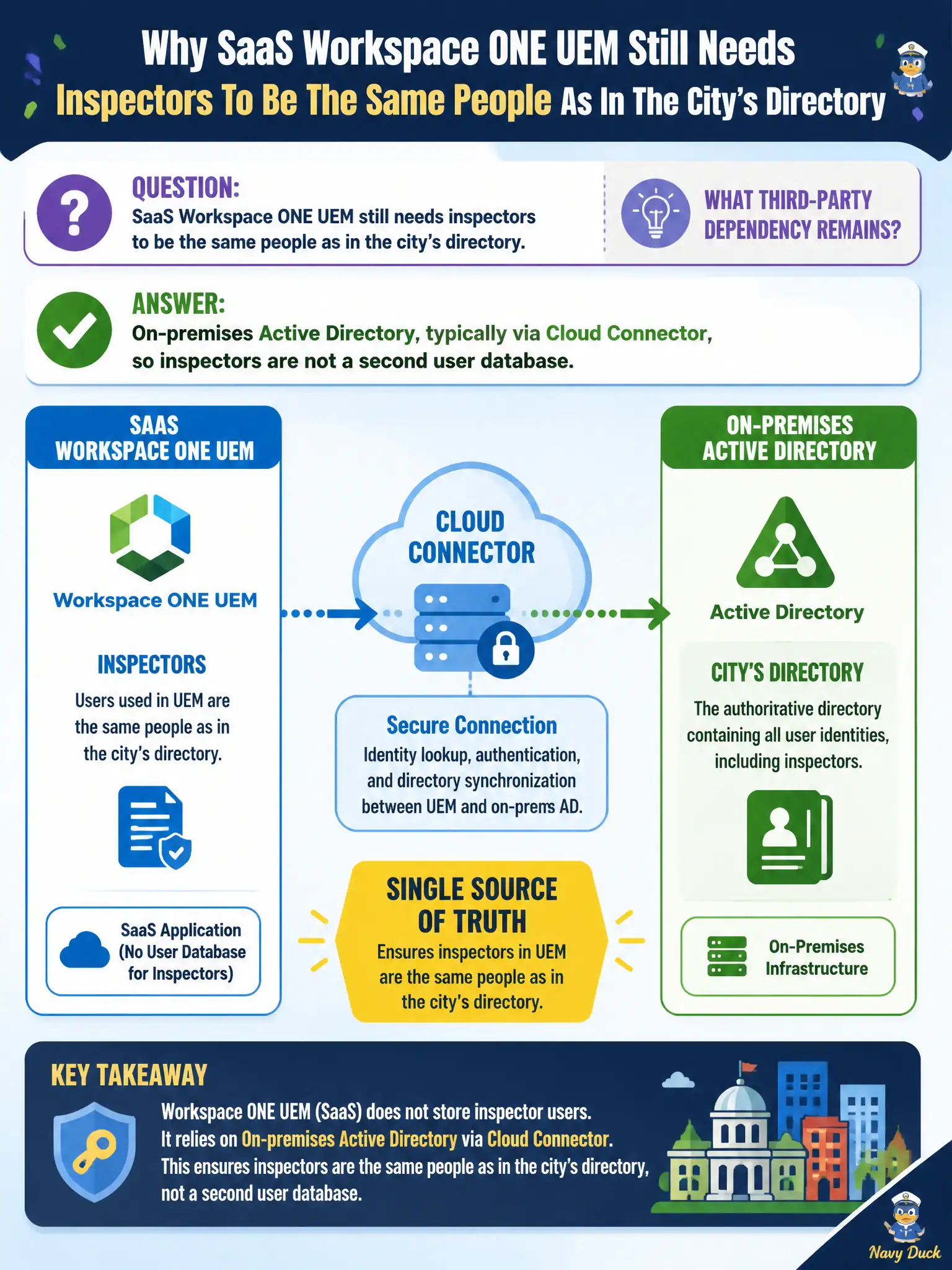
Short Explanation
SaaS UEM is still the city's phone book, not a second roster of inspectors. Active Directory stays on-prem and is reached through Cloud Connector. Horizon SQL, a PCoIP puck, and Citrix StoreFront are not that directory dependency.
Full Explanation
SaaS Workspace ONE UEM still needs inspectors to match the city's directory, typically via Cloud Connector to on-premises Active Directory, so UEM is not a second user database. In municipal EUC terms, treat the endpoint as a window into city systems when the architecture says so, not as the system of record for the files or apps in the stem. Distractor concept: Horizon SQL Server is not the UEM user store. Distractor concept: A PCoIP zero client is not the directory. Distractor concept: Citrix StoreFront is not the civic identity source for Workspace ONE. Exam caveat: SaaS UEM still depends on civic directory identity via connector patterns. Operational check: Verify Cloud Connector health to AD and that inspector enrollment/assignments resolve from directory groups. Record the chosen control and the rejected failure modes in the civic change ticket or runbook so on-call staff and auditors share the same rationale after the next maintenance window. Re-validate after personnel or image changes that the same control still meets the city's continuity, security, and support expectations for this service. Helpdesk coaching tip aligned to the conversational brief: SaaS UEM is still the city's phone book, not a second roster of inspectors. Active Directory stays on-prem and is reached through Cloud Connector. Horizon SQL, a PCoIP puck, and Citrix StoreFront are not that directory dependency.