
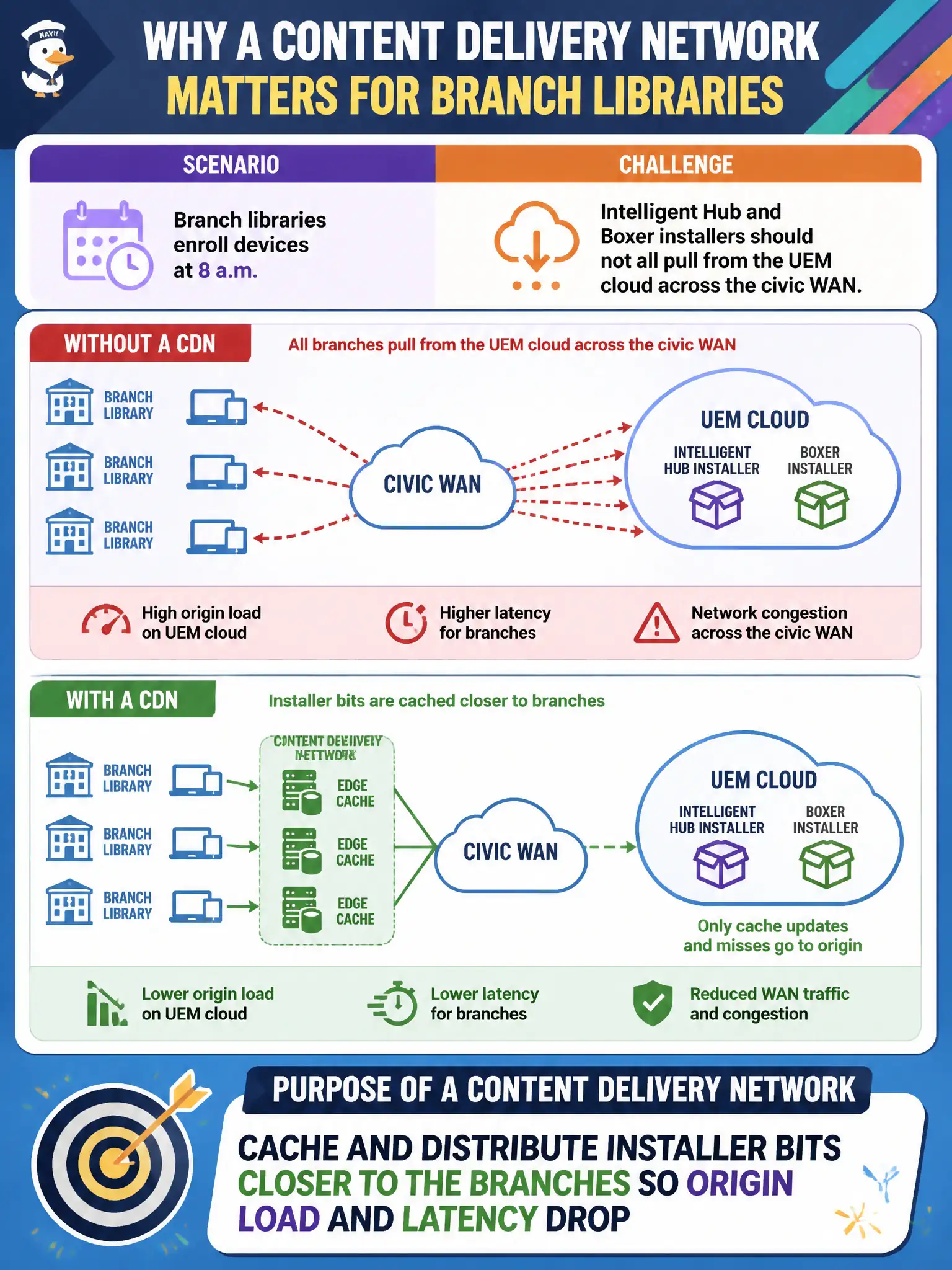
Branch libraries enroll devices at 8 a.m., and Intelligent Hub and Boxer installers should not all pull from the UEM cloud across the civic WAN. What is the purpose of a content delivery network in that scenario?
Select an answer to reveal the explanation.
Short Explanation
A CDN is a stack of neighborhood lockers for big files — Hub and Boxer bits land near the libraries instead of every tablet hiking back to the UEM cloud at 8 a.m. It does not broker VDI, log people in, or attach App Volumes.
Full Explanation
A CDN caches and distributes Intelligent Hub and Boxer installer bits closer to branch libraries so origin load and WAN latency drop during morning enrollment—not to broker Blast or authenticate users. In municipal EUC terms, treat the endpoint as a window into city systems when the architecture says so, not as the system of record for the files or apps in the stem. Distractor concept: A CDN does not broker Blast as a UAG replacement. Distractor concept: A CDN does not authenticate library staff instead of Workspace ONE Access. Distractor concept: A CDN does not assign App Volumes packages to library desktops. Exam caveat: CDN = edge distribution of apps/updates/media; not VDI broker, IdP, or App Volumes. Operational check: Measure enrollment-week download sources and confirm branches hit nearby caches rather than pulling every byte from the UEM cloud origin. Record the chosen control and the rejected failure modes in the civic change ticket or runbook so on-call staff and auditors share the same rationale after the next maintenance window. Re-validate after personnel or image changes that the same control still meets the city's continuity, security, and support expectations for this service.