
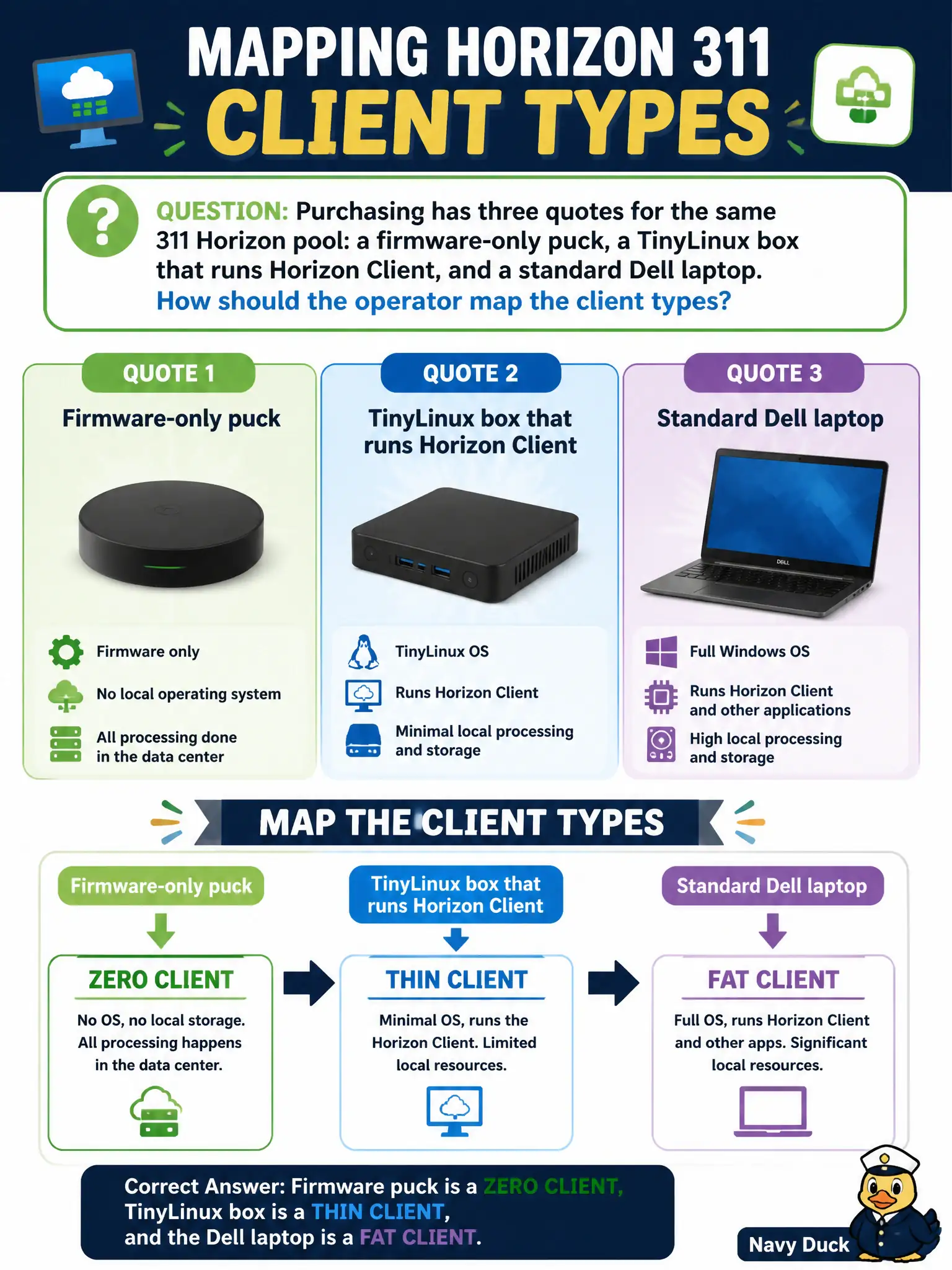
Purchasing has three quotes for the same 311 Horizon pool: a firmware-only puck, a TinyLinux box that runs Horizon Client, and a standard Dell laptop. How should the operator map the client types?
Select an answer to reveal the explanation.
Short Explanation
Same virtual desktop, three different doorbells: firmware puck is zero, little Linux box that runs the client is thin, and a normal Dell is fat. Displaying VDI does not make every endpoint thin, and none of those quotes is UAG or Connection Server.
Full Explanation
Map purchasing quotes correctly: firmware-only puck = zero client, TinyLinux box running Horizon Client = thin client, standard Dell laptop = fat client. In municipal EUC terms, treat the endpoint as a window into city systems when the architecture says so, not as the system of record for the files or apps in the stem. Distractor concept: Displaying a virtual desktop does not make all three thin clients. Distractor concept: Swapping zero/thin labels or calling the Dell a UAG is wrong. Distractor concept: Calling the puck fat or the Dell zero confuses the taxonomy entirely. Exam caveat: Classify by local OS/firmware footprint, not by the fact that VDI is displayed. Operational check: Annotate the three quotes with zero/thin/fat before PO approval so 311 buys the intended endpoint class. Record the chosen control and the rejected failure modes in the civic change ticket or runbook so on-call staff and auditors share the same rationale after the next maintenance window. Re-validate after personnel or image changes that the same control still meets the city's continuity, security, and support expectations for this service. Helpdesk coaching tip aligned to the conversational brief: Same virtual desktop, three different doorbells: firmware puck is zero, little Linux box that runs the client is thin, and a normal Dell is fat. Displaying VDI does not make every endpoint thin, and none of those quotes is UAG or Connection Server.