
Why does the clerk-of-court window standardize on zero clients rather than full PCs for Horizon sessions?
Select an answer to reveal the explanation.
Short Explanation
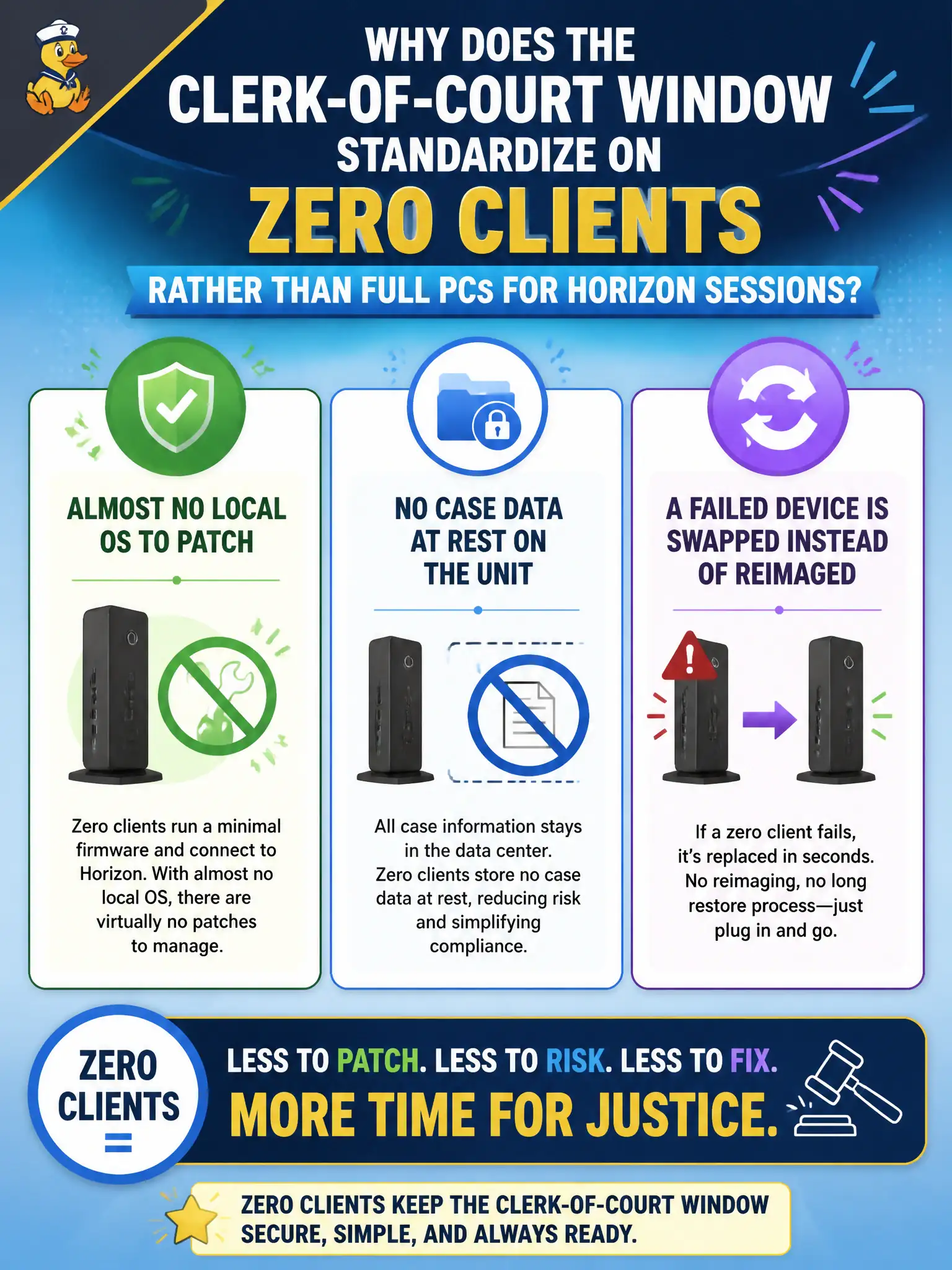
A zero client is more like a dumb terminal than a laptop you babysit — no local Windows to patch, no case files sitting on a disk, and a dead unit gets swapped like a keyboard. Boxer and AutoCAD need a real OS, and NSX overlay inspection is not why the window uses pucks.
Full Explanation
The clerk-of-court standardizes on zero clients because there is almost no local OS to patch, no case data at rest on the unit, and a failed device is swapped instead of reimaged. In municipal EUC terms, treat the endpoint as a window into city systems when the architecture says so, not as the system of record for the files or apps in the stem. Distractor concept: Boxer still needs a suitable endpoint OS/app environment; it is not why zero clients are chosen for counters. Distractor concept: AutoCAD offline in a trailer needs a fat client, not a zero client justification. Distractor concept: NSX Distributed Firewall inspecting overlay traffic is unrelated to choosing zero clients for counters. Exam caveat: Zero-client benefits = minimal local attack/patch surface and swap-not-reimage ops—not Boxer, CAD, or NSX. Operational check: Compare patch/reimage tickets for prior fat PCs versus swap procedures for zero clients at the clerk window. Record the chosen control and the rejected failure modes in the civic change ticket or runbook so on-call staff and auditors share the same rationale after the next maintenance window. Re-validate after personnel or image changes that the same control still meets the city's continuity, security, and support expectations for this service.