
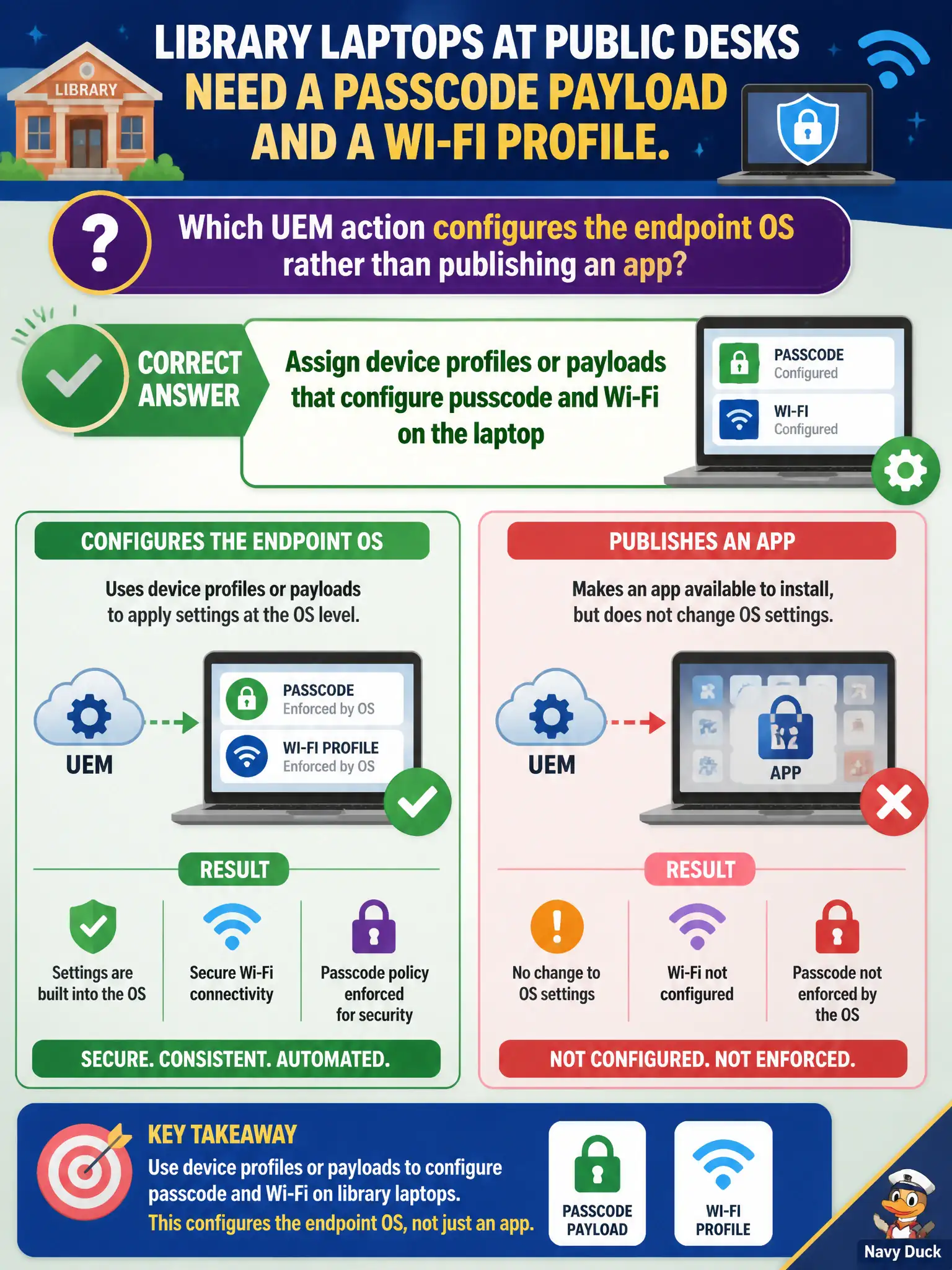
Library laptops at public desks need a passcode payload and a Wi-Fi profile. Which UEM action configures the endpoint OS rather than publishing an app?
Select an answer to reveal the explanation.
Short Explanation
Passcode and Wi-Fi are locks and keys on the laptop itself, not tiles in an app catalog. Device profiles push those OS settings; an app listing will not set the PIN.
Full Explanation
Device profiles or payloads configure passcode and Wi-Fi on the library laptop OS; that action configures the endpoint rather than publishing an app. In municipal EUC terms, treat the endpoint as a window into city systems when the architecture says so, not as the system of record for the files or apps in the stem. Distractor concept: Publishing passcode/Wi-Fi as a public app-store title does not push OS lock and network settings. Distractor concept: Horizon Client does not make the physical laptop inherit Wi-Fi and passcode from a VDI session. Distractor concept: Storing the Wi-Fi password only in Workspace ONE Content leaves a secret in a locker without configuring the OS. Exam caveat: Profiles configure devices; apps deliver software—do not swap those verbs. Operational check: Assign passcode and Wi-Fi profiles to the library smart group, sync, and confirm PIN and civic SSID apply without manual entry. Record the chosen control and the rejected failure modes in the civic change ticket or runbook so on-call staff and auditors share the same rationale after the next maintenance window. Re-validate after personnel or image changes that the same control still meets the city's continuity, security, and support expectations for this service.