
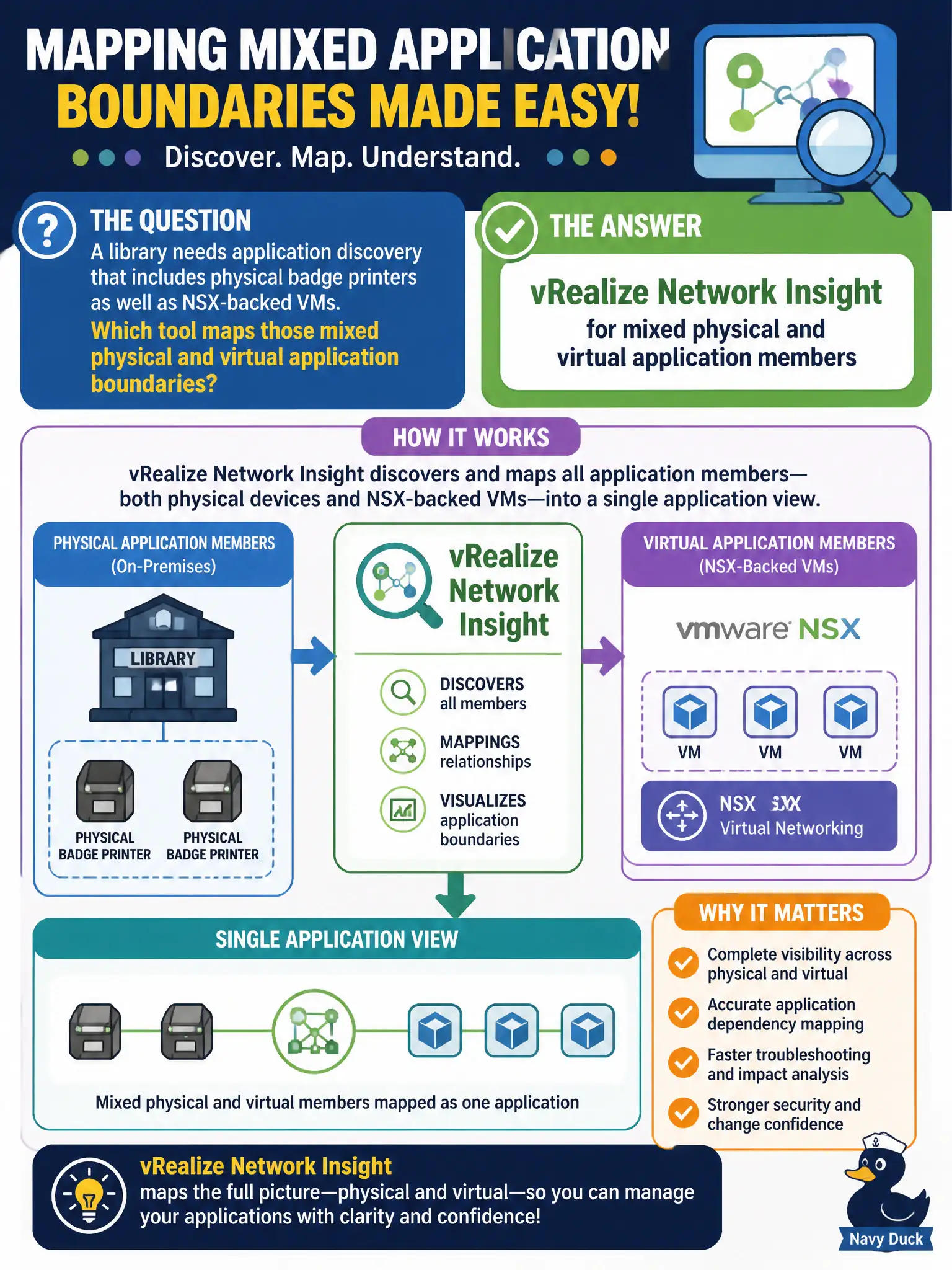
A library needs application discovery that includes physical badge printers as well as NSX-backed VMs. Which tool maps those mixed physical and virtual application boundaries?
Select an answer to reveal the explanation.
Short Explanation
Badge printers live on the physical floor, not as overlay VMs. vRNI is the tool that can draw an application mixing those printers with NSX VMs. Intelligence stays in the NSX estate.
Full Explanation
A library that needs application discovery spanning physical badge printers and NSX-backed VMs should use vRealize Network Insight for mixed physical and virtual application members. Badge printers live on the physical floor as non-overlay devices, while catalog and checkout VMs may sit on NSX; only a tool that can inventory both member types can draw the true application boundary for civic access planning. That mixed physical-virtual map is the library operations requirement. NSX Intelligence only, because printers appear as overlay workloads, fails by concept because printers are not NSX overlay VMs and Intelligence stays inside the NSX estate rather than inventing overlay membership for physical hardware. Guest Introspection on the printers through VMTools fails by concept because Guest Introspection and VMTools apply to virtual machines on prepared hosts, not bare physical badge printers. Carbon Black Cloud sensor groups on the printers fail by concept because endpoint sensor grouping does not perform mixed physical-virtual application discovery for NSX and metal members. Exam caveat: application maps that include physical devices plus NSX VMs are a vRNI job; do not force printers into Intelligence, Guest Introspection, or Carbon Black as if they were overlay workloads. Operational check: build the application in vRNI with printer IPs and NSX VM members, verify flows between them, export the boundary for segmentation design, and store the map with the library application inventory for civic asset governance.