
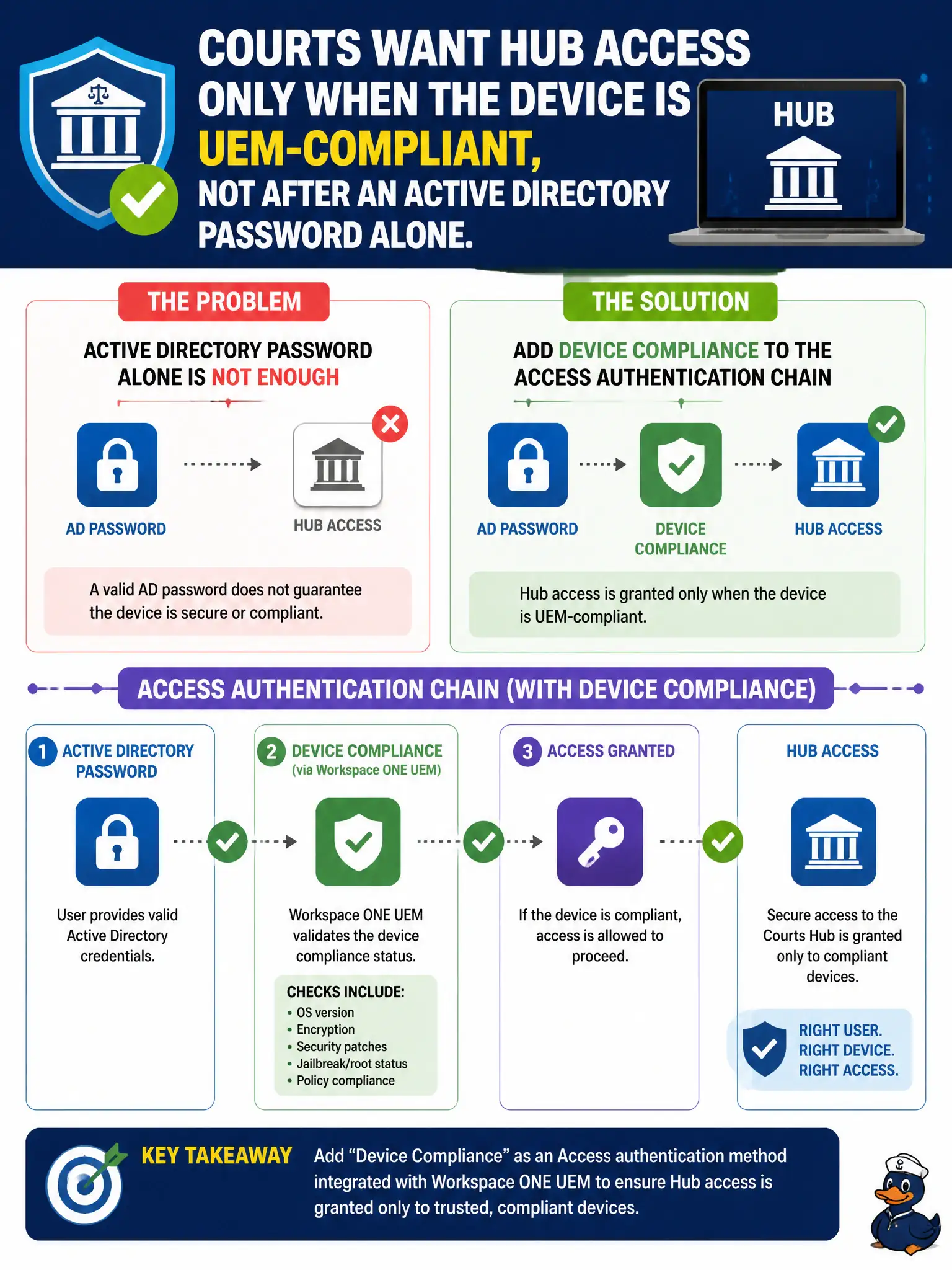
Courts want Hub access only when the device is UEM-compliant, not after an Active Directory password alone. What should be added to the Access authentication chain?
Select an answer to reveal the explanation.
Short Explanation
Password says who you are; device compliance says the laptop is still allowed in the building. Add Device Compliance as an Access method tied to UEM so Hub waits for a green compliance state, not just a correct AD password.
Full Explanation
Add Device Compliance as an Access authentication method integrated with Workspace ONE UEM so courts Hub access requires a UEM-compliant device rather than Active Directory password alone. Device Compliance bridges Access conditional access to UEM posture; password-only AD authentication cannot express whether the endpoint meets judicial device standards. A standalone AD password method with no device check fails the stated requirement that Hub open only on compliant devices. An NSX Guest Introspection signature set is host-based traffic introspection, not an Access authentication method for Hub. Using a Carbon Black Cloud sensor group as the Access identity provider miscasts endpoint grouping as an IdP and does not implement UEM compliance evaluation inside Access. Exam caveat: Device Compliance in Access depends on working UEM integration—enabling the method without posture sync will not enforce compliance even if password succeeds. Operational check: confirm UEM compliance policies evaluate court devices, include Device Compliance in the Hub authentication chain, verify a non-compliant device is denied while a compliant device succeeds, and retain integration settings in the courts IT change record for civic judicial-access assurance.