
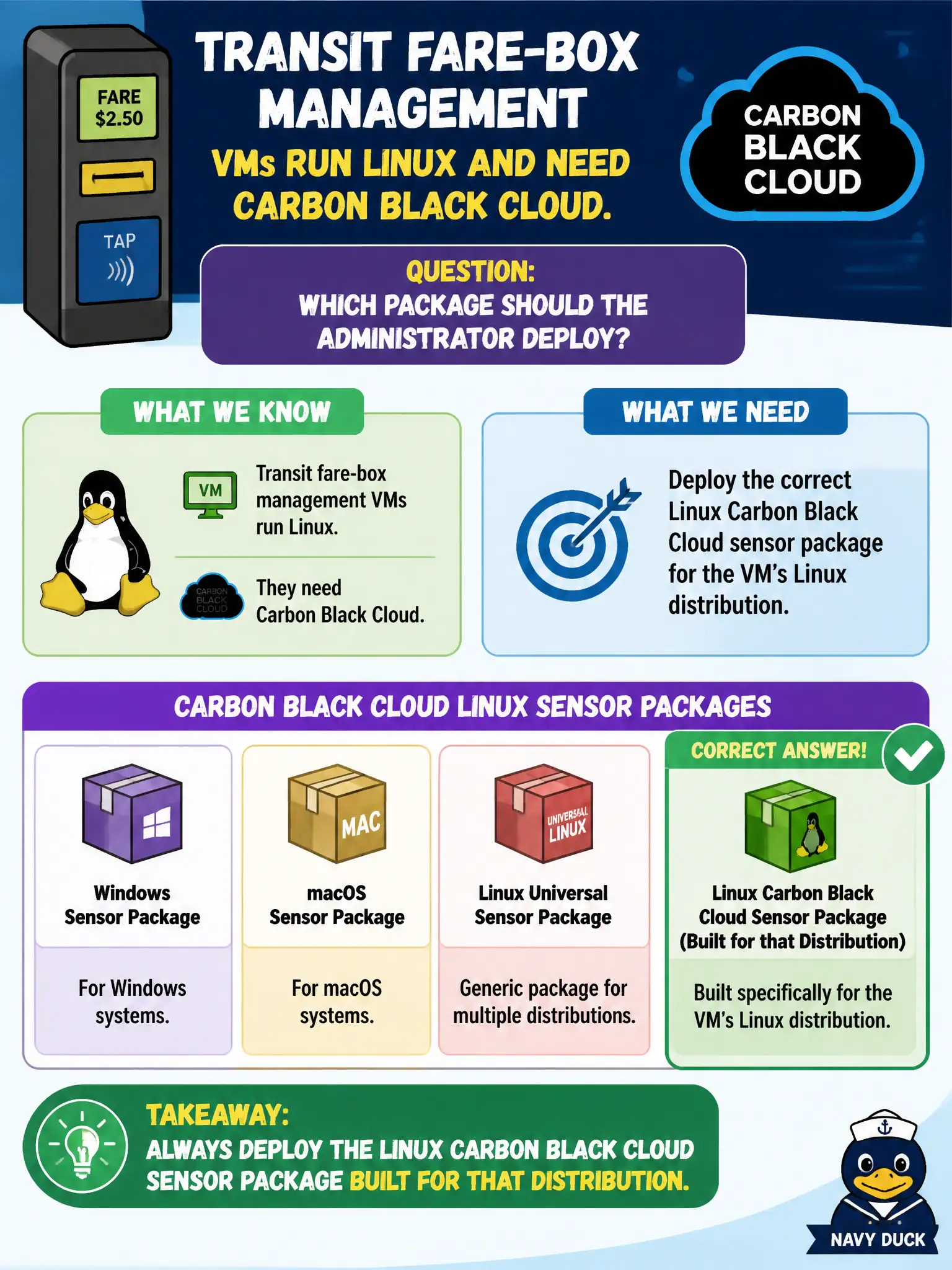
Transit fare-box management VMs run Linux and need Carbon Black Cloud. Which package should the administrator deploy?
Select an answer to reveal the explanation.
Short Explanation
Sensors are like transit radio firmware—you load the pack that matches the radio, not a Windows disk on a Linux box. Pick the Linux CBC sensor for those fare-box VMs. Guest Introspection is still not a substitute for the Linux agent.
Full Explanation
Transit fare-box management VMs run Linux and need Carbon Black Cloud. Deploy the Linux Carbon Black Cloud sensor package built for that distribution—sensors are like transit radio firmware where you load the pack that matches the radio, not a Windows disk on a Linux box. The Windows CB Defense MSI wrapped for Linux compatibility fails by concept because a Windows installer is not a supported Linux CBC sensor package and will not provide correct kernel integration. The macOS sensor PKG with a Linux compatibility flag fails because macOS packages are not Linux sensors and no such compatibility flag substitutes for the Linux build. NSX Guest Introspection only, claiming Linux VMs cannot run a Carbon Black Cloud sensor, fails because Linux CBC sensors exist for supported distributions and GI is not a full substitute for the Linux agent’s prevention telemetry. Exam caveat: Linux workloads require the Linux CBC sensor matched to the distro—not Windows MSI wrapping, macOS PKG myths, or GI-only. Operational check: install the correct Linux sensor on a fare-box management VM, confirm check-in and policy assignment in the Carbon Black console, validate connectivity through the documented sensor destinations, and update images to include the supported package. Maintain a transit CBC compatibility matrix of approved Linux distributions before rebuilds.