
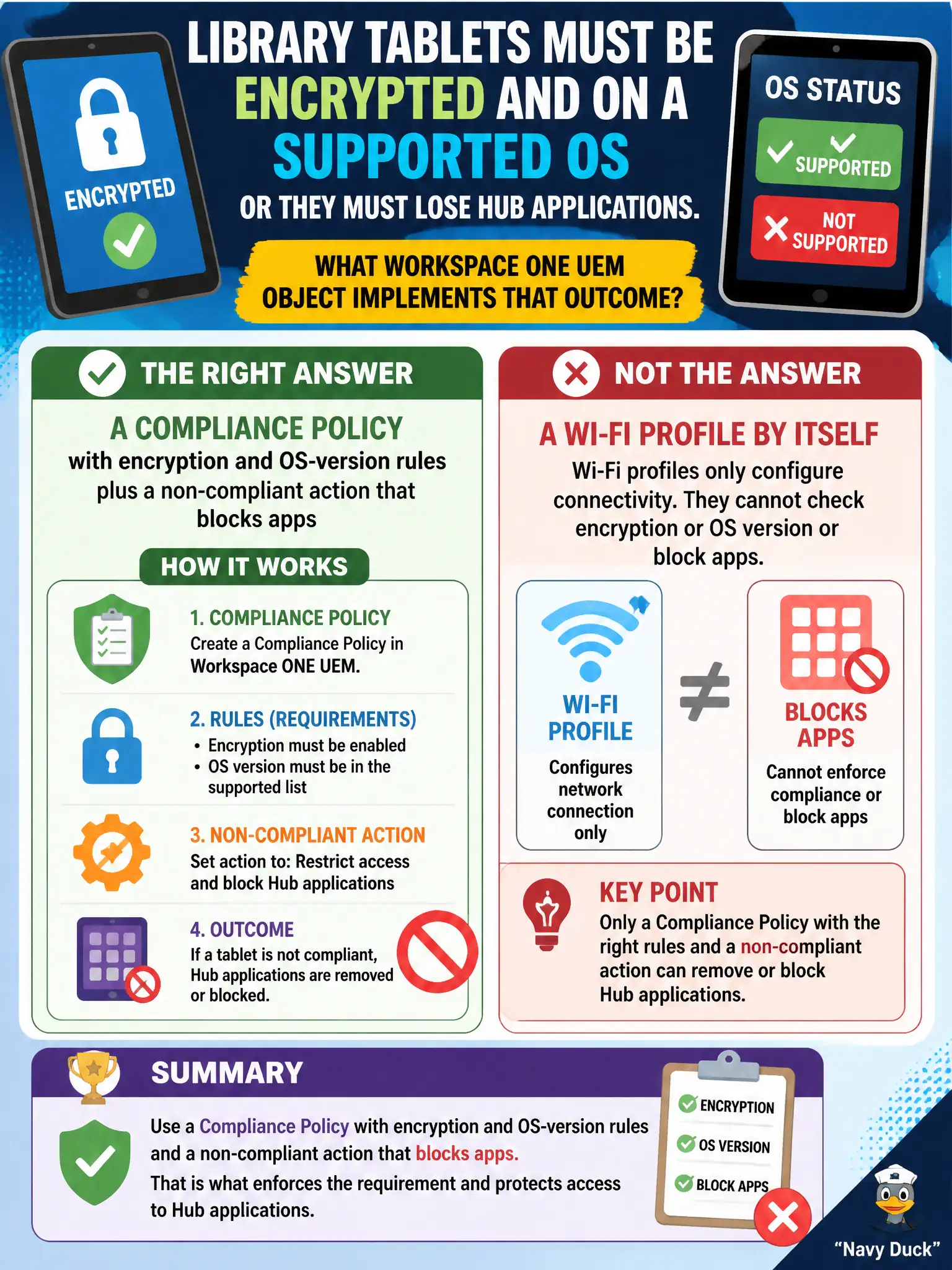
Library tablets must be encrypted and on a supported OS or they must lose Hub applications. What Workspace ONE UEM object implements that outcome?
Select an answer to reveal the explanation.
Short Explanation
A profile is the instruction sheet; compliance is the hall monitor. Encryption plus OS rules with a block-apps action is a compliance policy, not a Wi-Fi payload by itself.
Full Explanation
Library tablets must be encrypted and on a supported OS or they must lose Hub applications. Implement that with a compliance policy that includes encryption and OS-version rules plus a non-compliant action that blocks apps—not a Wi-Fi profile by itself. A profile is the instruction sheet; compliance is the hall monitor. Relying on a Wi-Fi profile alone fails by concept because profiles push configuration; they do not evaluate posture and revoke Hub apps by themselves. Using an NSX-T security group tag on the library VLAN fails because NSX tags do not implement UEM compliance actions on tablets. Using a Carbon Black Cloud watchlist that uninstalls Hub when encryption is off fails because watchlists are hunt objects and are not the UEM compliance engine. Exam caveat: posture-plus-action (block apps) is a UEM compliance policy; profiles, NSX tags, and CBC watchlists are the wrong objects for that outcome. Operational check: enroll a test tablet, fail encryption or OS rule intentionally, confirm Hub apps are blocked per action, remediate encryption, and confirm apps return when compliant. Publish the compliance rule set in the library device standard so auditors can map encryption and OS requirements to Hub entitlement loss.