
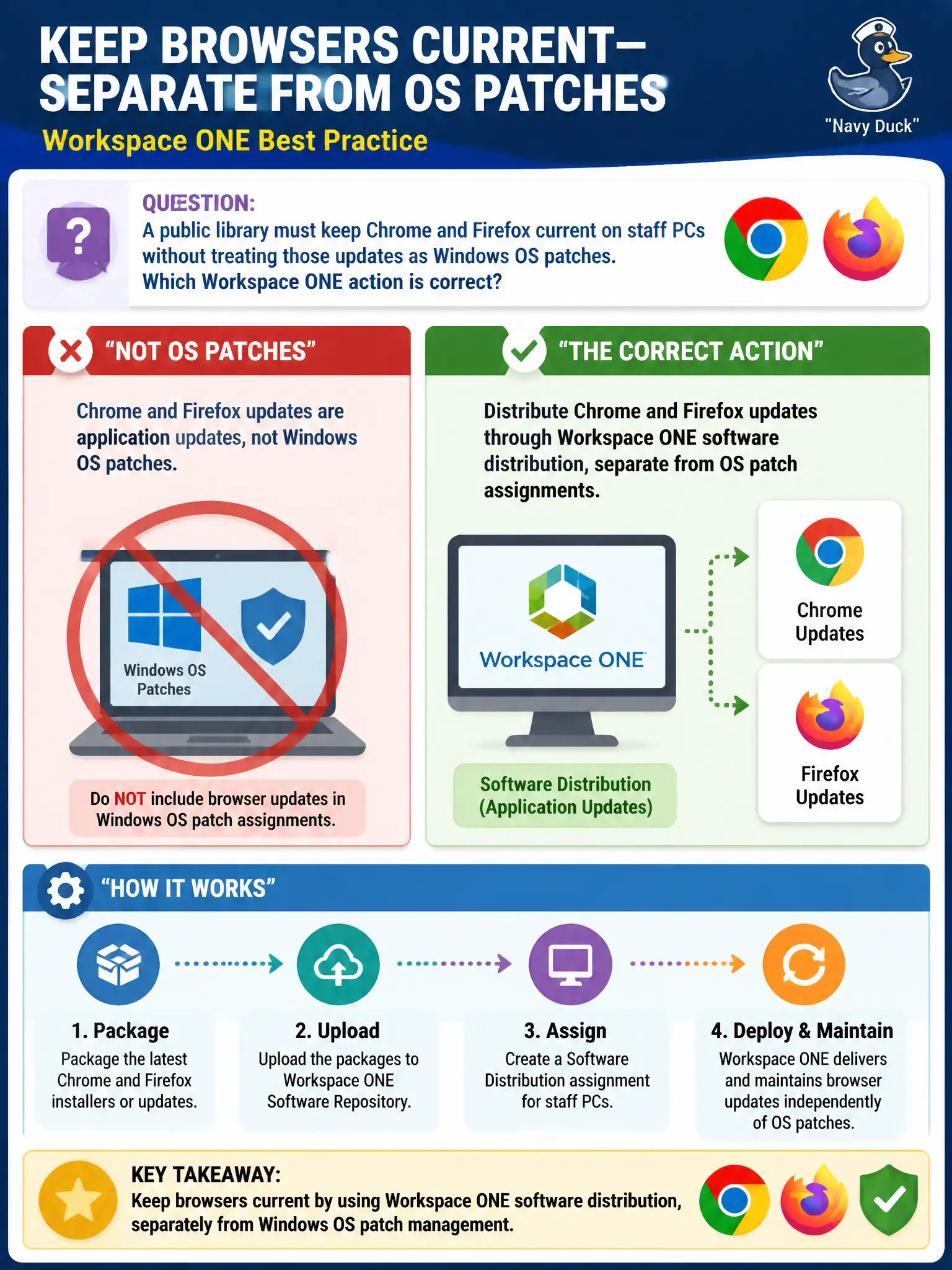
A public library must keep Chrome and Firefox current on staff PCs without treating those updates as Windows OS patches. Which Workspace ONE action is correct?
Select an answer to reveal the explanation.
Short Explanation
Browsers are library tools, not the Windows foundation. Ship Chrome and Firefox through software distribution, and keep OS patches on their own assignment.
Full Explanation
A public library keeping Chrome and Firefox current on staff PCs without treating those updates as Windows OS patches should distribute Chrome and Firefox updates through Workspace ONE software distribution, separate from OS patch assignments. Treat browser updates as library application packages on a different cart from the OS patch cart. Expecting Carbon Black Cloud prevention to upgrade browsers automatically fails by concept because prevention blocks or allows processes; it does not distribute browser version upgrades. Opening NSX-T Distributed Firewall any-any so browsers can self-update from any CDN fails because any-any is unsafe network exposure and is not managed software distribution. Disabling UEM software distribution and relying only on Windows Update for third-party apps fails because Windows Update is not the reliable managed path for Chrome and Firefox in this model. Exam caveat: third-party browsers are UEM software distribution, separate from OS patch assignments; CBC, DFW any-any, and Windows Update alone are not the browser update mechanism. Operational check: publish Chrome and Firefox via UEM software distribution to staff PC smart groups, confirm versions on a sample, keep OS patch assignments separate, and document the split in the library endpoint patching guide.