
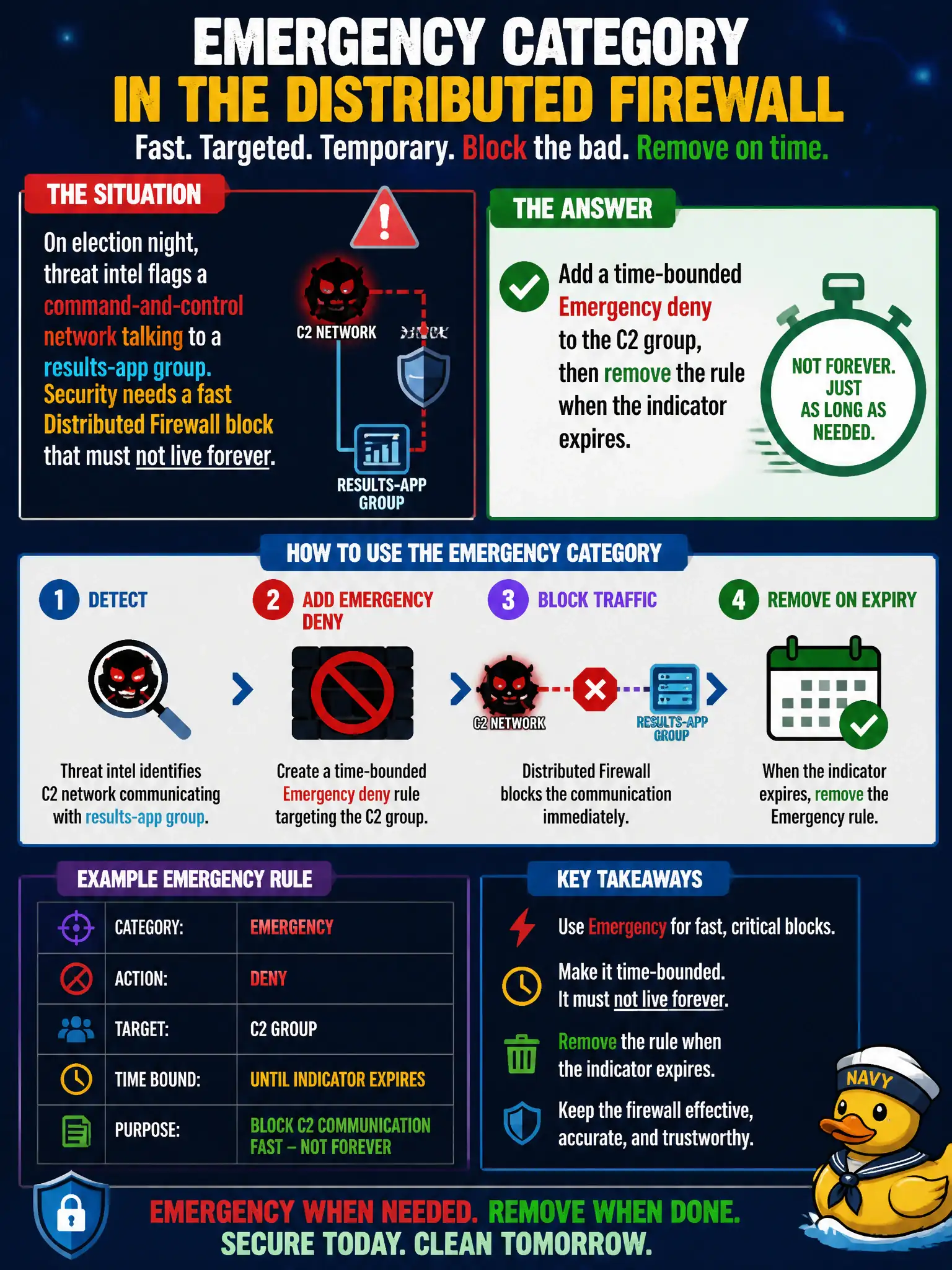
On election night, threat intel flags a command-and-control network talking to a results-app group. Security needs a fast Distributed Firewall block that must not live forever. How should the Emergency category be used?
Select an answer to reveal the explanation.
Short Explanation
Emergency is the red pull-handle, not a new permanent wall around the city. Slap a time-bounded deny on that C2 group, then take the handle off the wall when the indicator expires.
Full Explanation
On election night, when threat intel flags a command-and-control network talking to a results-app group, the Emergency category should receive a time-bounded Emergency deny to the C2 group, then the rule should be removed when the indicator expires. Treat Emergency as the night-shift lockdown that can drop a hostile hallway immediately but must not become a permanent unexplained any-any. Placing a permanent any-any deny in Application and never scheduling a review fails by concept because permanent Application any-any is not a time-bounded Emergency response and creates lasting policy debt. Disabling Identity Firewall until the canvass is certified fails because turning off Identity Firewall removes user-aware enforcement without blocking the C2 group. Changing the Tier-0 default origin to blackhole the entire civic WAN fails because blackholing the WAN is a routing catastrophe, not a scoped Emergency deny for a C2 group. Exam caveat: Emergency sits above Infrastructure and Application for fast incident blocks; use time-bounded Emergency denies and remove them when indicators expire. Operational check: add the C2 group Emergency deny with an expiry or calendar review, confirm Distributed Firewall hits against the results-app group, remove the rule when intel expires, and file the Emergency change in the election security log.