
County administrators review NSX Intelligence policy recommendations for a permitting application and accept them into Distributed Firewall. What is that action?
Select an answer to reveal the explanation.
Short Explanation
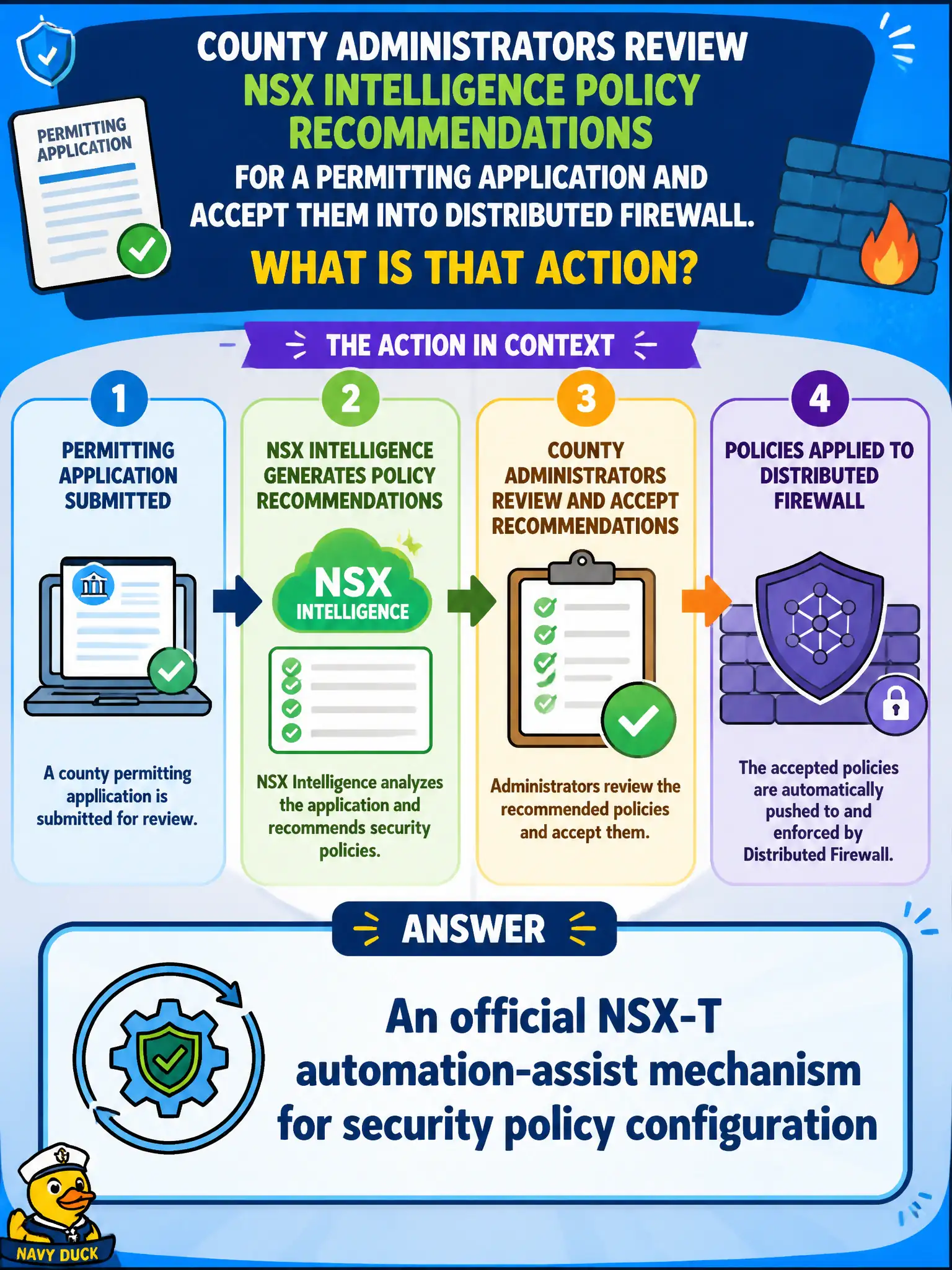
Intelligence watched the permitting app talk, then handed you a draft firewall. Accepting those recommendations is a supported way to build policy—not a paper CAB or a DRS move.
Full Explanation
When county administrators review NSX Intelligence policy recommendations for a permitting application and accept them into Distributed Firewall, that action is an official NSX-T automation-assist mechanism for security policy configuration. Intelligence observed the app’s conversations and offered draft rules; accepting them is a supported path to build policy faster with human review. Treating acceptance as a CISSP change-advisory-board substitute that replaces NSX fails by concept because a CAB process does not generate or realize Distributed Firewall rules, and Intelligence recommendations still live inside NSX-T policy, not as a paperwork replacement for the platform. Calling it a vSphere DRS recommendation unrelated to firewall policy fails because DRS balances compute placement; it does not author security groups or Distributed Firewall sections. Calling it a Carbon Black Cloud watchlist that only quarantines devices fails because CBC watchlists are endpoint detection constructs, not NSX Intelligence firewall recommendation acceptance. Exam caveat: accepting NSX Intelligence recommendations is NSX-T policy automation-assist; it is not CAB theater, DRS, or Carbon Black Cloud quarantine. Operational check: review recommended groups and services for the permitting app, accept into a draft Distributed Firewall section, peer-review and publish, validate hit counts on real permitting flows, and record that Intelligence-assisted rules still require the same change control as hand-authored policy.