
After independent scoring and consensus review for a city's transit-planning Request for Proposals (RFP), two shortlisted firms finish with identical total evaluation scores, and the RFP is silent on tie-breakers. Which action should the procurement officer take?
Select an answer to reveal the explanation.
Short Explanation
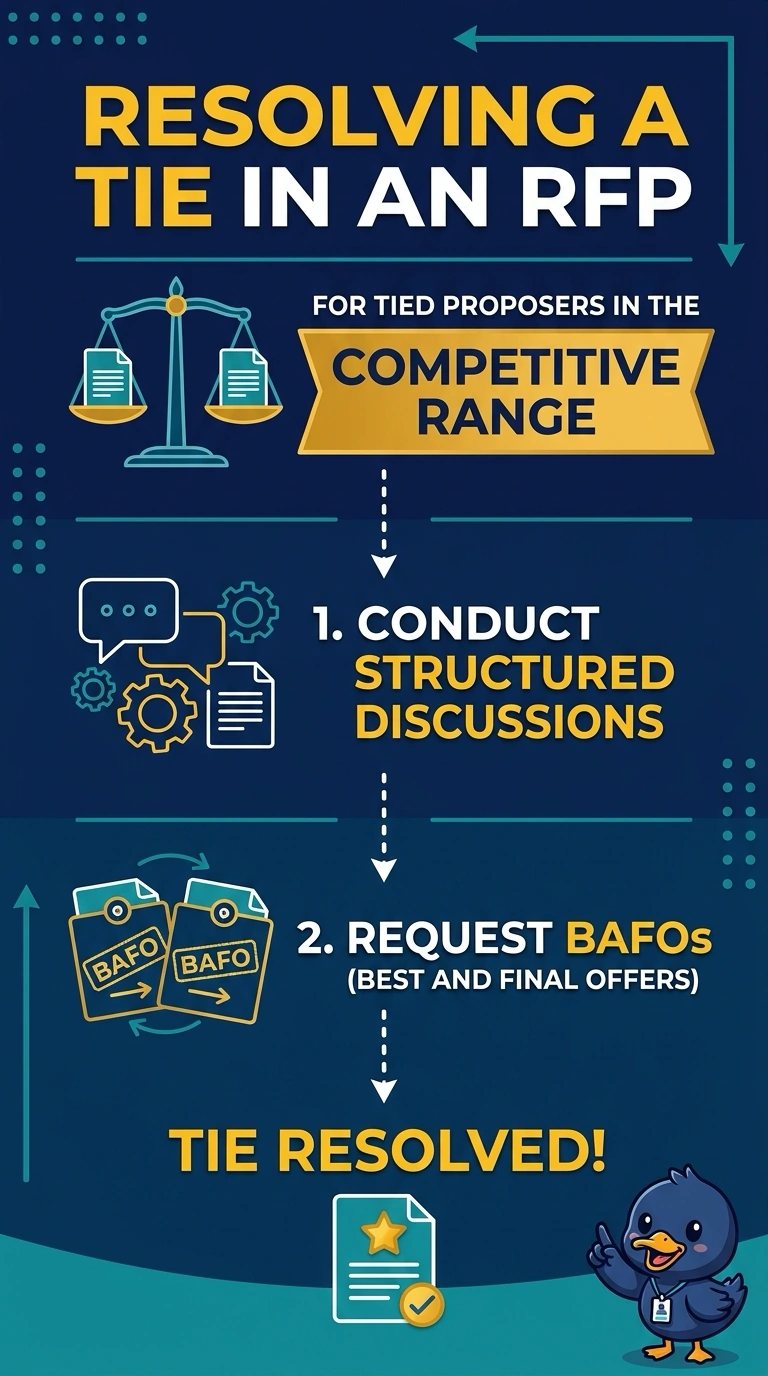
In an RFP, a tie is not broken by a coin toss; the agency should use structured discussions and BAFOs so both firms can be distinguished on best value. You give both teams a fair, documented chance to sharpen their proposals without inventing new rules.
Full Explanation
Unlike sealed bidding, a Request for Proposals is designed to identify best value through comparative evaluation and, when needed, structured negotiation. Choosing to Conduct structured discussions and request Best and Final Offers (BAFOs) from the tied proposers in the competitive range gives both firms an equal, documented opportunity to clarify scope assumptions, strengthen deliverables, or refine pricing so the committee can make a defensible distinction. By contrast, choosing to Break the tie by drawing lots or flipping a coin in public view, just as in a sealed Invitation for Bids applies a low-bid tie-breaker that ignores qualitative differences and lacks authority when the RFP does not specify random selection. Choosing to Award the contract to whichever of the two tied firms submitted the lower initial price proposal introduces an unstated tie-breaking rule after scoring, which exposes the award to protest if price was only one weighted factor. Meanwhile, choosing to Ask the evaluation committee chair to cast a tie-breaking vote after rereading both proposals violates objective scoring rules and undermines evaluation integrity. One caveat is that if the RFP already contains an explicit, published tie-breaker clause, the agency must follow that stated rule instead. As an operational check, issue identical written discussion questions and BAFO deadlines to all proposers in the competitive range.
Prefer to study offline? Printable PDF study book + test engine ($7.50, unofficial). These questions stay free here.