
A county plans to restore a historic nineteenth-century courthouse facade requiring specialized stone-conservation expertise, and staff worry that an open Invitation for Bids could obligate award to an inexperienced low bidder. Which pre-solicitation tool should the buyer use first?
Select an answer to reveal the explanation.
Short Explanation
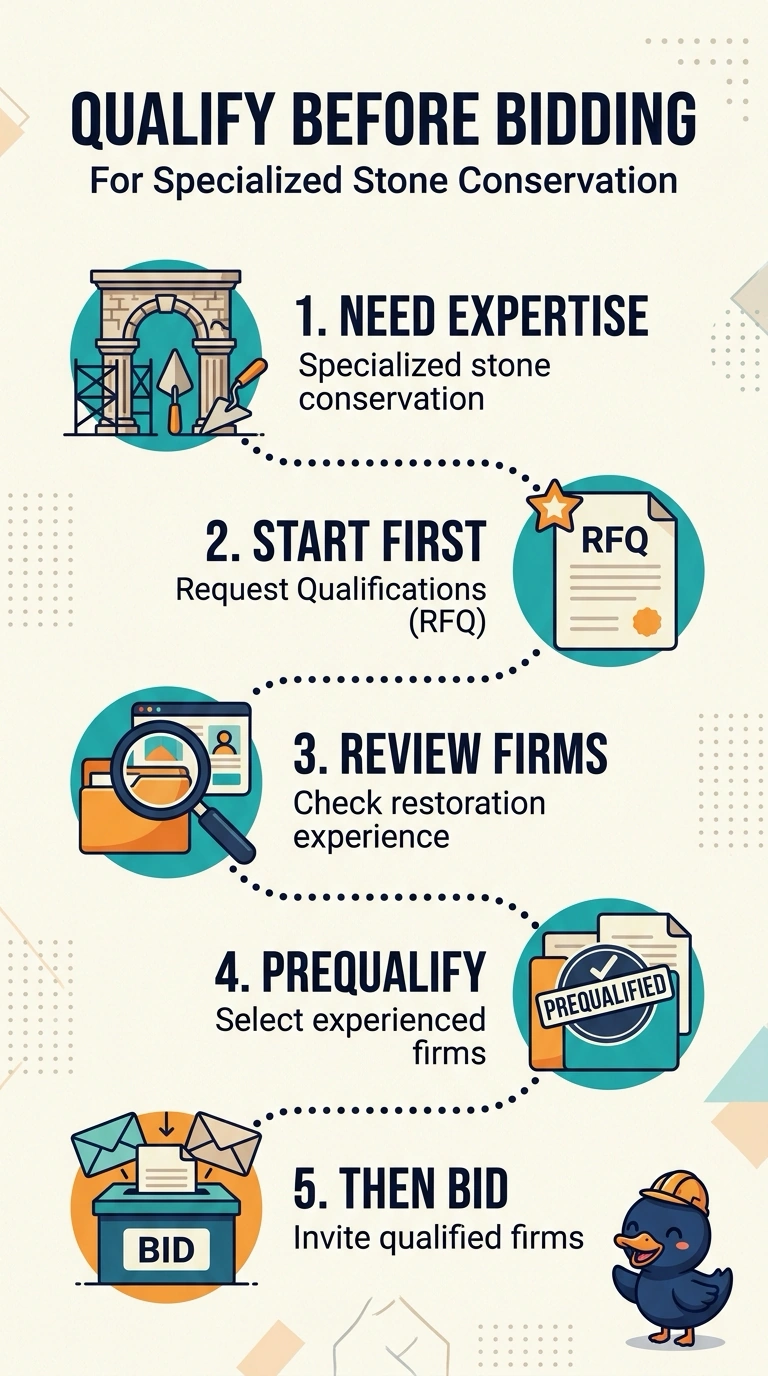
You wouldn't pick a heart surgeon by lowest sticker price alone, and historic masonry is no different. The trap is either skipping competition altogether or running an open low-bid where an unvetted contractor can damage irreplaceable stonework. Use a Request for Qualifications first so only proven specialists compete on price.
Full Explanation
When specialized technical capability is essential to prevent irreversible damage or contract failure, prequalification protects public assets while preserving price competition. Choosing to Issue a Request for Qualifications to prequalify experienced restoration firms before bidding screens prospective contractors against objective historic-preservation credentials so that only qualified firms advance to competitive bidding. By contrast, opting to Award a direct non-competitive contract to a nearby general masonry firm without public advertising violates competitive procurement mandates when multiple qualified restoration specialists exist in the market. Choosing to Issue an open Invitation for Bids with no experience minimums and rely solely on a performance bond invites unqualified low bidders, and a bond only compensates after damage occurs rather than preventing bad work. Deciding to Issue an Invitation for Bids that awards on price after a responsibility check limited to the license and the bond still risks award to an unqualified low bidder because a license and a bond do not screen conservation skill. As a caveat, prequalification criteria must be objective, publicly advertised, and open to any firm meeting the published standards rather than arbitrarily excluding newcomers. As an operational check, publish clear minimum experience and credential thresholds in the Request for Qualifications and document every determination.
Prefer to study offline? Printable PDF study book + test engine ($7.50, unofficial). These questions stay free here.