
A county's facilities director proposes paying a renovation contractor for all actual labor and material costs plus a fixed ten-percent markup on every dollar spent, arguing it simplifies budgeting for an uncertain scope. How should the buyer advise the director?
Select an answer to reveal the explanation.
Short Explanation
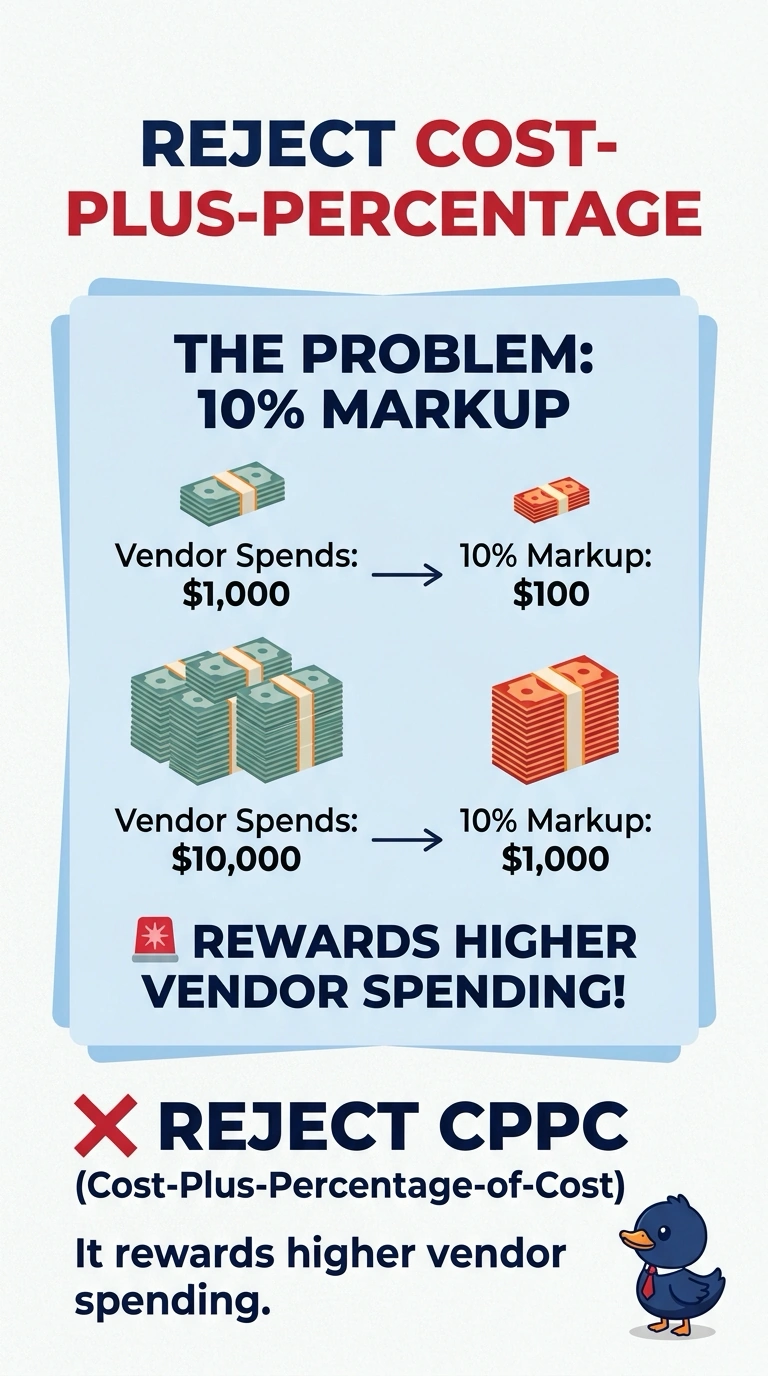
You’re right to question a fee that grows with every dollar spent: it gives the contractor a reason to increase costs. The key incentive is the problem, not whether the ten-percent markup sounds modest.
Full Explanation
Rejecting the cost-plus-percentage-of-cost structure is sound because the contractor’s profit rises automatically as labor and material spending rises, creating an incentive to increase costs rather than control them. Suggesting the percentage markup simplifies budgeting for uncertain scope is flawed because the county still pays the underlying costs plus the related markup and retains inflation risk, so ease of budgeting does not remove the reward for greater spending. Paying actual labor and materials with no fee is flawed because it still fails to price a defined scope and will not attract a responsible contractor willing to perform the work. Converting to a firm-fixed-price contract priced at the director’s rough project allowance is flawed because a fixed price still needs a defined scope, and a rough allowance cannot support fair pricing and enforceable obligations. One caveat is that some cost-reimbursement contracts are permitted, but their fee must be fixed or tied to objective performance incentives, not calculated as a percentage of incurred costs. As a practical check, review the payment formula and scope before approval: confirm that the contractor’s fee does not increase simply because actual spending rises, and that the work to be priced is adequately defined.
Prefer to study offline? Printable PDF study book + test engine ($7.50, unofficial). These questions stay free here.