
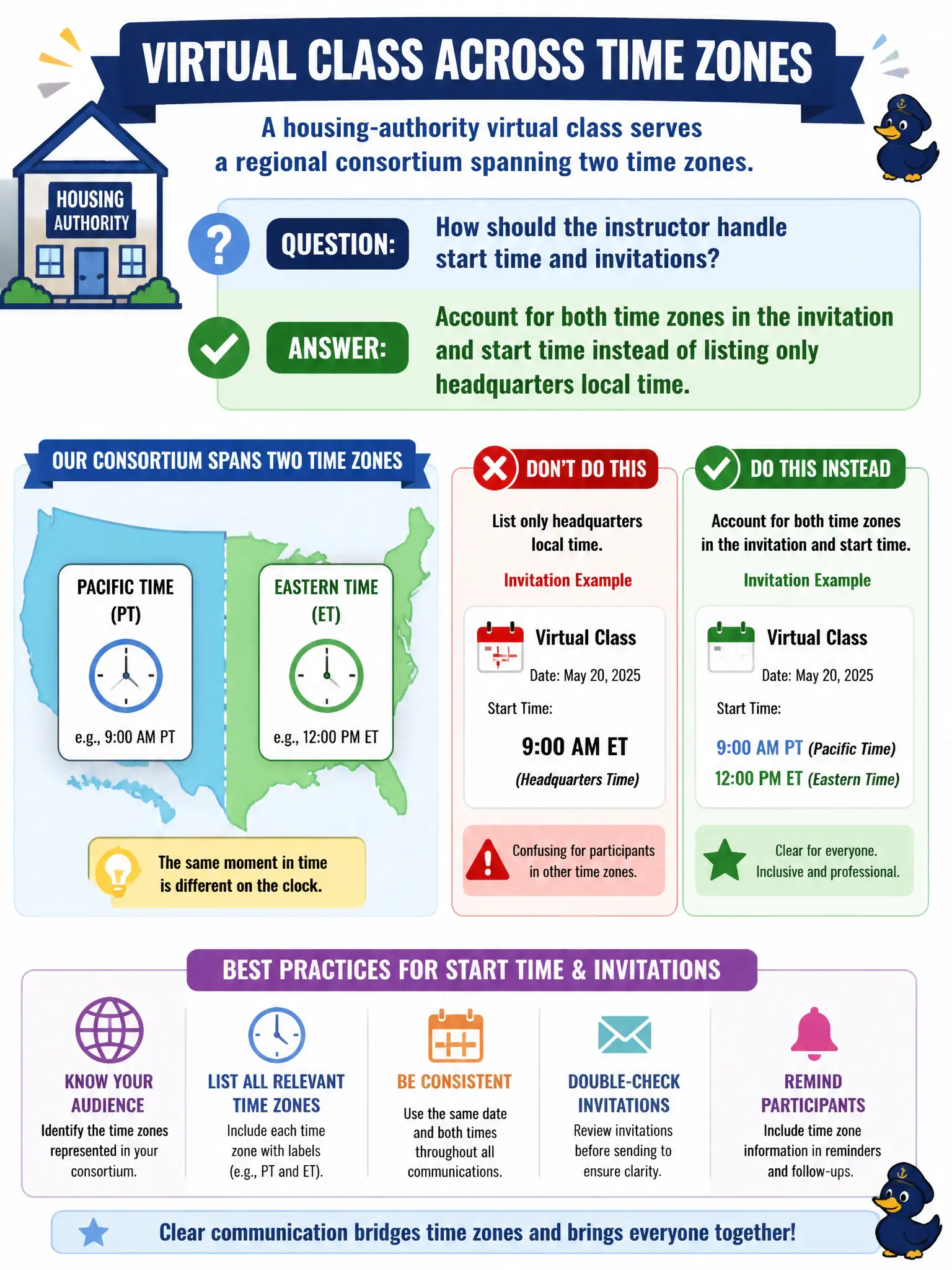
A housing-authority virtual class serves a regional consortium spanning two time zones. How should the instructor handle start time and invitations?
Select an answer to reveal the explanation.
Short Explanation
Nine o'clock on a two-zone consortium invite is like saying meet at the diner at 9 without saying which town. Put both zones on the invitation and pick a start that remote sites can actually make.
Full Explanation
Multi-time-zone municipal cohorts need invitations that account for every zone. A housing-authority virtual class spanning a regional consortium across two time zones requires the instructor to show both zones in the invitation and start time rather than listing only headquarters local time. Using headquarters time only and expecting remote sites to convert it themselves invites late joins and missed openings. Scheduling two duplicate live sessions solely to avoid printing two zones may be valid operations design but is not required merely to dodge clear invitations; the item tests invitation clarity for one multi-zone session. Recording headquarters delivery and skipping a live start for the second zone removes synchronous participation the offering promised. Exam caveat: CTT+ virtual logistics include timezone-aware communications for distributed civic audiences. Operational check: list both local start times on the invite, send a calendar artifact that renders correctly in each zone, and confirm one remote site’s displayed time before class day. Regional housing consortia routinely span time zones; invitations that show only HQ local time manufacture tardiness. Dual-zone clarity is basic virtual logistics. CTT+ expects timezone-aware invites for distributed cohorts. Include both zone labels in the subject line and body, and avoid ambiguous abbreviations like “EST” during daylight-shift periods.