
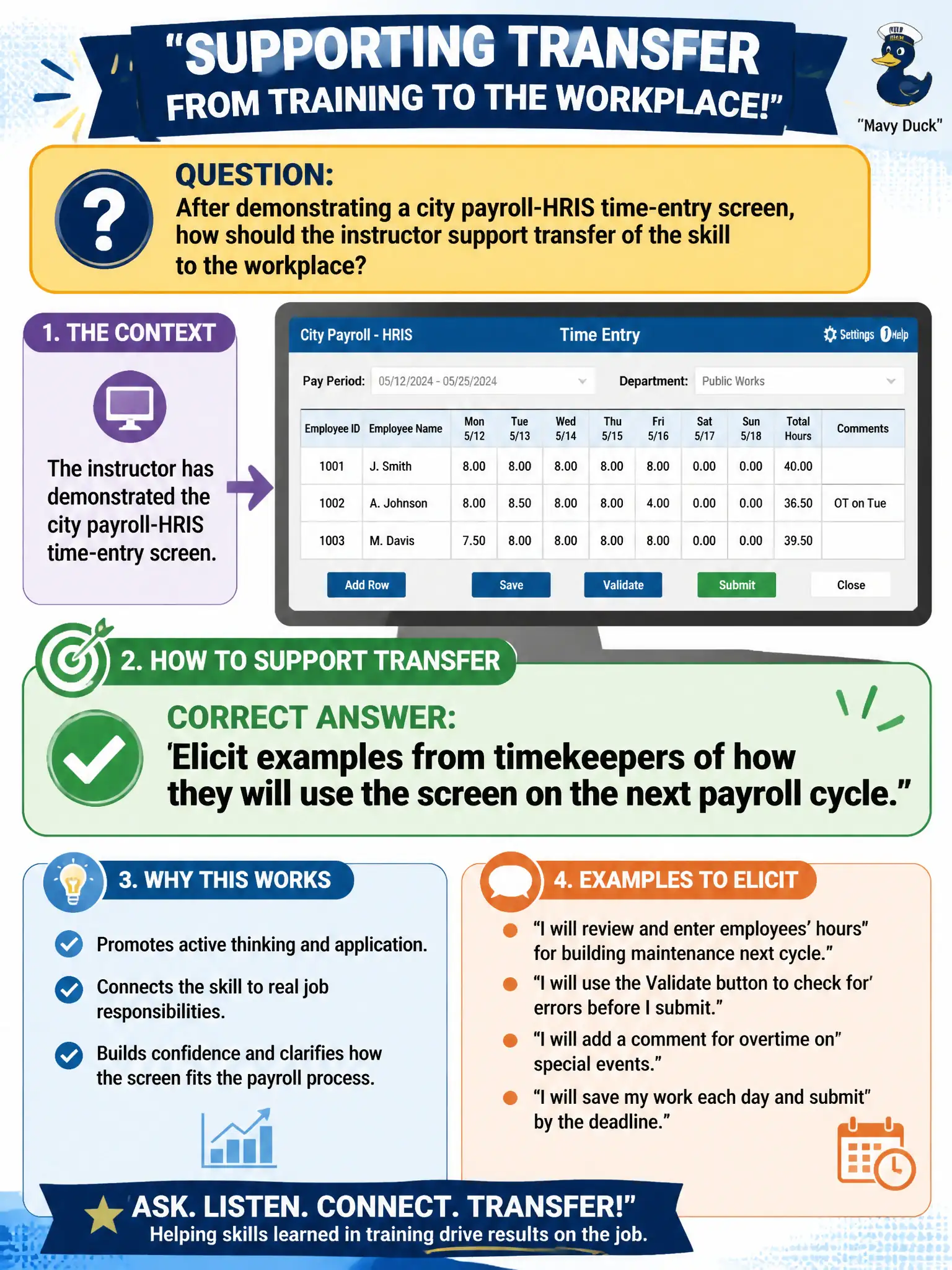
After demonstrating a city payroll-HRIS time-entry screen, how should the instructor support transfer of the skill to the workplace?
Select an answer to reveal the explanation.
Short Explanation
A demo that never leaves the classroom is a museum exhibit. Ask the timekeepers how this screen shows up on Monday's payroll. Their examples are the bridge from the lab to the job.
Full Explanation
Instructors provide and elicit practical examples of how skills transfer to the workplace. After demonstrating a city payroll-HRIS time-entry screen, eliciting examples from timekeepers of how they will use the screen on the next payroll cycle makes transfer explicit and learner-owned. Municipal application talk is the bridge from lab demo to Monday’s work, not an optional courtesy. Without that elicitation, clerks may leave able to click in class yet unsure how the same screen appears in a live pay period.
Ending class immediately so timekeepers “figure it out Monday” fails by concept: withholding transfer discussion leaves application to chance and abandons the instructor’s role in workplace connection. Assigning a quiz that names adult-learning theorists fails because theorist labels are not job-use evidence for HRIS screens and do not prove municipal transfer. Repeating the demo twice more without asking how the work will be used fails by adding exposure without the transfer conversation the objective needs.
Exam caveat: CTT+ transfer items favor eliciting learner job examples after demonstration. More demo alone is not automatically more transfer.
Operational check: after the time-entry demo, ask at least two timekeepers to describe a next-cycle use case; confirm their examples reference actual municipal payroll tasks; only then close the segment.