
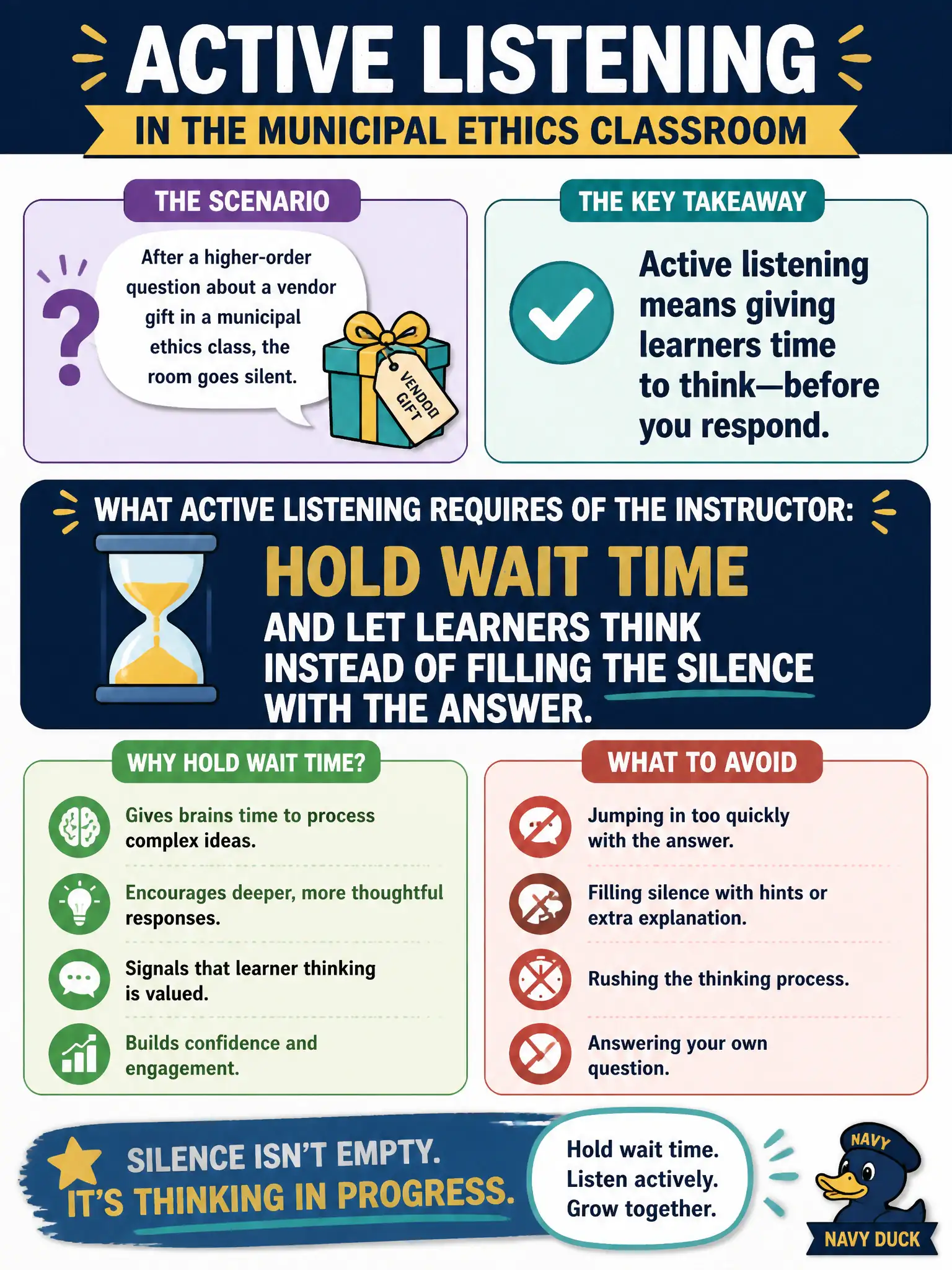
After a higher-order question about a vendor gift in a municipal ethics class, the room goes silent. What does active listening require of the instructor?
Select an answer to reveal the explanation.
Short Explanation
Silence after a hard ethics question is thinking, not a broken class. Filling it with the answer is like shouting the crossword clue. Give the room a beat and listen.
Full Explanation
Municipal ethics scenarios about vendor gifts protect public trust and procurement integrity. After a higher-order question, when the room goes silent, active listening requires holding wait time and letting learners think instead of filling the silence with the answer. Silence after a hard prompt is often processing, not failure.
Stating the preferred answer immediately fails by concept: it converts thinking time into a lecture and trains the room to wait for the key. Cold-calling the newest hire before think time compounds pressure without giving cognitive space. Dropping the question because silence 'means it failed' abandons a valuable ethics item too early.
Exam caveat: recommended wait time is typically several seconds (often cited around three to five or more for complex items); exact seconds matter less than resisting the urge to rescue instantly. After wait time, you may rephrase, scaffold, or then direct to an individual.
Operational check: ask the vendor-gift question, silently count five seconds while scanning faces, then if needed rephrase once; only after that invite a volunteer or offer a smaller scaffold question. Ethics wait time signals that vendor-gift judgments deserve deliberation—the same deliberation public employees owe citizens. Filling silence trains dependence on the instructor’s preferred answer and weakens transfer to unsupervised dilemmas. After adequate wait time, if needed offer a scaffold (stakeholder, policy citation, or consequence) rather than the full key, then invite a volunteer to complete the reasoning.