
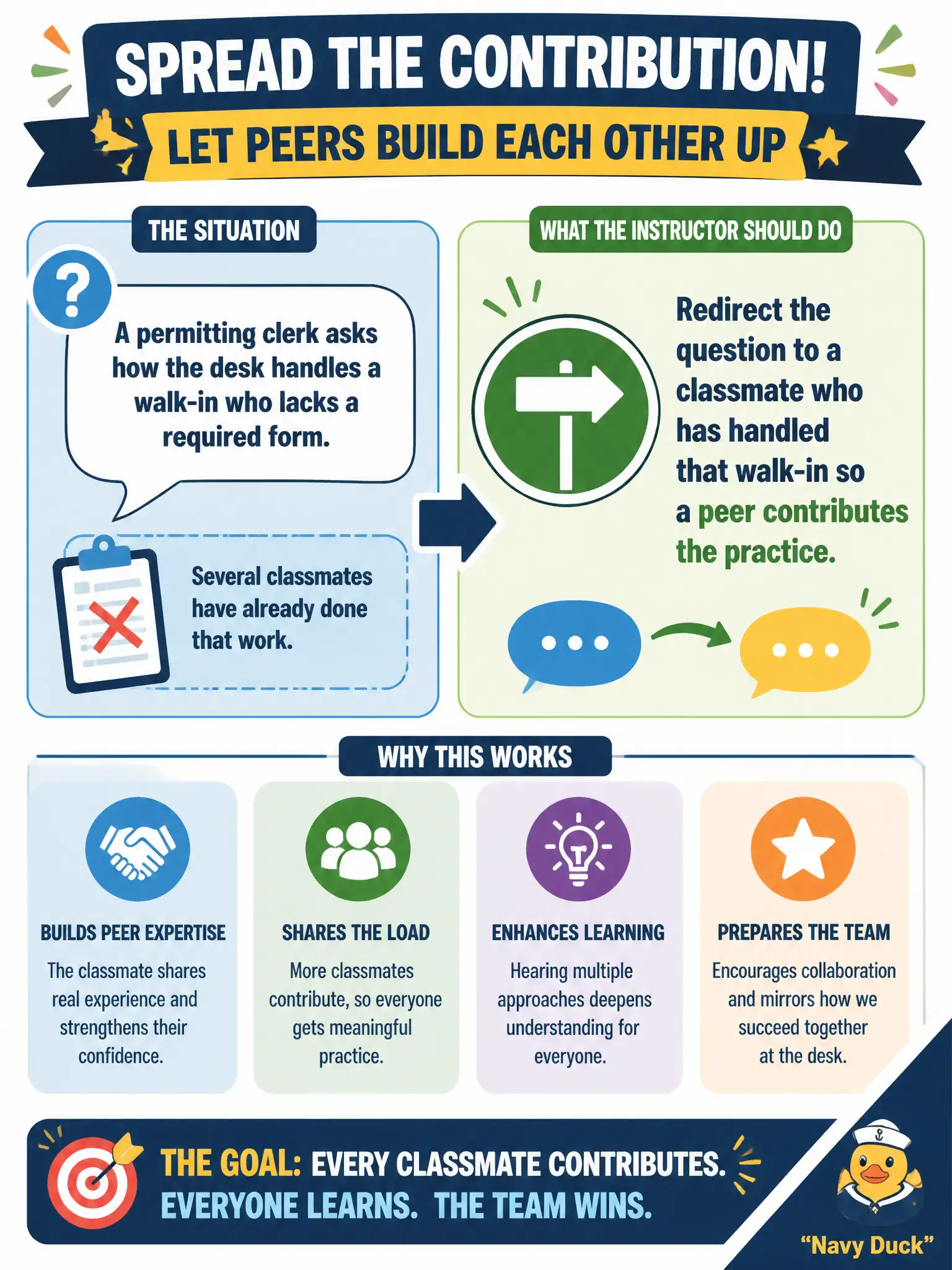
A permitting clerk asks how the desk handles a walk-in who lacks a required form. Several classmates have already done that work. How should the instructor spread contribution?
Select an answer to reveal the explanation.
Short Explanation
Sometimes the best answer is a bounce pass. A classmate already lives that walk-in, so toss the question over and let the desk teach the desk. The trainer still coaches, but more voices get in the game.
Full Explanation
Permitting walk-ins without required forms are everyday civic friction at the public counter. Redirecting the question to a classmate who has handled that walk-in spreads contribution and lets peer expertise teach practice while the instructor coaches accuracy. Facilitation includes distributing airtime, not monopolizing answers from the podium.
Answering immediately from the podium fails by concept when peers already hold the experiential knowledge—you miss a contribution opportunity and model instructor-centered talk. Ignoring the question until an end-of-day parking lot delays a teachable counter skill. Requiring every clerk to write a silent essay with no discussion blocks peer exchange on a collaborative desk practice.
Exam caveat: redirecting to peers still requires instructor verification so incorrect 'how we really do it' folklore does not become the taught method. Thank the peer, confirm against policy, then proceed.
Operational check: bounce the walk-in question to a named experienced clerk, listen, then ask the room what matches the official incomplete-application procedure; correct any gap before the next scenario. Walk-in exceptions at permitting counters are where unofficial workarounds flourish. Redirecting to a peer surfaces tribal knowledge so it can be aligned with written incomplete-application rules that protect applicants and the city. Always close the bounce-pass by validating or correcting the peer answer against the SOP, then have a third clerk restate the approved handling in one sentence.