
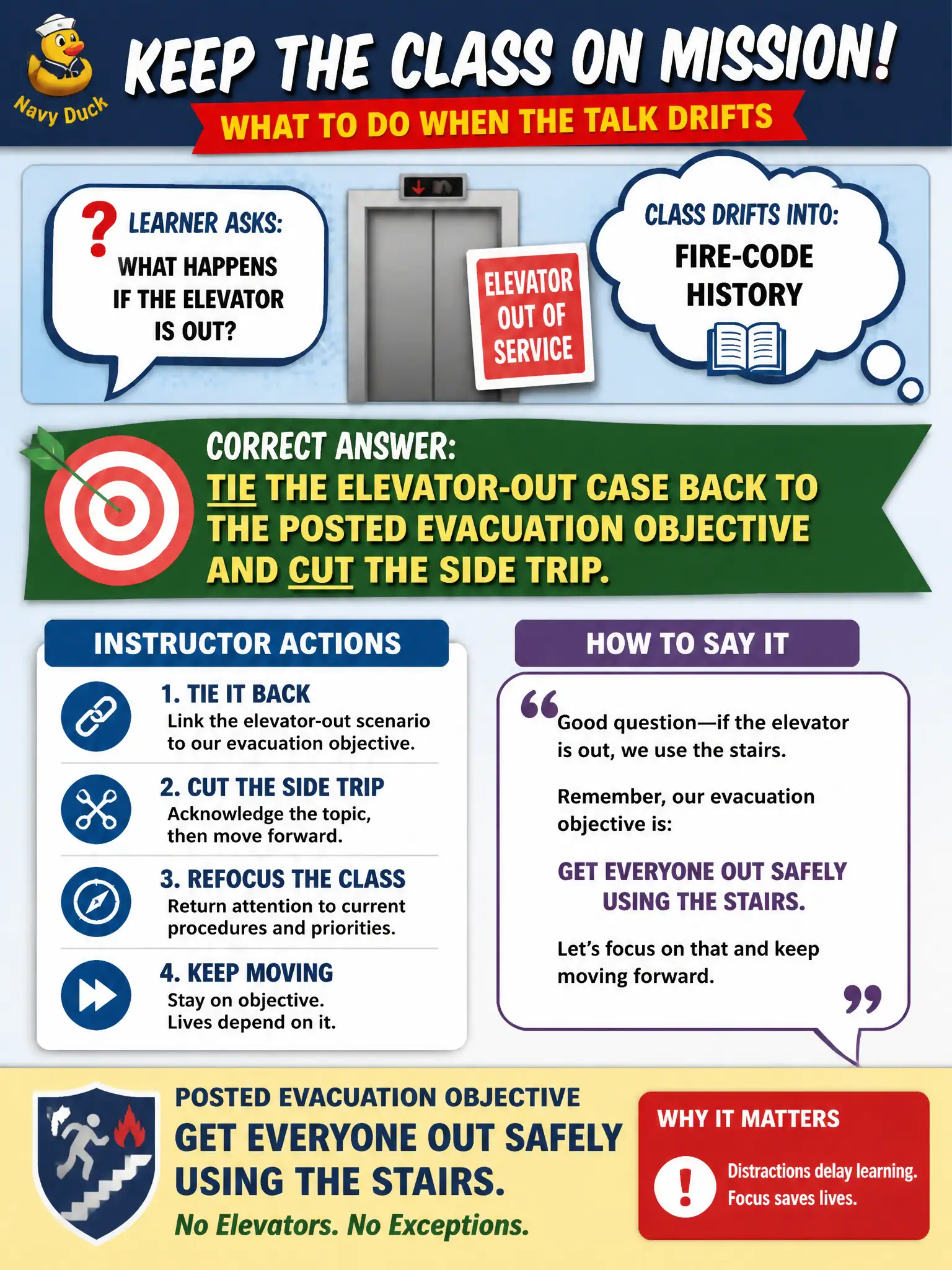
In a municipal high-rise evacuation class, a learner asks what happens if the elevator is out. The talk drifts into fire-code history. What should the instructor do about this hypothetical?
Select an answer to reveal the explanation.
Short Explanation
A hypothetical is a leash, not a long walk. The elevator-out case is useful only while it still teaches the posted evacuation move. When the talk turns into fire-code trivia, tug it back.
Full Explanation
Municipal high-rise evacuation training exists so occupants and staff can exit safely under city emergency plans. When a hypothetical about elevators being out drifts into fire-code history, the instructor should tie the elevator-out case back to the posted evacuation objective and cut the side trip. Hypotheticals are valuable only while they serve the learning objective.
Letting the hypothetical run indefinitely because 'any discussion is engagement' fails by concept: unfocused talk is not facilitation toward evacuation performance. Banning all hypotheticals overreacts; the tool is useful when bounded. Converting the question into after-class fire-code research abandons the in-class chance to practice the evacuation decision tied to today's objective.
Exam caveat: manage hypotheticals with a leash—acknowledge, connect to the objective, extract the decision rule, then park deeper legal history. Do not confuse lively digression with mastery of exit procedures.
Operational check: restate the posted objective, ask what first action the elevator-out case requires under that objective, confirm against the plan, and write any fire-code history questions on the parking lot for a specialist follow-up.