
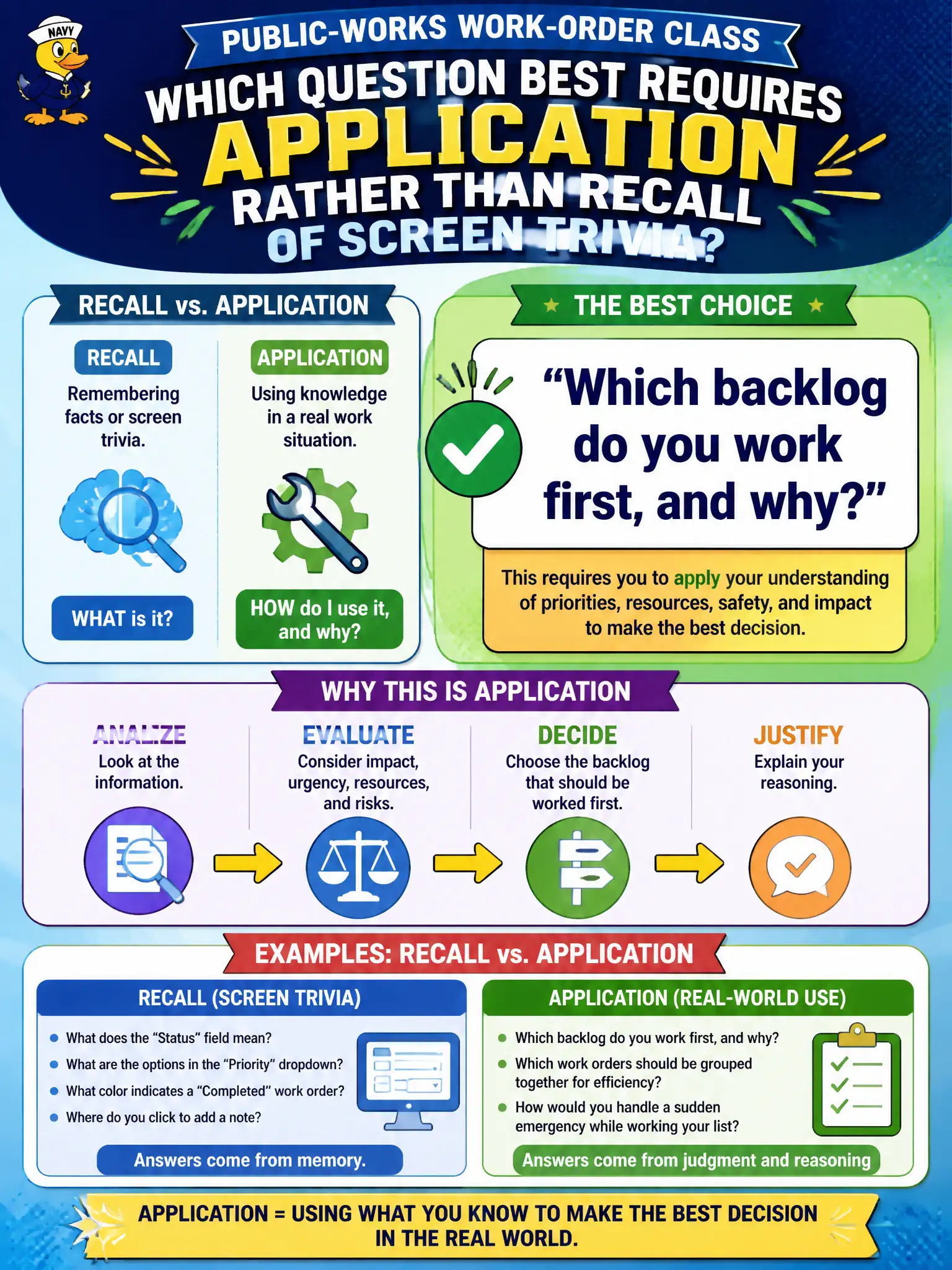
In a public-works work-order class, which question best requires application rather than recall of screen trivia?
Select an answer to reveal the explanation.
Short Explanation
Asking what color the wrench is does not prove you can pick the next job. Asking which backlog to work first, and why, makes public-works staff think like the desk, not like a paint chip. Color, vendor address, and pixel width are recall toys.
Full Explanation
Public-works work-order prioritization affects which residents get service first after storms and outages. Asking which backlog to work first, and why, requires application of criteria rather than recall of screen trivia. Higher-order and application questions verify job judgment, not cosmetic knowledge of the interface.
'What color is the Complete button?' fails by concept: color recall does not prove prioritization skill. Asking for the vendor's street address is irrelevant trivia disconnected from closing work. Asking dashboard pixel width likewise tests nothing about civic work-order decisions.
Exam caveat: application questions should use realistic job constraints (safety, SLA, equity) taught in class. Avoid labeling every 'why' question as higher-order if it only asks for a memorized slogan.
Operational check: present two competing work orders and require a spoken priority choice with a criterion from today's lesson. If answers cite only button colors or gut feel, reteach the priority rules and retry. Prioritization questions mirror the desk’s ethical burden: which neighborhood waits when crews are finite. Application items should force use of taught criteria such as safety, service-level agreements, and equity—not aesthetics of the software. End the check by having staff annotate two sample work orders with priority and criterion citations, then peer-review whether the criterion actually appears in today’s job aid.