
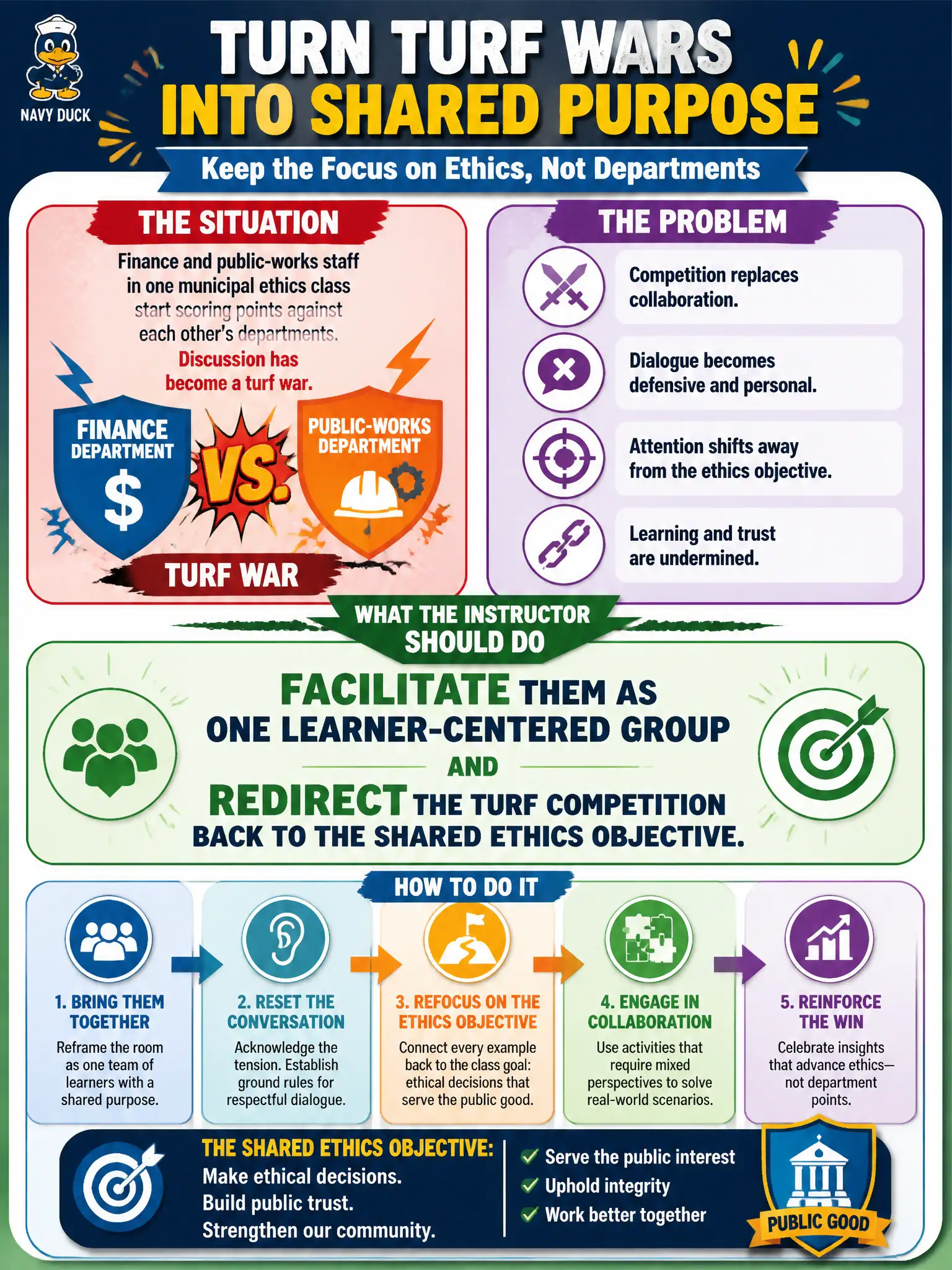
Finance and public-works staff in one municipal ethics class start scoring points against each other’s departments. Discussion has become a turf war. What should the instructor do?
Select an answer to reveal the explanation.
Short Explanation
Two city shops in one ethics class is still one class. If they start keeping score, pull them back to the shared objective instead of refereeing a turf match. Pick a side or split the room and you just hired a new rivalry coach.
Full Explanation
Instructors facilitate learners as one learner-centered group and redirect turf competition back to shared objectives. When finance and public-works staff in a municipal ethics class start scoring points against each other’s departments, the instructor reunifies them around the shared ethics objective rather than letting the room become a departmental contest. Cross-department municipal training succeeds when facilitation protects the common learning task.
Letting departments debate until one side “wins” fails by concept: win-lose turf fights are not ethics skill practice and damage climate. Splitting permanently into two classes so departments never work together fails as avoidance that abandons interdepartmental learning goals. Joining the finance side because budget staff “usually have the stronger argument” fails as favoritism and takes a partisan role.
Exam caveat: CTT+ group facilitation items reward one-group focus on shared objectives over refereeing departmental scorekeeping.
Operational check: name the turf pattern, restate the shared ethics outcome, assign a mixed-department task with a joint product, and block point-scoring language as it reappears. In civic public-training settings, that judgment protects both learner dignity and the municipality’s duty to leave staff actually able to perform the job after class—not merely to finish slides or keep a schedule looking tidy.