
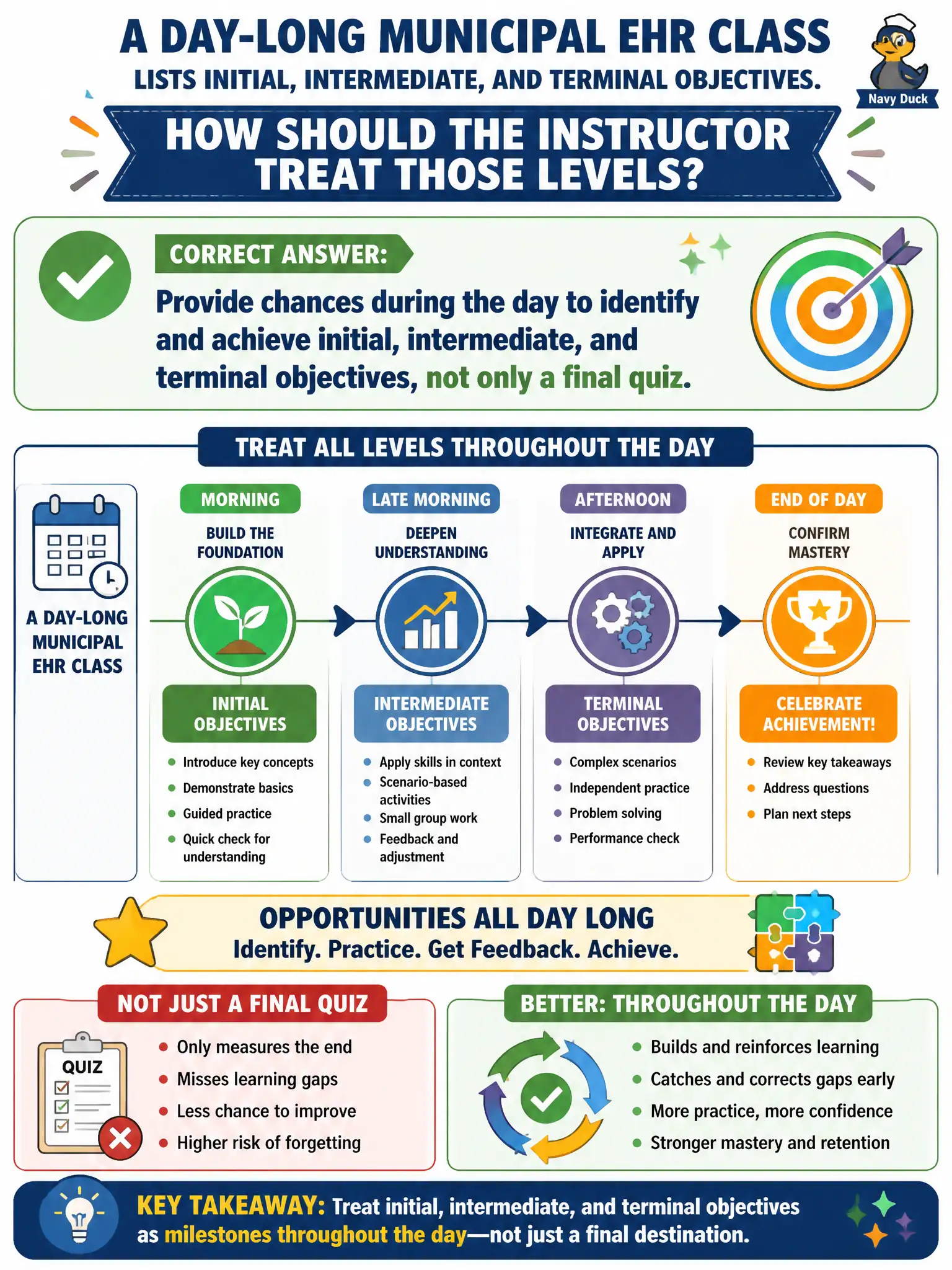
A day-long municipal EHR class lists initial, intermediate, and terminal objectives. How should the instructor treat those levels?
Select an answer to reveal the explanation.
Short Explanation
A day-long EHR class is a staircase, not a trapdoor at 4 p.m. Give a step at the start, a landing at midday, and the top at the end. One final quiz is a jump from the basement.
Full Explanation
Courses with initial, intermediate, and terminal objectives need chances during the day to identify and achieve those levels—not only a single end-of-day quiz. In a day-long municipal EHR class, checking progress across levels keeps instruction diagnostic and prevents discovering at 4:00 p.m. that clerks never mastered early screens that later objectives assume. Layered achievement is how complex clinical-admin workflows become teachable in city health settings.
Saving all checking for a single end-of-day quiz fails by concept: it withholds formative evidence when remediation is still possible. Covering only the terminal objective because audits usually cite it fails by skipping enabling skills that make the terminal performance possible. Skipping intermediate checks if the morning lecture ran long fails by letting schedule slip erase designed assessment points.
Exam caveat: CTT+ objective-level items reward practicing and checking across initial, intermediate, and terminal outcomes during the offering.
Operational check: map each EHR module to an objective level; insert brief checks after initial and intermediate skills; reserve the terminal performance for after those gates are met, not as the only assessment of the day.