
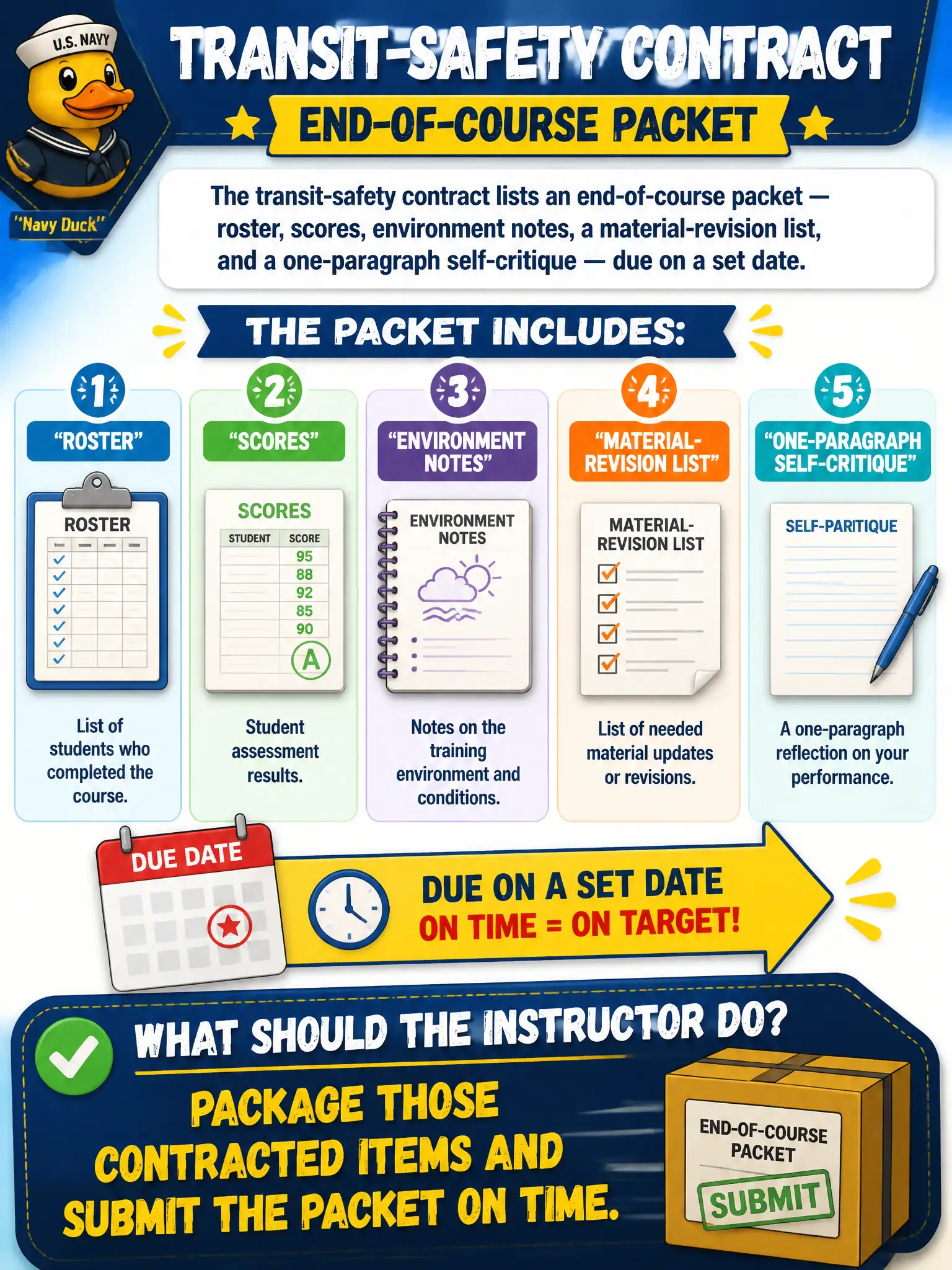
The transit-safety contract lists an end-of-course packet — roster, scores, environment notes, a material-revision list, and a one-paragraph self-critique — due on a set date. What should the instructor do?
Select an answer to reveal the explanation.
Short Explanation
The contract already wrote the table of contents. Build that packet — roster, scores, room notes, fixes, and a short self-critique — and send it by the due date. Smile sheets or a flyer are not the list.
Full Explanation
When the transit-safety contract lists an end-of-course packet—roster, scores, environment notes, a material-revision list, and a one-paragraph self-critique—due on a set date, the instructor should package those contracted items and submit the packet on time. Contractual evaluation deliverables are not optional à la carte. Sending only smile sheets and skipping the rest as optional breaches the listed requirements. Holding the packet until a second offering so the self-critique can wait misses the due date and mixes offerings. Submitting a marketing flyer about the vendor instead of the listed reports fails content and purpose. Exam caveat: build the exact packet the contract enumerates and hit the date. Operational check: assemble roster, scores, environment notes, material-revision list, and self-critique; verify each element is present; submit through the contracted channel by the due date; and retain the packet plus submission proof in the transit-safety training file. Keep the published objective visible on every rubric and report so raters do not drift into convenience metrics. Confirm with a second reviewer when stakes are high that the evidence matches the objective rather than a proxy such as speed, smiles, or familiarity.