
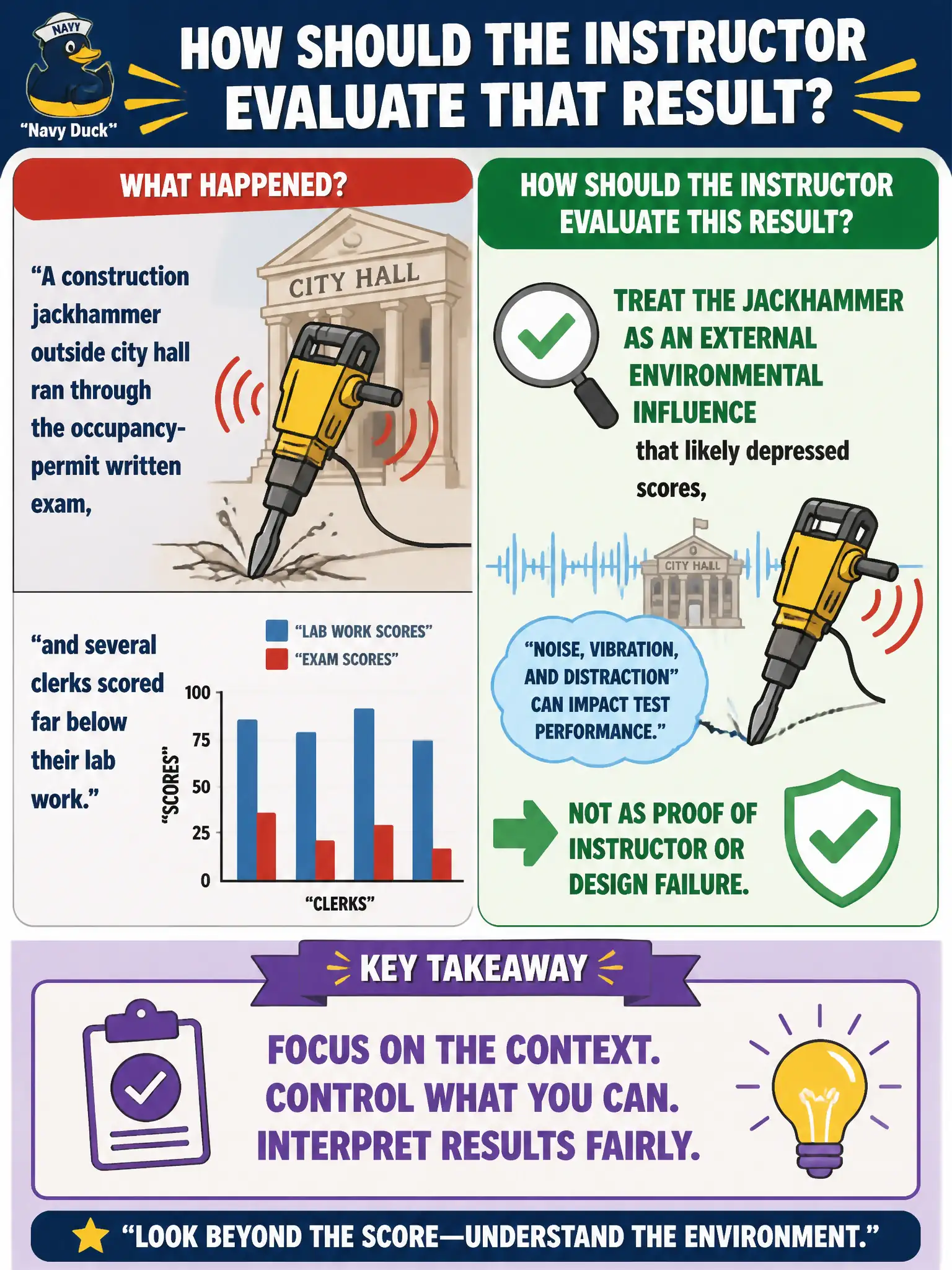
A construction jackhammer outside city hall ran through the occupancy-permit written exam, and several clerks scored far below their lab work. How should the instructor evaluate that result?
Select an answer to reveal the explanation.
Short Explanation
A jackhammer next to the test is like giving a driving exam in a hailstorm — the score may say more about the weather than the driver. Separate that outside noise from whether the instructor or the design actually failed. Environment can tank a test even when the class itself was solid.
Full Explanation
When a construction jackhammer outside city hall ran through the occupancy-permit written exam and several clerks scored far below their lab work, the instructor should treat the jackhammer as an external environmental influence that likely depressed scores—not as automatic proof of instructor or design failure. Evaluation of results must separate content design problems from environmental interference that prevented fair demonstration of knowledge. Concluding the course design failed solely because scores dropped fails causal analysis by ignoring a loud, documented disruption during testing. Attributing low scores to the instructor talking too fast while claiming environment never affects written exams fails basic test-condition logic; noise is a classic external influence. Discarding the class roster so housing never sees that an exam occurred fails record-keeping and transparency duties. Exam caveat: document external influences honestly when interpreting municipal assessment results. Operational check: note the jackhammer interval and room conditions in the after-action report, compare lab performance to written scores, avoid rewriting the course as "failed design" without that context, and schedule a quieter makeup assessment if stakes require a cleaner measure of the occupancy knowledge objective for city staffing decisions.