
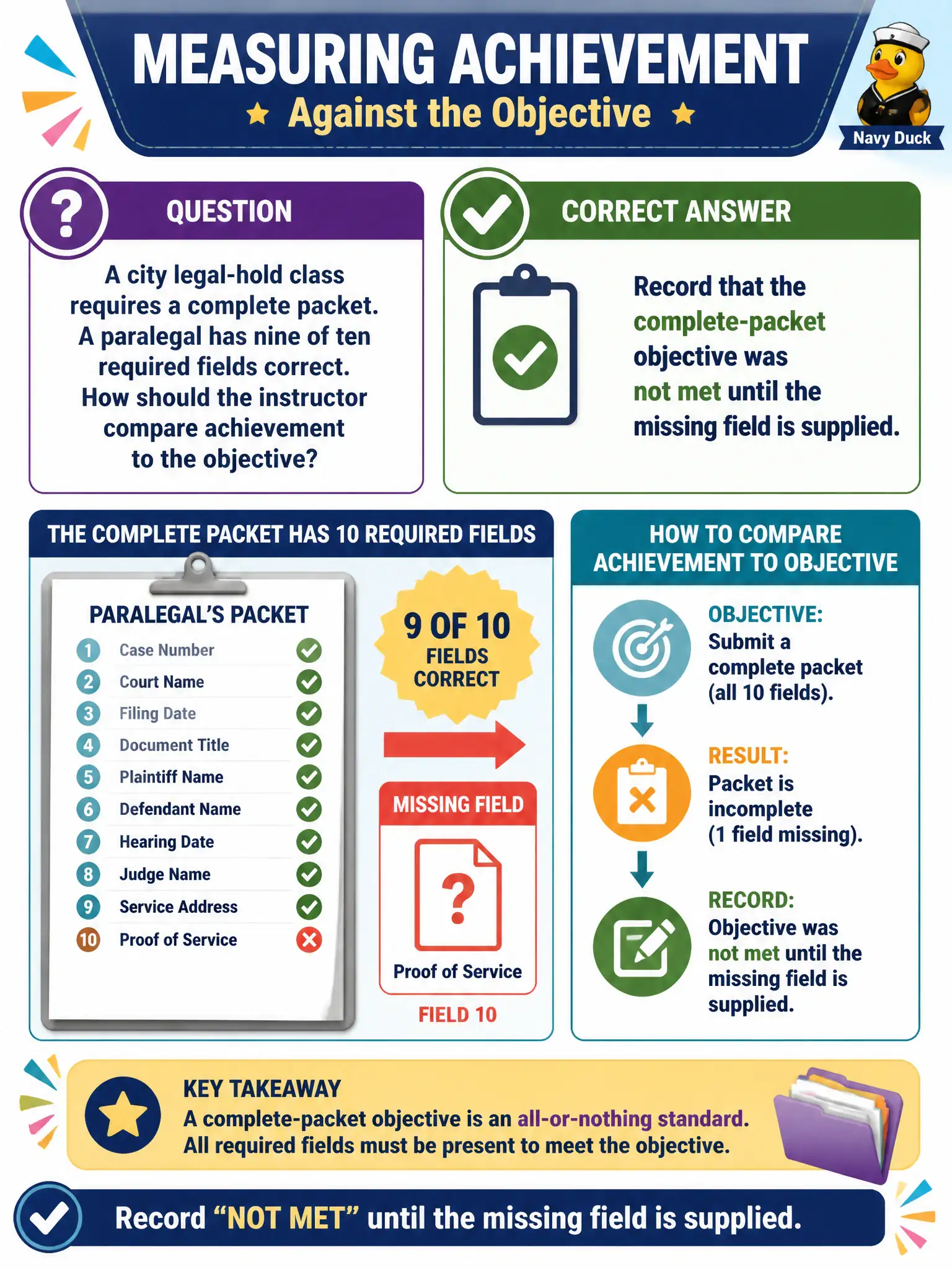
A city legal-hold class requires a complete packet. A paralegal has nine of ten required fields correct. How should the instructor compare achievement to the objective?
Select an answer to reveal the explanation.
Short Explanation
Complete means complete. Nine fields and a hole is not a legal-hold packet. Do not average it with a smile or a side quiz to paper over the gap.
Full Explanation
In a city legal-hold class that requires a complete packet, a paralegal with nine of ten required fields correct has not met the complete-packet objective until the missing field is supplied. Criterion-referenced comparison to the objective means complete means complete when completeness is the standard. Passing because ninety percent would be an "A" in school fails municipal criterion logic when the objective demands a complete packet. Passing because the paralegal is well liked fails impartiality. Averaging the packet with an unrelated ethics quiz to raise the score fails construct purity and masks the missing legal-hold field. Exam caveat: compare the work product to the published completeness rule, not to school grading curves or popularity. Operational check: identify the missing field, require correction, re-check the packet against the ten-field checklist, and record met only when all required fields are present and accurate. Legal-hold packets that miss a required field create discovery risk for the city; nine of ten correct is still not met when completeness is the objective, regardless of school-style percentages or personal popularity. Keep the civic standard visible on the rubric so every rater and learner sees what "met" means.