
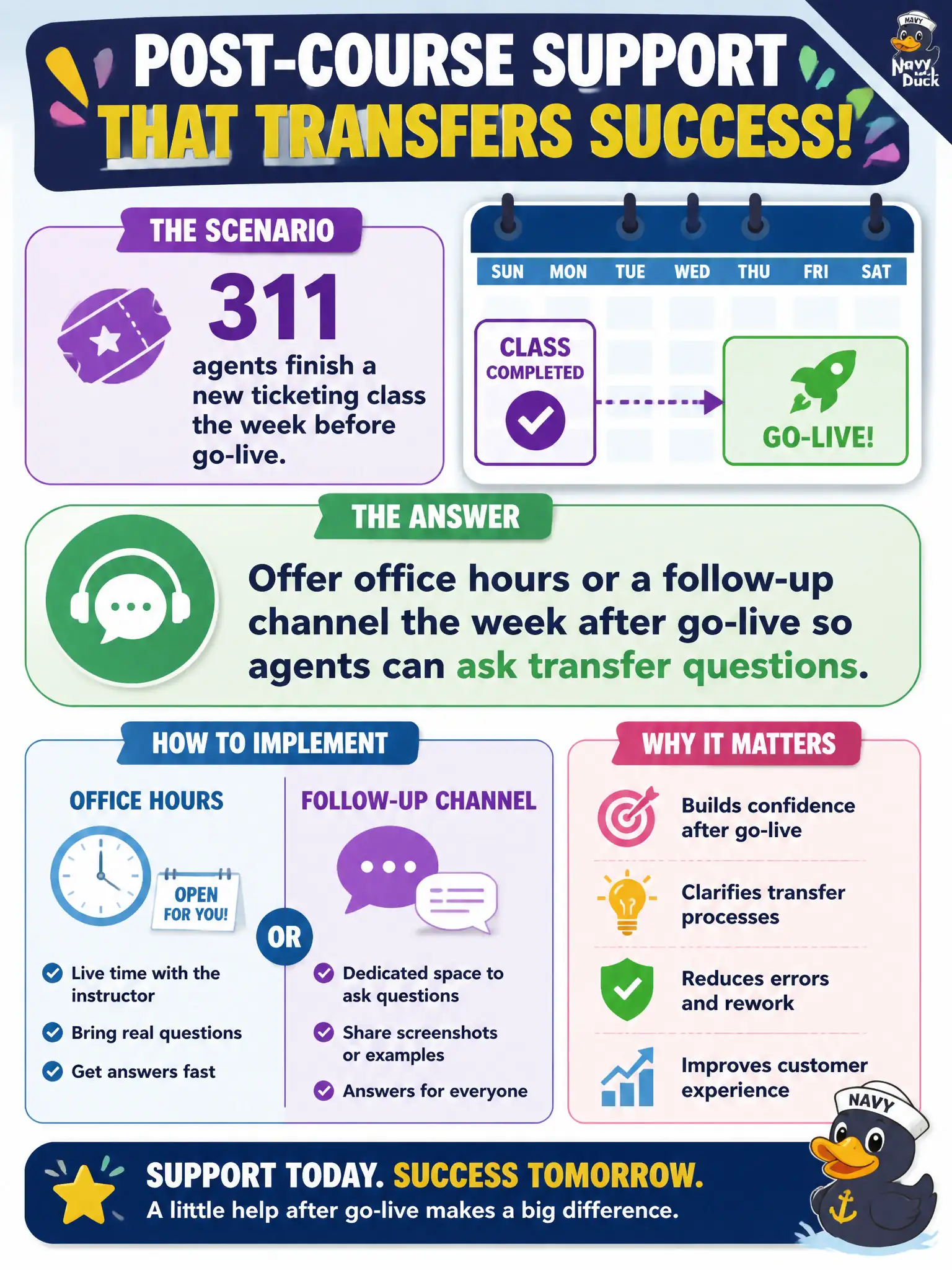
311 agents finish a new ticketing class the week before go-live. What post-course support should the instructor plan?
Select an answer to reveal the explanation.
Short Explanation
Go-live week is when the real tickets show up. Leave a door open—office hours or a channel—so agents can ask while the new system is live. Good luck is not a support plan.
Full Explanation
After 311 agents finish a new ticketing class the week before go-live, the instructor should plan post-course support such as office hours or a follow-up channel the week after go-live so agents can ask transfer questions. Transfer support bridges the classroom and the live queue when real tickets differ from labs. Telling agents good luck and closing the room immediately fails post-course support duty at the moment transfer risk peaks. Referring every leftover question to civil-service HR as a classification issue fails relevance; HR classification does not coach ticketing mechanics. Requiring every agent to sit the entire course again the next morning regardless of scores fails efficiency and ignores differentiated need. Exam caveat: plan follow-up access around go-live; dismissal is not a transfer strategy. Operational check: publish office hours or a monitored channel for the first week after go-live, log recurring transfer questions, feed fixes into a quick tip sheet, and confirm agents can reach help without re-sitting the full class unnecessarily. Go-live weeks are when 311 transfer questions spike under real call pressure, so office hours or a monitored channel after class are part of evaluation-informed support—not an optional courtesy—if the city expects tickets to stay accurate on day one.