
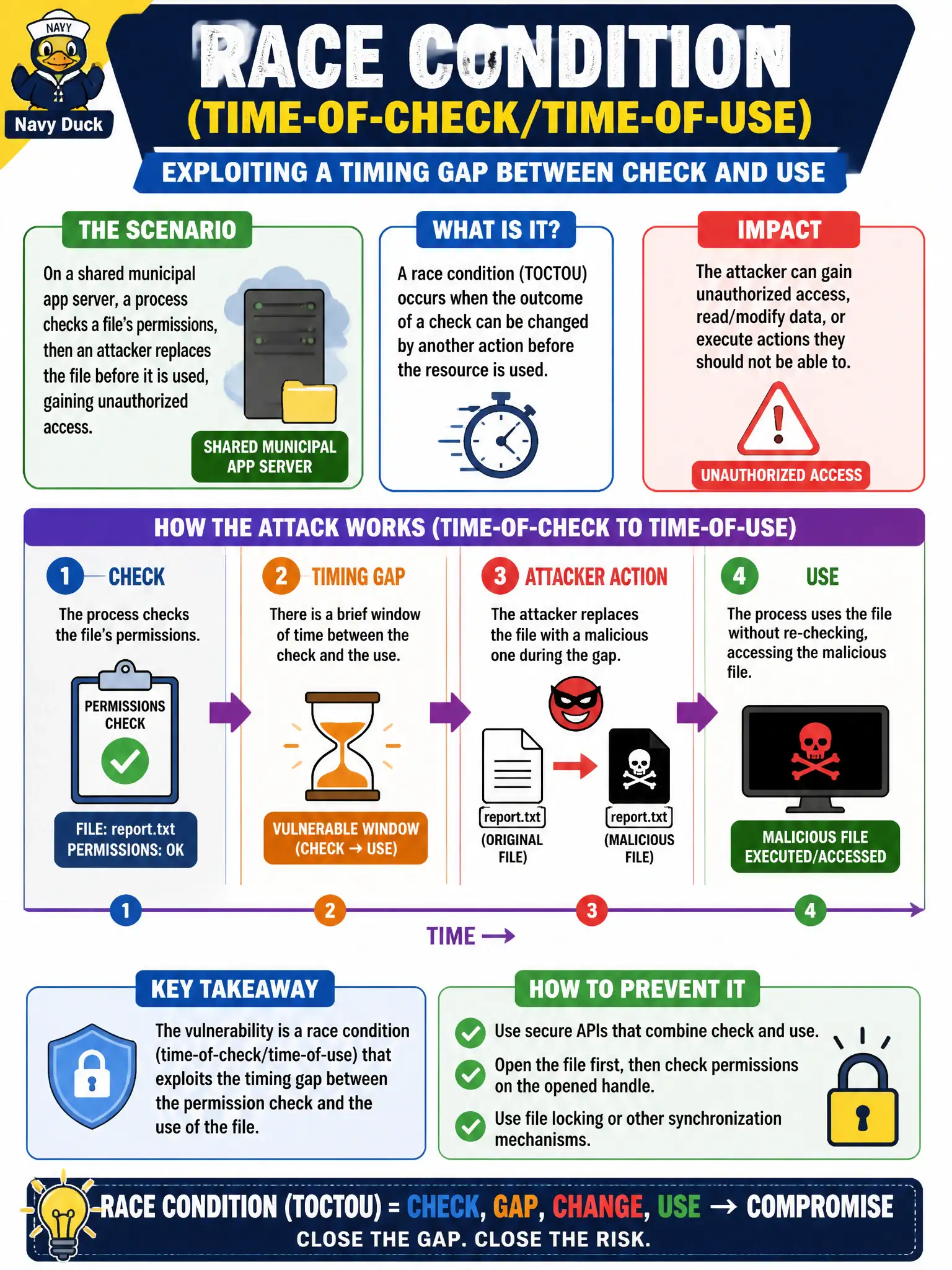
On a shared municipal app server, a process checks a file’s permissions, then an attacker replaces the file before it is used, gaining unauthorized access. Which vulnerability does this describe?
Select an answer to reveal the explanation.
Short Explanation
Check the lock, swap the door, then walk through — that timing gap is a TOC/TOU race condition. It is a concurrency bug, not a CIO phone scam or default RDP password. Shared municipal app servers need atomic permission checks and safe file-handling patterns.
Full Explanation
A race condition of the time-of-check/time-of-use (TOC/TOU) type exploits a timing gap: a process verifies a file’s permissions, then an attacker replaces the file before it is used, gaining unauthorized access. On a shared municipal app server, concurrent access makes that window exploitable. The vulnerability is incorrect assumptions about atomicity between check and use—not weak passwords or social engineering.
Vishing impersonating the CIO on a help-desk reset call is voice social engineering. No phone pretext appears; the flaw is concurrent file handling.
Image-based malware delivery inside a GIS map update is a media/delivery vector. TOC/TOU is a concurrency logic bug on the app server.
Default credentials on Internet-exposed RDP are exposure plus credential hygiene failures. They do not describe swapping a file between permission check and use.
Exam caveat: TOC/TOU is the race-condition story Security+ expects when stems mention check-then-use gaps on files or resources. Do not confuse with SQLi/XSS simply because an "app server" is named. Multi-user shared hosts increase practical exploitability.
Operational check: use atomic APIs that open files with the intended access rights in one step, avoid check-then-open patterns on world-writable directories, harden temp directories, reduce shared writable paths on municipal app servers, and add regression tests for symlink/replace races. Code review should treat TOCTOU as a first-class defect in civic multi-tenant services.