
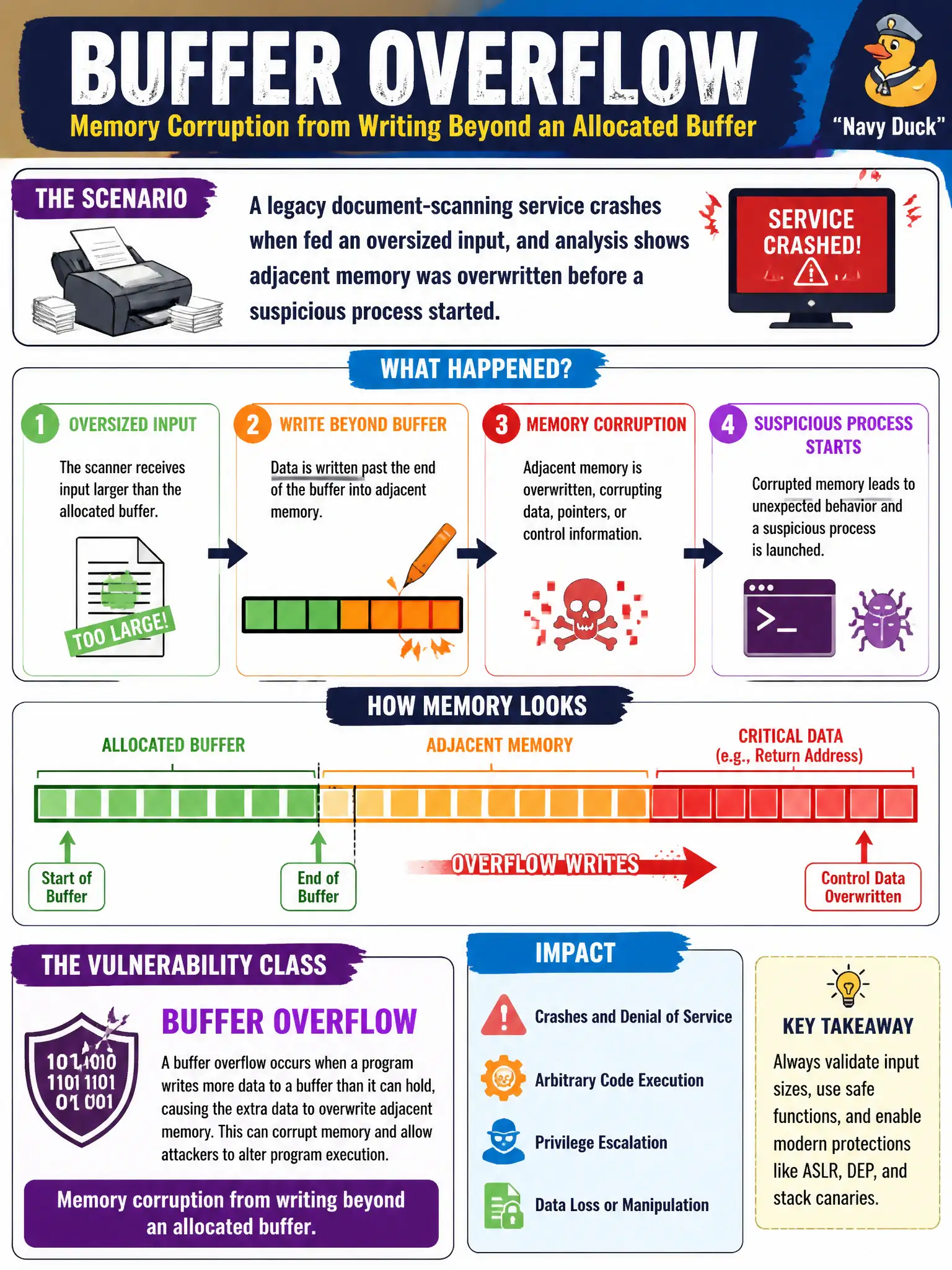
A legacy document-scanning service crashes when fed an oversized input, and analysis shows adjacent memory was overwritten before a suspicious process started. Which application vulnerability class best fits?
Select an answer to reveal the explanation.
Short Explanation
Too much data shoved into too small a memory bucket is a buffer overflow — classic application memory-safety failure. Social lies and guest Wi-Fi bridging are different problems. Replace or harden that legacy scanner service before someone turns the crash into code execution.
Full Explanation
Buffer overflow is memory corruption caused by writing beyond an allocated buffer. When a legacy document-scanning service crashes on oversized input and analysis shows adjacent memory overwritten before a suspicious process starts, the vulnerability class is classic unsafe memory handling—often in C/C++ services that trust length fields. Successful exploitation can escalate from denial of service to arbitrary code execution on municipal infrastructure.
A misinformation campaign posting false emergency notices manipulates public narrative. It does not overwrite process memory in a scanning service.
Unsecure guest wireless bridging into a staff VLAN is a network segmentation failure. Memory corruption on a scanner daemon is an application/memory-safety issue.
Business email compromise redirecting a vendor payment is email-based payment fraud. It shares no mechanism with oversized input crushing a buffer.
Exam caveat: Buffer overflows sit under application vulnerabilities tied to memory safety. Distinguish from integer overflows, race conditions, and injection flaws. Crash-plus-adjacent-memory-overwrite language is a strong buffer-overflow signal even before full exploit development is described.
Operational check: isolate or retire the legacy scanning service, apply vendor patches or replace with memory-safe implementations, restrict who can submit scan jobs, run the service under least privilege, and monitor for crash loops followed by unusual child processes. Civic document pipelines that touch PII need hardening before opportunistic exploits turn crashes into footholds.