
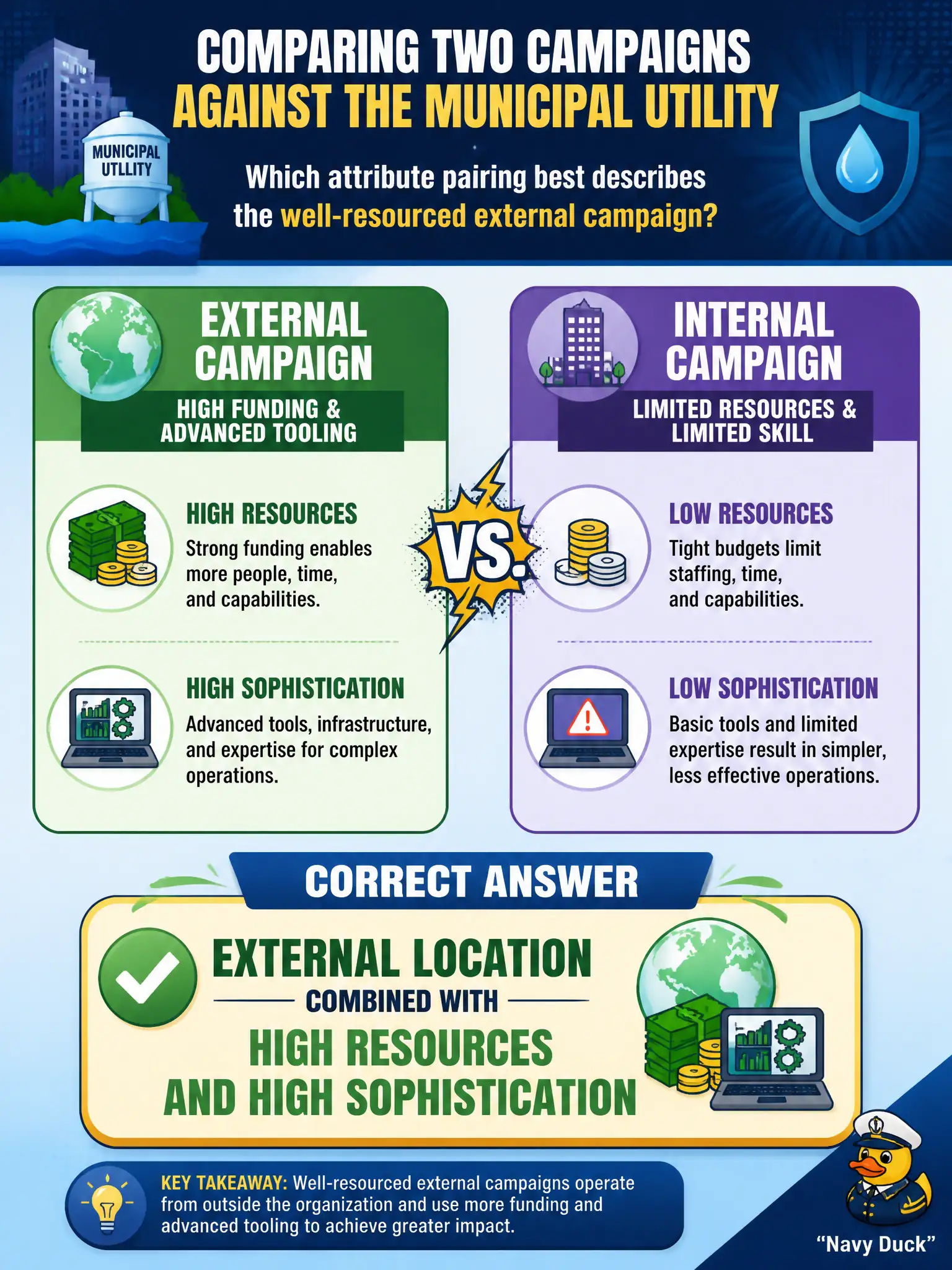
Analysts compare two campaigns against the municipal utility: one is external with high funding and advanced tooling; the other is internal with limited skill. Which attribute pairing best describes the well-resourced external campaign?
Select an answer to reveal the explanation.
Short Explanation
Actor attributes are the trading cards: where they sit, how deep their pockets are, and how sharp their skills run. A well-funded outside campaign scores external + high resources + high sophistication—not the internal newbie profile.
Full Explanation
Threat-actor analysis for municipal utilities uses attributes such as location relative to the organization (internal versus external), resources/funding, and sophistication. A campaign that is external, well funded, and equipped with advanced tooling is described by the pairing external location combined with high resources and high sophistication. That triad distinguishes APT-style pressure against utility systems from low-capability noise or accidental misconfiguration.
Internal location with low funding and commodity-only capability describes a weaker insider or low-skill profile, not the well-resourced external campaign. External location with no resources and accidental misconfiguration only mixes outsider placement with accidental governance failure and zero resources—mismatched to advanced tooling. An internal privileged user solely motivated by routine password resets is an operational identity task, not a campaign attribute set for a high-end external threat.
Exam caveat: memorize and apply actor attributes independently—do not assume external always means sophisticated, but when the stem gives high funding and advanced tooling, select the high-resource high-sophistication external pairing. Operational check: profile utility threats with those attributes in IR playbooks, prioritize detection depth for high-sophistication external actors, and avoid under-resourcing monitoring simply because another concurrent issue looks like low-skill internal mistakes.