
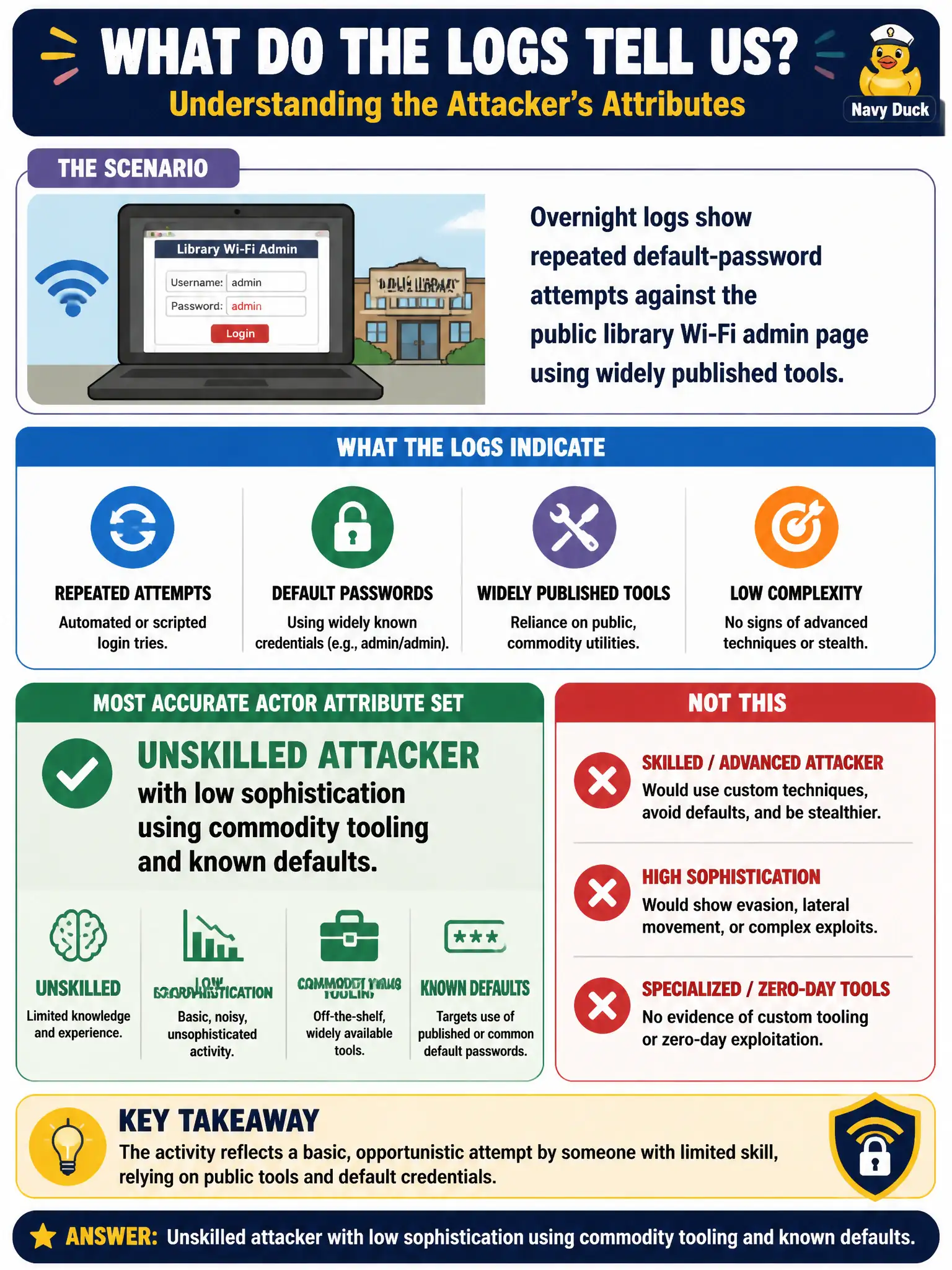
Overnight logs show repeated default-password attempts against the public library Wi-Fi admin page using widely published tools. Which actor attribute set is most accurate?
Select an answer to reveal the explanation.
Short Explanation
Default passwords plus off-the-shelf scripts is the textbook unskilled attacker—more crowbar than laser cutter. Do not inflate it into a nation-state story just because the admin page got rattled.
Full Explanation
Repeated default-password attempts against a public library Wi-Fi admin page using widely published tools indicate low skill and low originality. The actor relies on commodity scanners or scripts and known default credentials rather than custom exploits, zero-days, or stealthy persistence. That attribute set—unskilled attacker, low sophistication, commodity tooling—is the most accurate classification for overnight spray-and-pray against an exposed admin interface.
A nation-state espionage cell with custom zero-day malware would not typically telegraph itself as noisy default-password retries with public tools against a library Wi-Fi page. An organized crime ransomware affiliate focused on encrypting payment databases pursues financial encryption-and-extortion outcomes, not merely admin-page password spraying on guest Wi-Fi infrastructure. An authorized penetration tester under a signed rules-of-engagement letter would operate with documented scope, scheduling, and typically identifiable test accounts or pre-briefs—not unexplained overnight commodity attacks.
Exam caveat: noisy default-credential spraying with public tools maps to unskilled/commodity attributes, not APT or authorized testing by default. Operational check: eliminate default passwords on municipal library gear, place admin interfaces off the public SSID or behind management networks and MFA, alert on repeated auth failures, and verify any claimed security testing against an active ROE before assuming friendliness.