
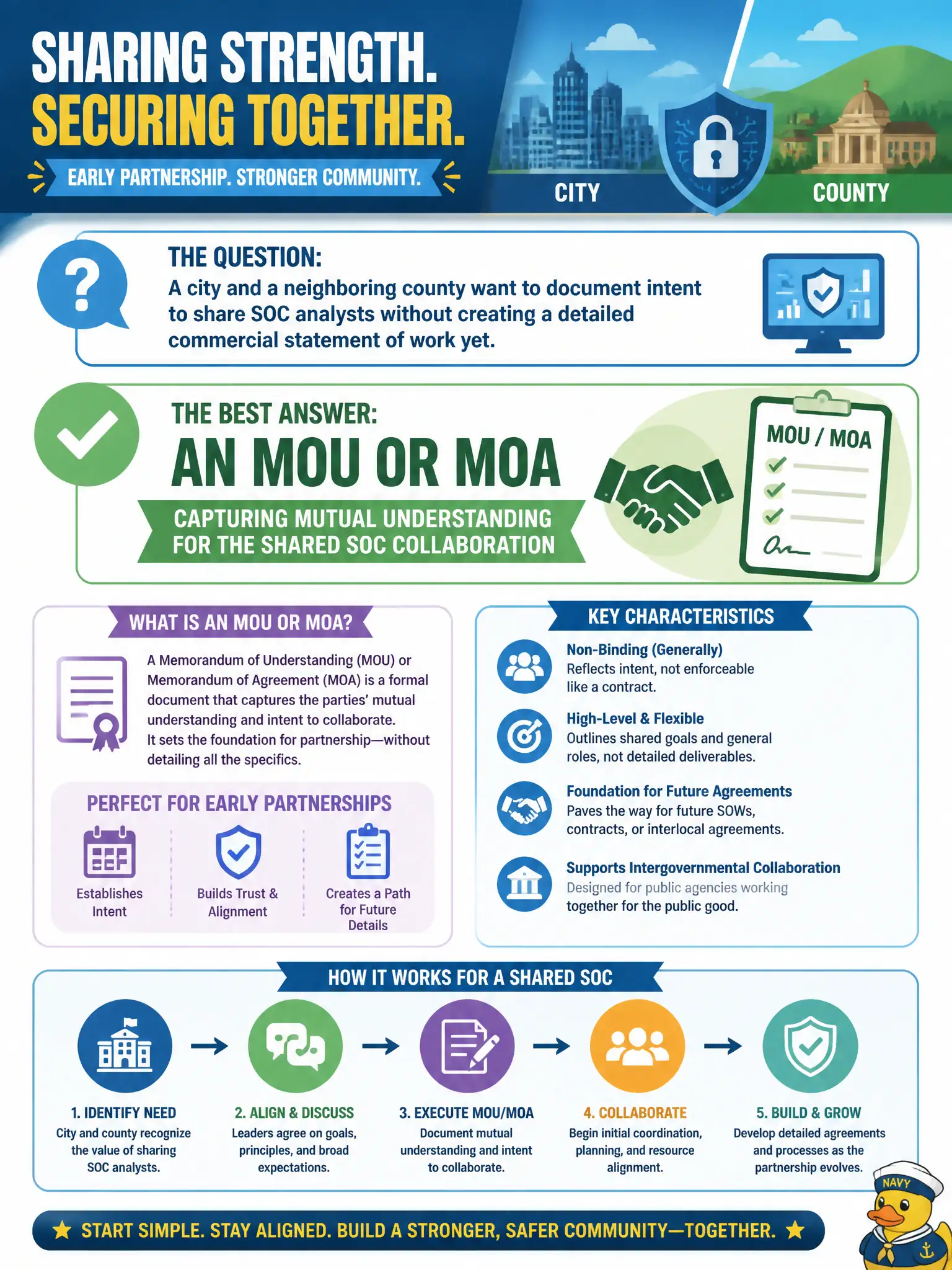
A city and a neighboring county want to document intent to share SOC analysts without creating a detailed commercial statement of work yet. Which agreement type best fits that early intergovernmental partnership?
Select an answer to reveal the explanation.
Short Explanation
When two governments shake hands on sharing a SOC before the fine-print shopping list, they reach for an MOU or MOA—the friendly handshake in writing. Save MSAs, SOWs, and work orders for the detailed paid work later.
Full Explanation
Memoranda of understanding or memoranda of agreement commonly document cooperative intent between public entities before or alongside detailed commercial instruments. When a city and neighboring county want to capture shared SOC analyst collaboration without yet writing a detailed statement of work, an MOU or MOA fits: it records mutual understanding, roles at a high level, and partnership framing appropriate to intergovernmental cooperation. Detailed MSAs, SOWs, or work orders can follow when paid tasks and deliverables need precision. A BPA that only lists cafeteria prices for a joint venture snack bar is a business partnership agreement misapplied to food pricing. It neither frames SOC collaboration nor serves as the right early instrument for shared security operations. A work order that installs fiber without any partnership framing authorizes a narrow technical task. Fiber installation paperwork does not document mutual SOC staffing intent between governments. An SLA that solely lists toner delivery times for printers defines office-supply performance, not shared SOC partnership. Toner SLAs are unrelated to intergovernmental security operations collaboration. Exam caveat: MOU/MOA are the usual early agreements for public-sector mutual understanding; do not confuse them with BPAs, work orders, or SLAs that address different commercial or operational details. Operational check: Draft an MOU/MOA stating shared SOC purpose, high-level responsibilities, and next steps toward detailed operating agreements; avoid relying on unrelated BPAs, work orders, or supply SLAs as the partnership vehicle.