
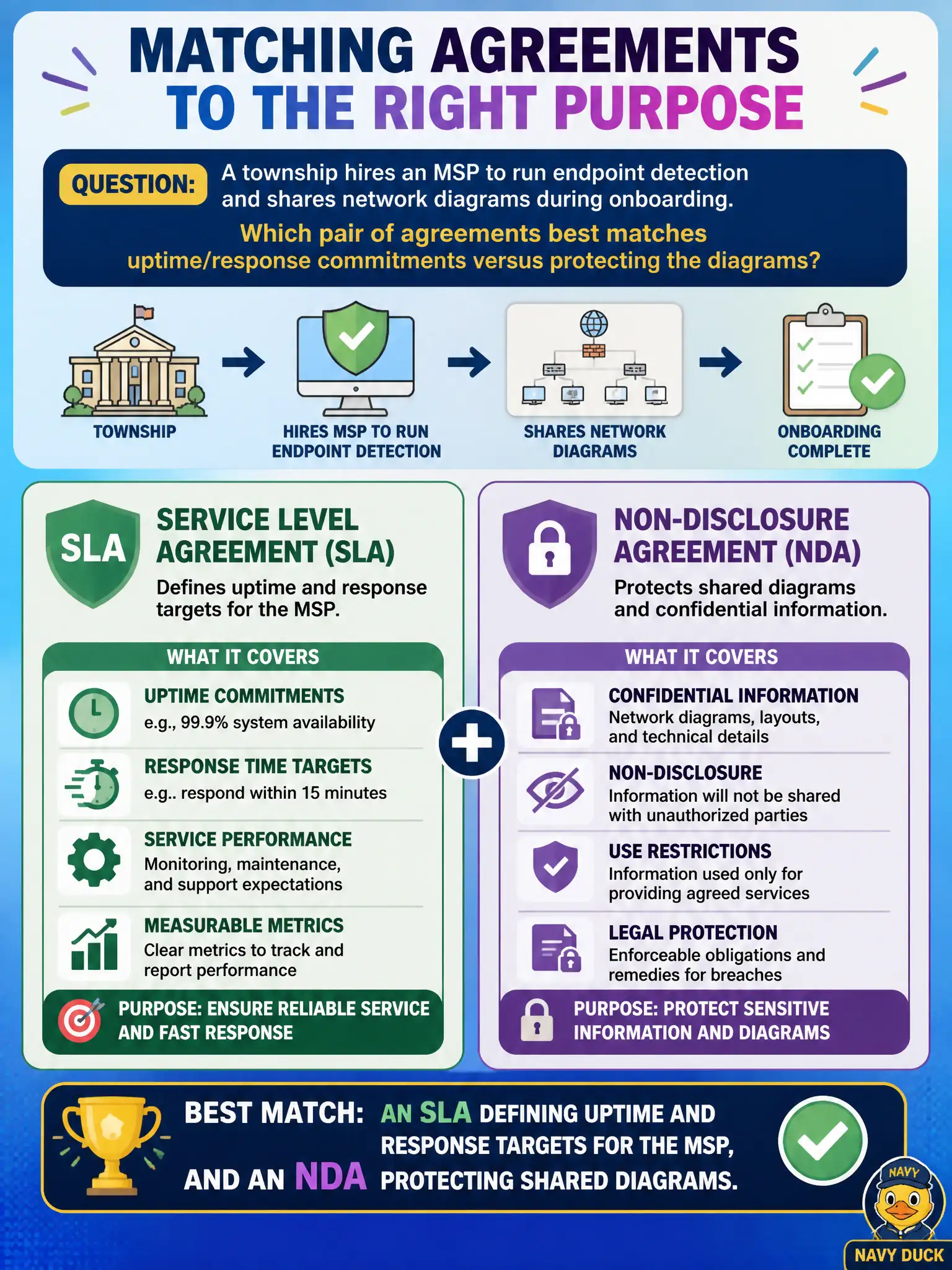
A township hires an MSP to run endpoint detection and shares network diagrams during onboarding. Which pair of agreements best matches uptime/response commitments versus protecting the diagrams?
Select an answer to reveal the explanation.
Short Explanation
SLA is the scoreboard for how fast and how available the MSP must be; NDA is the zippered folder for the network maps you hand them. Don't swap those jobs—secrecy papers don't promise uptime.
Full Explanation
A service level agreement specifies measurable service commitments such as uptime percentages and incident response times that an MSP must meet for endpoint detection operations. A nondisclosure agreement obligates parties to protect confidential information shared during onboarding, including network diagrams. Using an SLA for performance commitments and an NDA for diagram confidentiality matches each agreement to its purpose when a township hires an MSP and shares sensitive topology. An NDA for uptime percentages and an SLA for keeping diagrams secret swaps the instruments. NDAs protect confidentiality; SLAs define service levels. Mixing those roles leaves performance unenforceable and secrecy poorly framed. Only a cafeteria catering contract covers food service, not cybersecurity operations or protection of network diagrams. Catering agreements cannot substitute for MSP performance or confidentiality terms. A badge visitor log records facility visits; it does not create enforceable uptime targets or confidentiality obligations for shared diagrams and cannot replace legal agreements with an MSP. Exam caveat: SLA equals measurable service performance; NDA equals confidentiality of shared information. Exam items often swap those definitions—keep them straight. Operational check: Execute an SLA with clear uptime and response metrics for EDR services, execute an NDA before transmitting network diagrams, and align both agreements to the MSP onboarding checklist.