
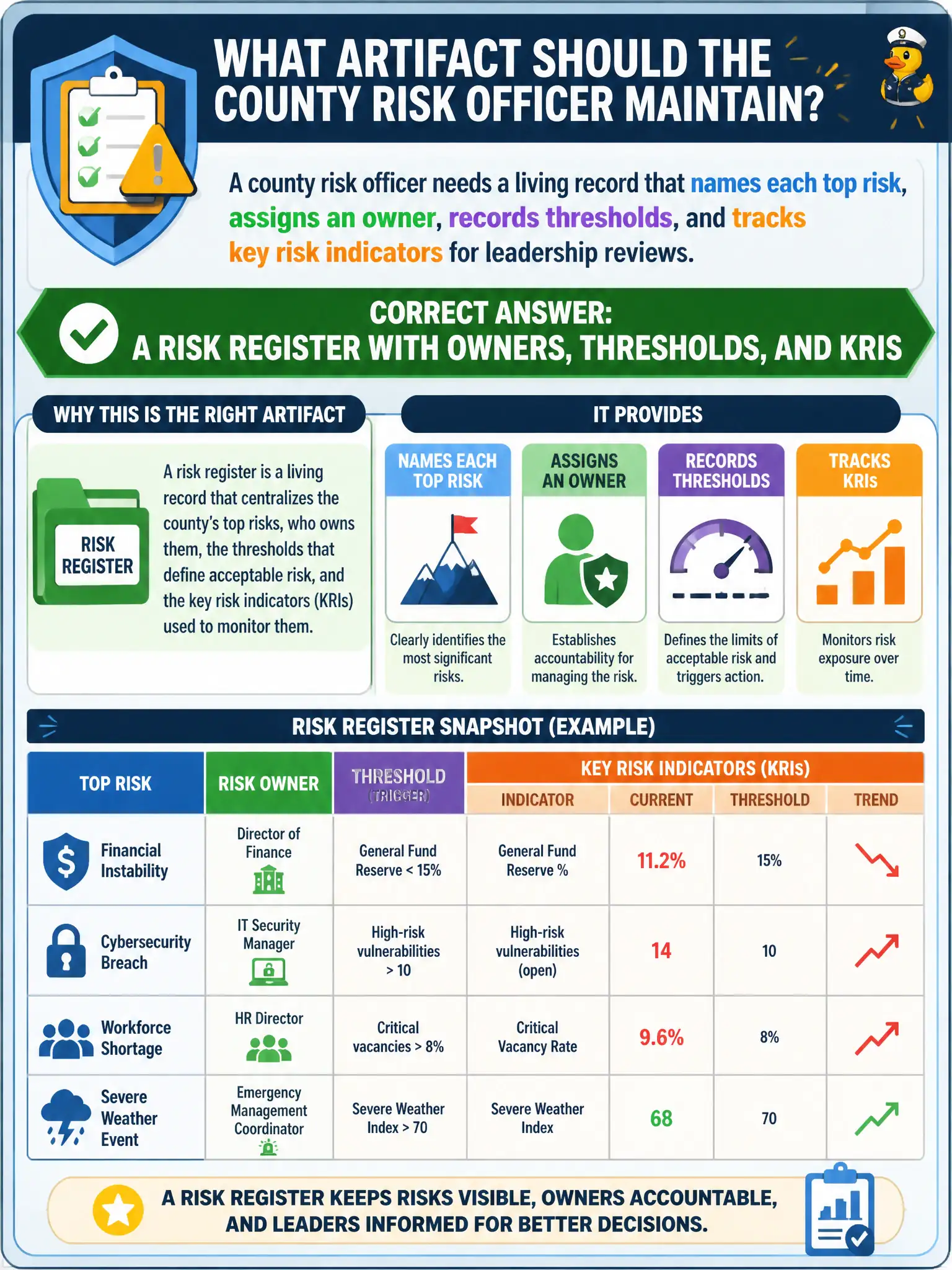
A county risk officer needs a living record that names each top risk, assigns an owner, records thresholds, and tracks key risk indicators for leadership reviews. Which artifact should they maintain?
Select an answer to reveal the explanation.
Short Explanation
The risk register is the scoreboard and roster in one—who owns each risk, where the alarm line sits, and which indicators say the risk is climbing. Lobby sheets and toner forms don't steer leadership risk talks.
Full Explanation
A risk register is the living inventory of identified risks used for municipal governance. Mature registers name each risk, assign an owner, record likelihood and impact or scores, track treatment status, define thresholds that trigger escalation, and capture key risk indicators so leadership can see whether risk is rising or falling between reviews. That package is exactly what a county risk officer needs for recurring oversight meetings. A visitor sign-in sheet at the courthouse lobby supports physical access accountability for guests. It does not inventory cyber or enterprise risks, assign risk owners, or track KRIs for leadership risk reviews. A toner reorder form for the assessor's printers is a supply process. Consumable reordering has no role as the authoritative record of top risks, thresholds, or indicators for the risk program. A cafeteria menu rotation schedule manages food service logistics. It is unrelated to risk ownership, threshold management, or KRI trending and cannot substitute for a risk register. Exam caveat: When the stem asks for a living record of risks with owners, thresholds, and KRIs, the answer is the risk register. Do not be distracted by other municipal forms that also 'record' something but lack risk-management content. Operational check: Keep the register current before leadership reviews, ensure every top risk has a named owner and threshold, and report KRI movement so the audit committee sees posture changes rather than a static list.