
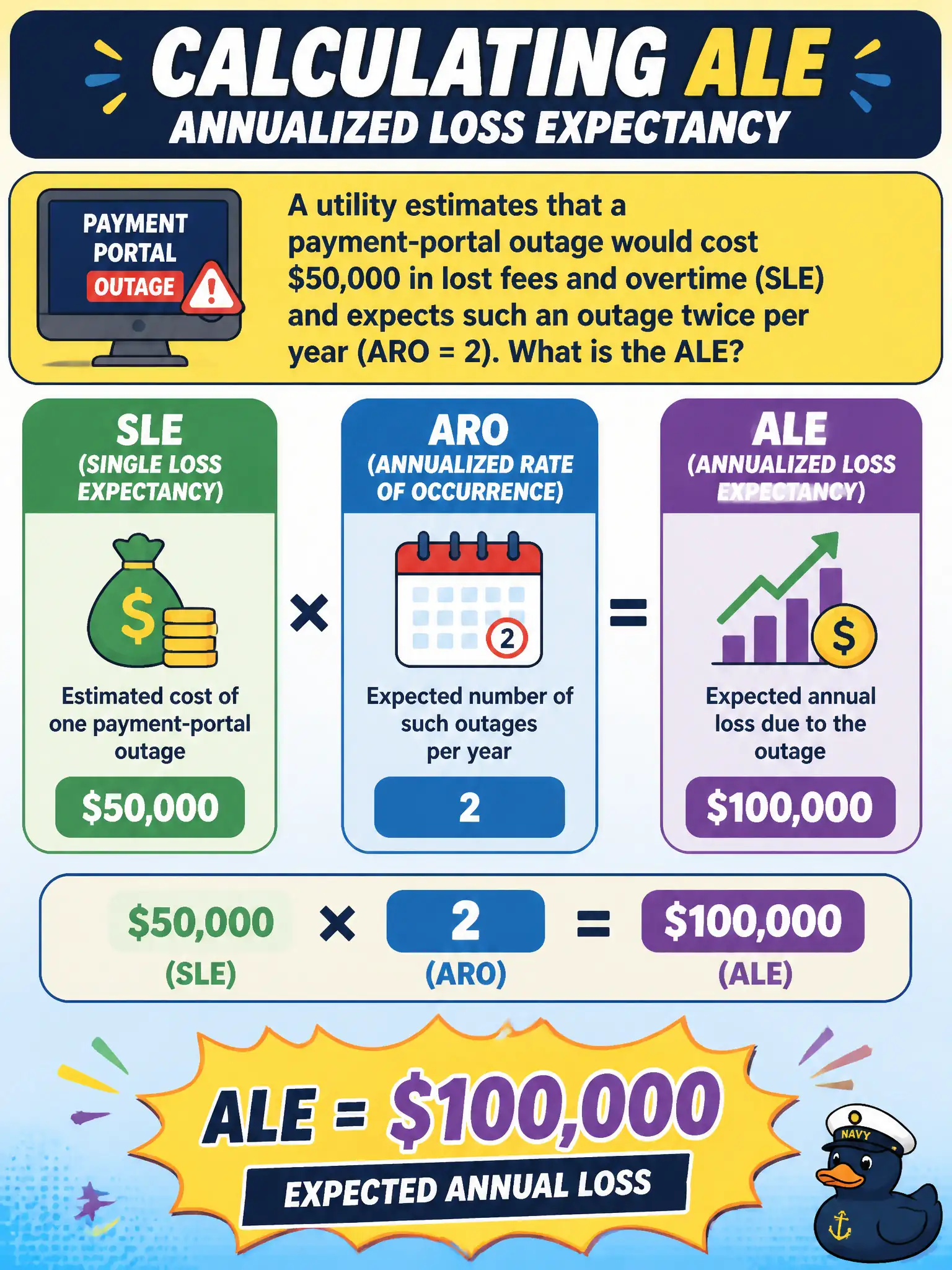
A utility estimates that a payment-portal outage would cost $50,000 in lost fees and overtime (SLE) and expects such an outage twice per year (ARO = 2). What is the ALE?
Select an answer to reveal the explanation.
Short Explanation
ALE is just SLE times how often it happens each year. Fifty thousand dollars times two hits a year is one hundred thousand dollars of expected annual pain—simple multiplication, not a new formula from outer space.
Full Explanation
Annualized loss expectancy is calculated as single loss expectancy multiplied by annualized rate of occurrence: ALE = SLE × ARO. For the utility payment portal, SLE is given as $50,000 per outage and ARO is 2 expected outages per year, so ALE equals $100,000. That expected annual loss figure helps municipal finance and security compare the cost of mitigations, redundancy, or insurance against the yearly pain of portal downtime. Selecting $50,000 mistakes SLE for ALE. Fifty thousand dollars is the loss per event; without multiplying by how often the event is expected each year, the figure understates annualized exposure when ARO is greater than one. Selecting $25,000 incorrectly halves the SLE or otherwise mishandles the arithmetic. Neither dividing SLE by ARO nor inventing a half-SLE value is part of the ALE definition on the exam. Selecting $2 confuses ARO with a dollar result or treats the rate of occurrence as if it were the loss figure. ARO is a frequency input; it is not the ALE by itself and has no unit of currency until combined with SLE. Exam caveat: Memorize ALE = SLE × ARO and apply the given numbers directly. Distractors often reuse SLE, invert the formula, or present the ARO as if it were money. Operational check: Recompute ALE from documented SLE and ARO assumptions, record those assumptions for auditability, and use the $100,000 annualized figure when comparing portal hardening or failover investments to expected yearly loss.