
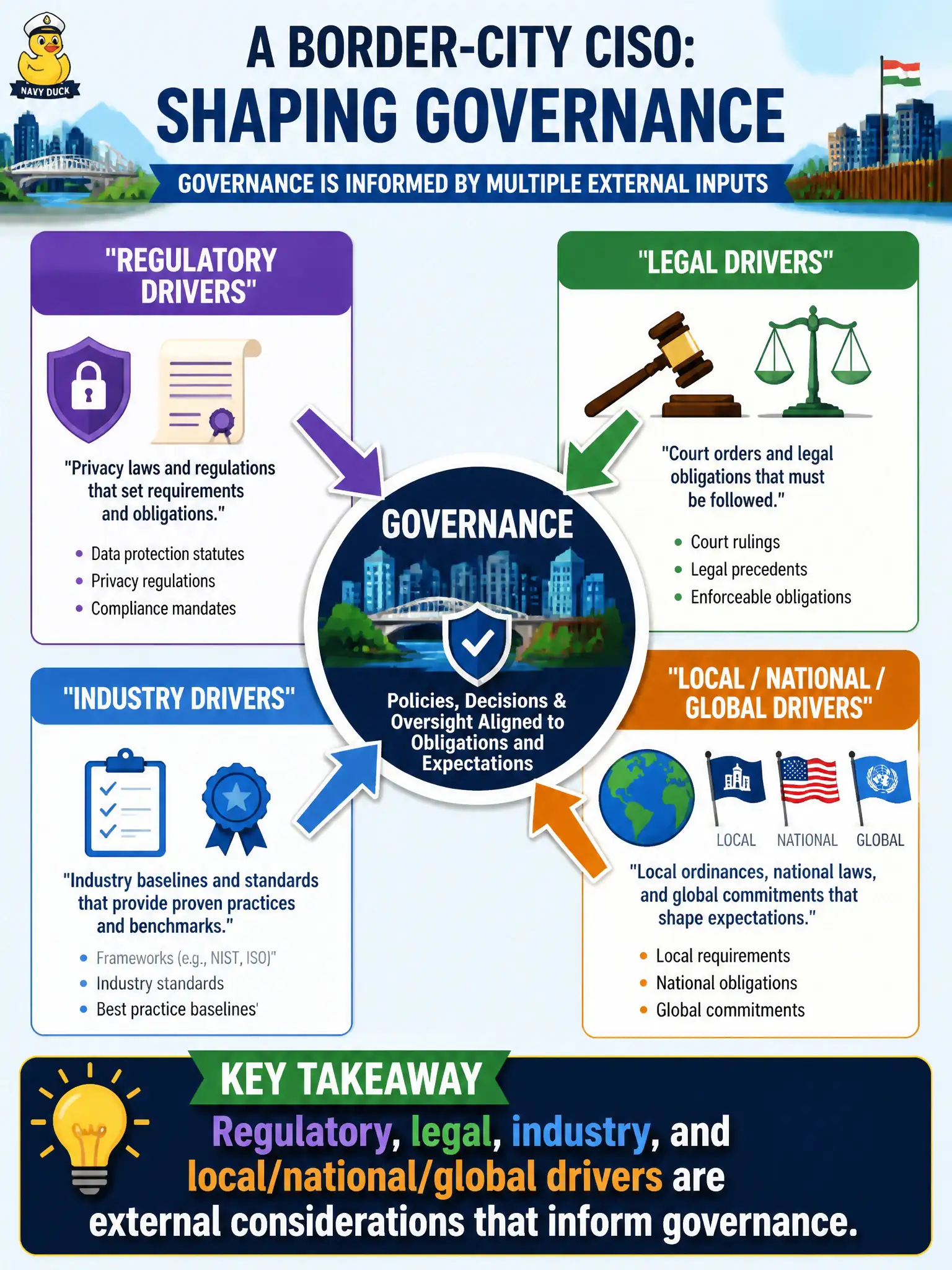
A border-city CISO must shape governance that reflects privacy statutes, court orders, industry baselines, and both local and national obligations. Which statement best describes these inputs?
Select an answer to reveal the explanation.
Short Explanation
Border-city security does not live in a vacuum—statutes, courts, industry norms, and local-to-global rules all tug on the program. Those external considerations shape real policy, not just a cozy internal wiki. Ignoring local law because a global framework is trendy is a fast way to fail compliance.
Full Explanation
Security governance is shaped by external considerations that the organization does not invent in isolation. Regulatory requirements (privacy statutes, sector rules), legal obligations (court orders, contracts, discovery), industry baselines and frameworks, and expectations that span local, national, and global contexts all inform which policies, standards, and controls a border-city CISO must implement. Treat these drivers as inputs to the governance program: map them to internal artifacts, assign owners, and evidence compliance. Ignoring them for convenience does not remove liability when citizen data or cross-border operations are involved.
Treating external considerations as optional once an internal wiki exists elevates informal notes over binding law. Claiming only global frameworks matter while ignoring local law invites noncompliance with statutes that still apply to the city. Letting procurement discounts override regulatory obligations subordinates legal duties to cost—an unacceptable governance failure. Exam caveat: external considerations include regulatory, legal, industry, and multi-jurisdictional drivers that inform governance—they are not optional flavor text. Operationally, maintain a compliance register linking privacy statutes, court orders, and industry baselines to municipal controls; review it when laws change; and require legal counsel input before exceptions that would weaken mandated protections.