
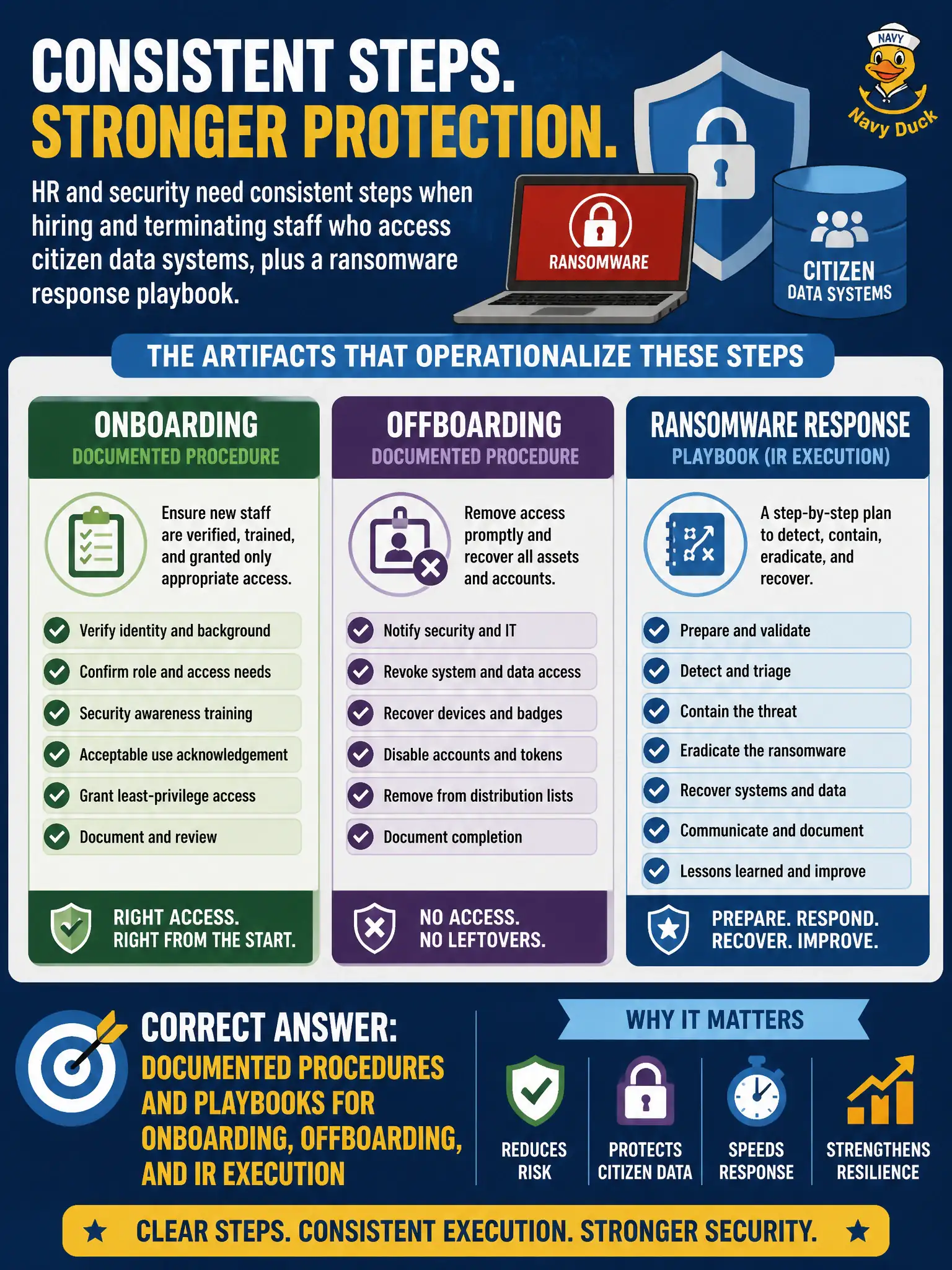
HR and security need consistent steps when hiring and terminating staff who access citizen data systems, plus a ransomware response playbook. Which artifacts operationalize those steps?
Select an answer to reveal the explanation.
Short Explanation
Procedures and playbooks turn policy into “do this, then this” for hiring, offboarding, and ransomware night shifts. Without them, citizen-data access hangs on whoever remembers the folklore. Posters and mission statements set tone but do not walk the steps.
Full Explanation
Procedures and playbooks turn policy into repeatable action. HR and security need consistent hiring and termination steps for staff who access citizen data systems—account provisioning, access reviews, credential issuance, and timely offboarding disables—plus a ransomware response playbook that sequences containment, communications, and recovery. Documented procedures reduce dependence on a single administrator’s memory and ensure new employees and departing staff are handled the same way across departments. Playbooks add scenario-specific decision trees for IR so responders execute under stress without inventing steps.
Vision posters without actionable steps inspire but do not operationalize onboarding or ransomware response. Unwritten tribal knowledge held by one senior admin creates bus-factor risk and inconsistent enforcement when that person is unavailable. A high-level mission statement alone states purpose without executable tasks. Exam tip: stems asking what operationalizes steps point to procedures and playbooks, not slogans or oral tradition. Operationally, maintain versioned onboarding/offboarding checklists tied to identity systems, test the ransomware playbook in tabletops, assign procedure owners, and audit whether terminated users lose citizen-data access within the required window every time.