
A records manager asks how municipal governance documents differ. Which statement correctly contrasts them?
Select an answer to reveal the explanation.
Short Explanation
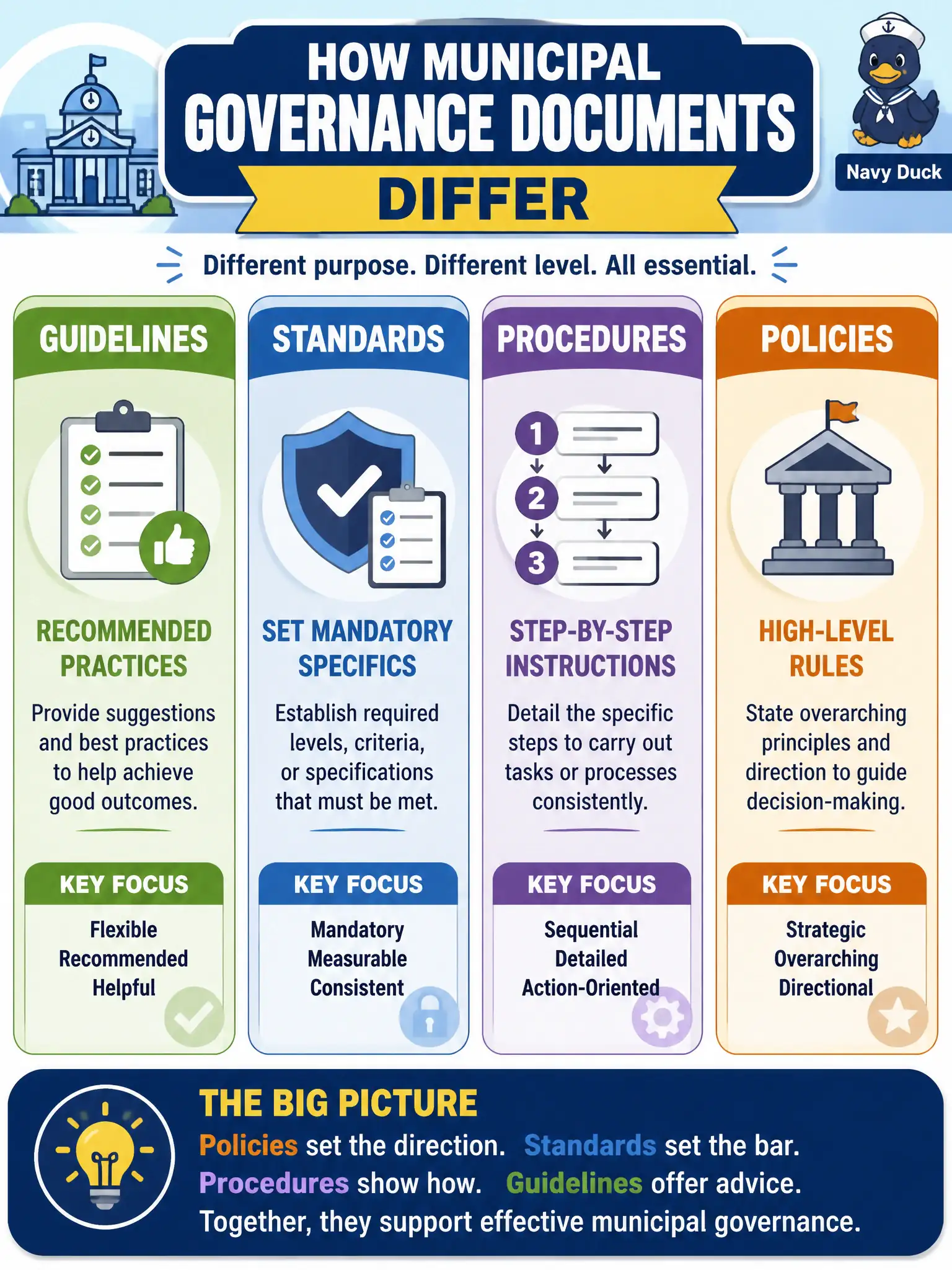
Picture city hall documents as layers: policies are the big “must,” standards nail measurable specifics, procedures are the cookbook steps, and guidelines are helpful “shoulds.” Mixing those labels confuses auditors and staff alike. One signed policy never magically deletes the need for standards and how-to procedures.
Full Explanation
Municipal governance documents differ by authority and specificity. Policies are high-level mandatory rules expressing leadership intent (what must be achieved and why). Standards set mandatory, measurable baselines that make policy concrete—such as required encryption algorithms, password length, or MFA for remote access. Procedures are step-by-step instructions for performing tasks consistently. Guidelines are recommended practices that advise without the same binding force as standards or policies. Understanding this hierarchy prevents treating a friendly recommendation as optional law—or treating a high-level policy as a click-by-click runbook.
Claiming procedures are high-level principles while policies are only click-by-click commands reverses the usual hierarchy. Calling standards optional suggestions while treating guidelines as mandatory encryption algorithms swaps force levels and confuses implementers. Asserting that signed policies eliminate any need for standards or procedures leaves staff without measurable baselines or executable steps. Exam caveat: CompTIA expects clear distinctions—guidelines recommend; standards mandate specifics; procedures sequence actions; policies set high-level rules. Operationally, map each municipal control to the right artifact: write policy for intent, standards for testable baselines, procedures for operations, and guidelines for helpful advice; then train auditors and admins to cite the correct document type during reviews.