
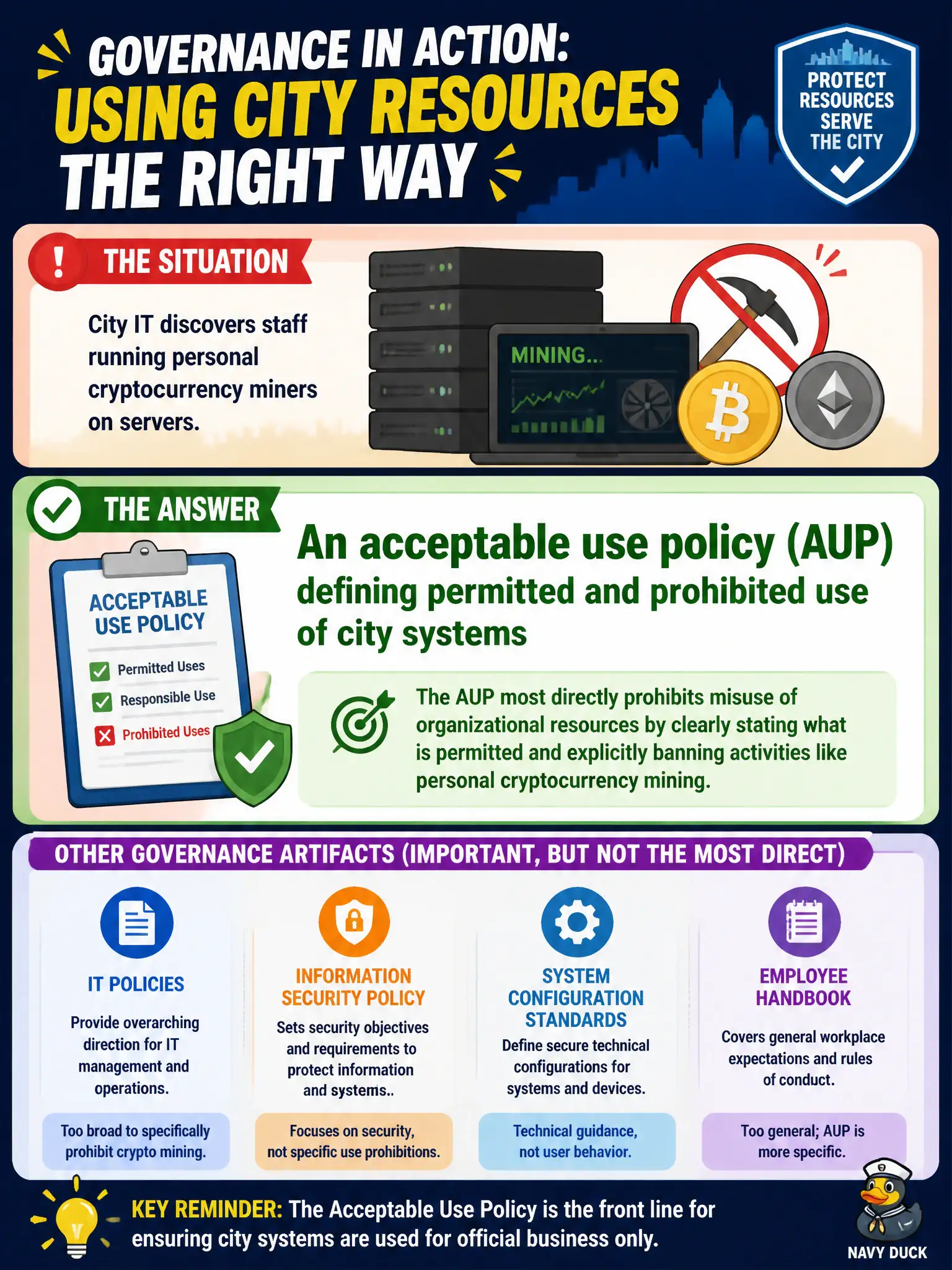
City IT discovers staff running personal cryptocurrency miners on servers. Which governance artifact most directly prohibits that use of organizational resources?
Select an answer to reveal the explanation.
Short Explanation
An AUP is the house rules for city computers—what you may and may not do with them. Personal crypto mining on municipal servers is classic unacceptable use. Cable specs and GPU quotes do not set staff behavior rules.
Full Explanation
An acceptable use policy (AUP) is the governance artifact that defines permitted and prohibited uses of organizational computing resources. When city staff run personal cryptocurrency miners on municipal servers, the AUP is the document that most directly forbids diverting CPU, electricity, and capacity to unauthorized personal workloads, and it underpins disciplinary and investigative follow-up. AUPs typically address personal software, resource abuse, data handling, and monitoring consent, giving security and HR a clear rule set rather than relying on ad hoc judgment after discovery.
A network diagram legend without behavioral rules describes symbology, not user obligations. A cabling standard that only specifies fiber connectors is a technical infrastructure standard, not a behavioral use policy. A vendor GPU price quote is a procurement artifact and does not prohibit cryptomining. Exam tip: match the artifact type to the problem—behavioral misuse of systems maps to AUP, not diagrams or cabling specs. Operationally, ensure the city’s AUP explicitly bans unauthorized mining and similar resource abuse, require acknowledgment at hire and periodically, monitor for mining indicators on servers, and coordinate enforcement with HR using the AUP citation when violations are confirmed.