
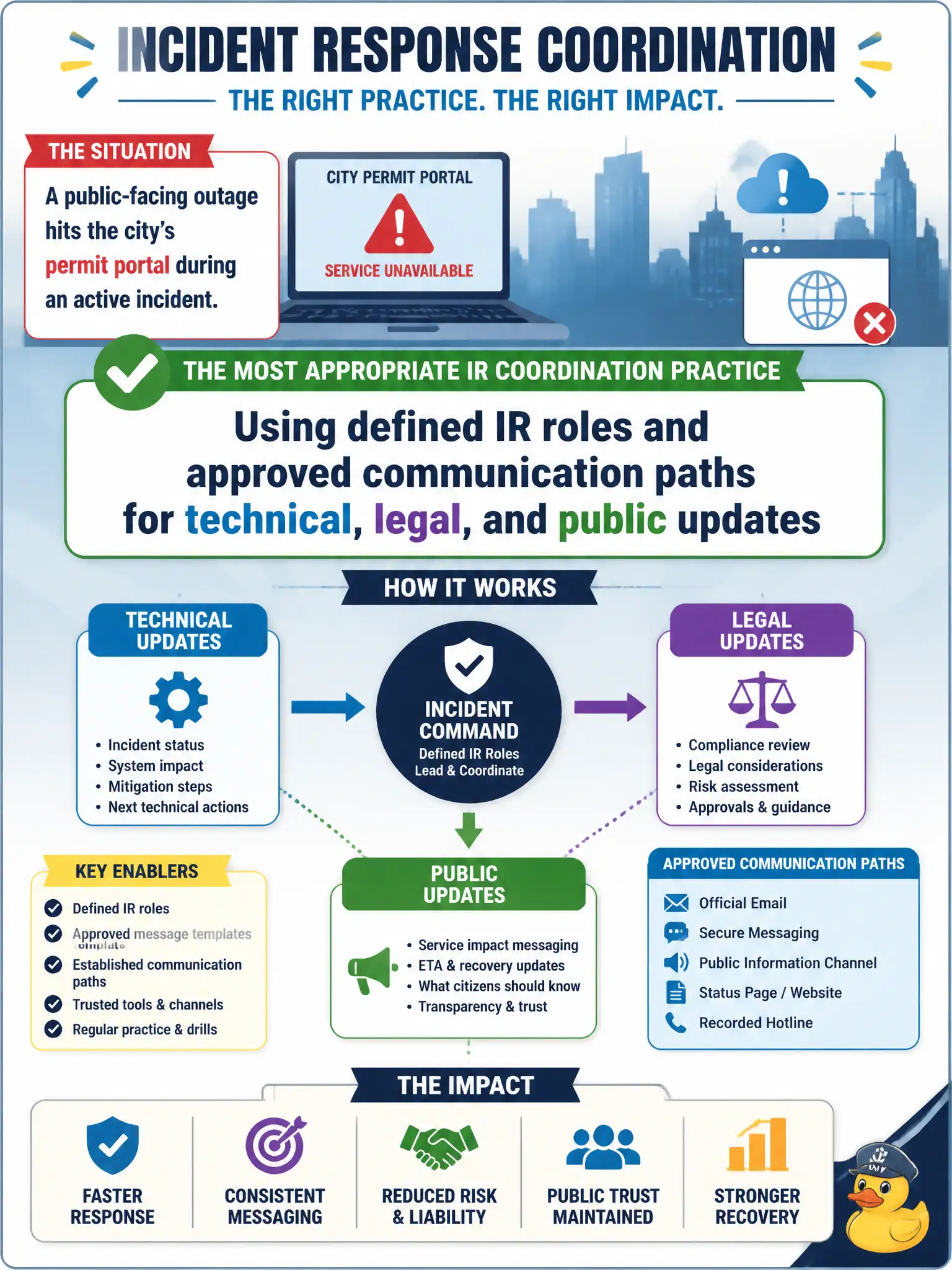
A public-facing outage hits the city’s permit portal during an active incident. Which IR coordination practice is most appropriate?
Select an answer to reveal the explanation.
Short Explanation
Public outages need a clear org chart for who fixes, who talks to counsel, and who speaks to residents. Defined IR roles and approved comms paths stop conflicting tweets and missed briefings. Freelancing status on social media turns a technical incident into a messaging incident.
Full Explanation
Incident response coordination for a public-facing outage requires defined roles and approved communication paths spanning technical response, leadership, legal, and public information. During a permit-portal incident, technical leads contain and restore systems; legal advises on disclosure and records obligations; communications issues resident-facing updates; and executives receive timed briefings. Approved channels prevent conflicting statements, leaked unfinished theories, and missed escalations. Clear RACI-style assignments keep the city from mixing speculative troubleshooting chatter with official public status.
Letting every technician post unvetted social media updates creates messaging chaos, may tip off attackers, and can create liability through inaccurate claims. Keeping legal, communications, and technical leads unaware of each other produces siloed decisions—technical fixes that ignore disclosure duties or press statements that contradict operational reality. Assigning only a single technical fixer while ignoring executive briefings leaves governance and public accountability unaddressed during a visible civic outage. Exam caveat: coordination questions emphasize role separation and communication discipline, not heroic lone administrators. Operationally, activate the IR org chart at declaration, route public updates through the authorized PIO or communications lead, keep a single source of truth for status, and log decisions so after-action review can improve the city’s permit-outage playbook.