
Threat intel reports a new exploit kit targeting services the county still runs at the edge. What IDS/IPS maintenance actions best keep detections current and useful?
Select an answer to reveal the explanation.
Short Explanation
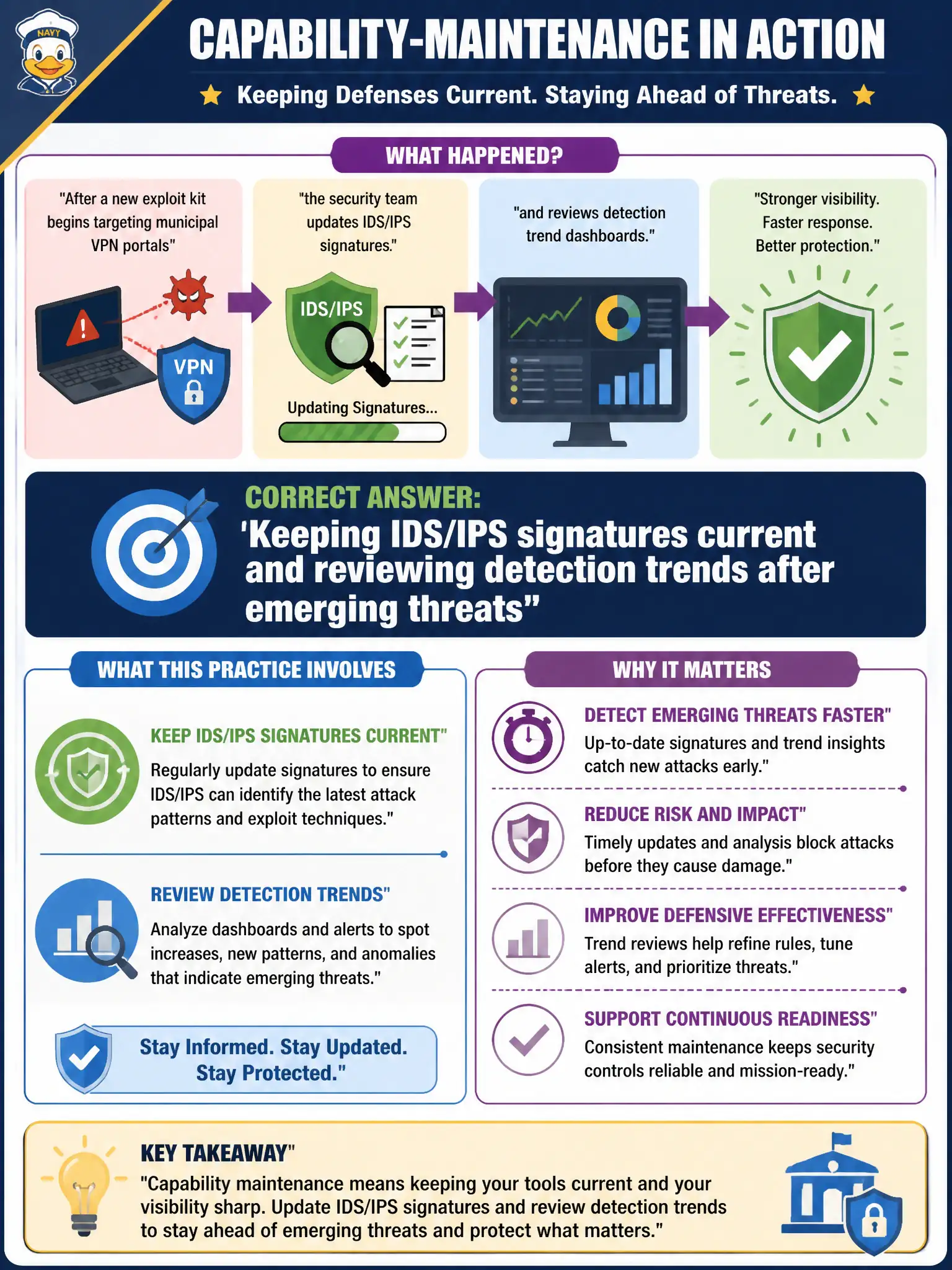
When a new exploit kit shows up, refresh the IDS/IPS signatures and peek at the trend lines—are you catching it, or drowning in junk? Freezing signatures or flipping to allow-all is how you miss the wave.
Full Explanation
When threat intel reports a new exploit kit aimed at services the county still runs at the edge, IDS/IPS maintenance must update signatures or rules for that kit and review detection trends for gaps, misses, or noise. Fresh content restores visibility into novel attack patterns, while trend analysis shows whether the municipal sensors are catching the activity cleanly or drowning analysts. Those paired actions keep detections current and operationally useful.
Freezing signature sets permanently so labs stay quiet during elections intentionally blinds monitoring in a high-risk civic period. Deleting historical IDS alerts so charts start at zero erases baselines needed to spot meaningful change. Switching the IPS to allow-all until vendors publish a press release abandons both prevention and detection when intel already indicates active tooling in the wild.
Exam caveat: new signatures can false-positive—stage critically sensitive rules in detect mode, validate against production traffic, then enforce. Signature updates complement anomaly and threat-intel matching; freezing content is not a stability strategy.
Operational check: push vendor/ISAC content for the kit within an emergency change window, watch hit rates and true-positive ratios, tune noisy rules with documented suppressions, and confirm inline IPS blocking only after a controlled validation against county edge traffic.