
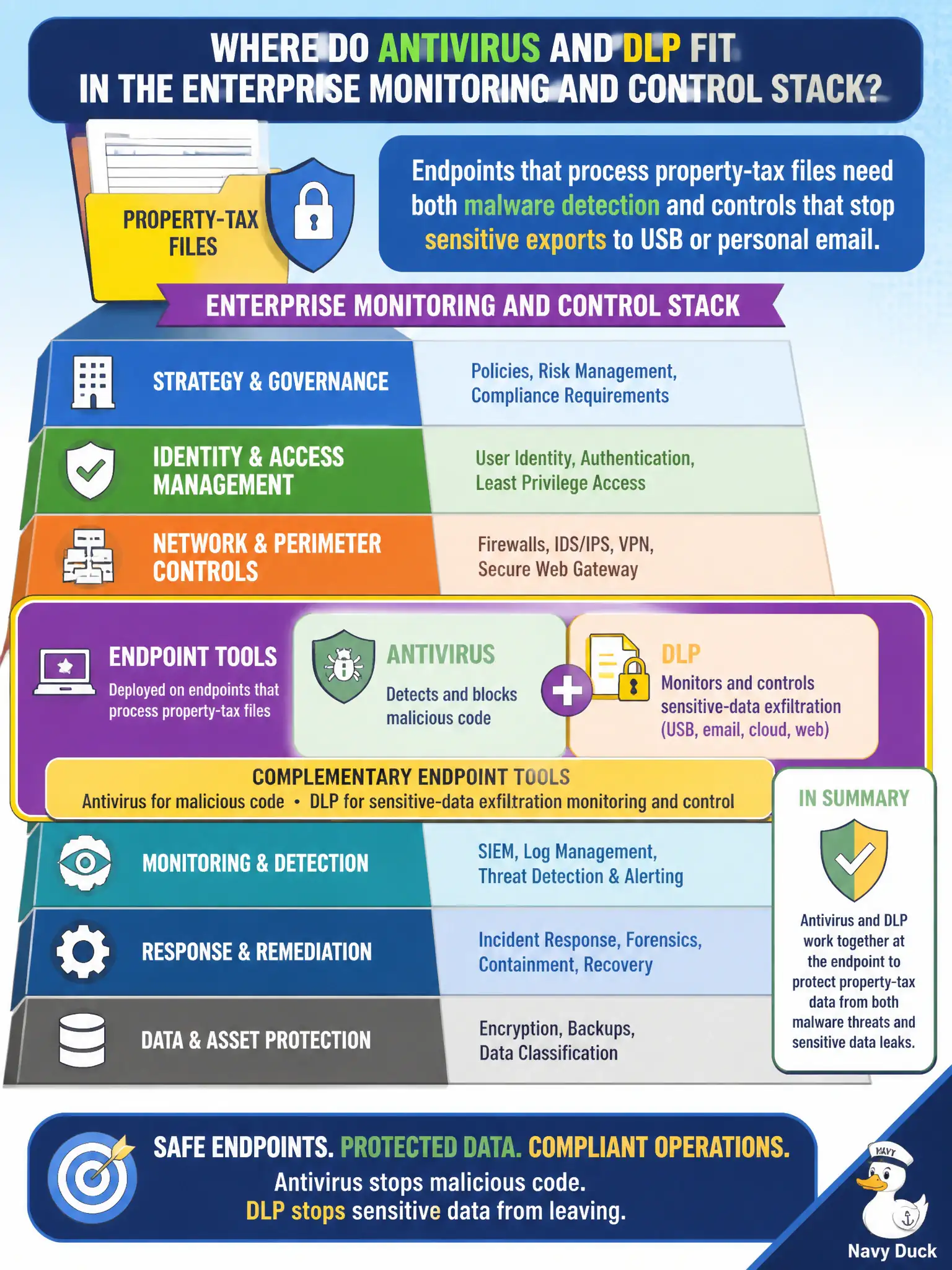
Endpoints that process resident tax filings need malware detection plus controls that stop sensitive returns from being copied to USB or emailed outside policy. Which tooling pair best belongs in that monitoring and control stack?
Select an answer to reveal the explanation.
Short Explanation
Tax PCs need a malware guard and a data leash—antivirus/EDR watches for bad code, DLP watches so returns do not stroll out on USB or email. Door locks alone will not catch either problem.
Full Explanation
Endpoints that process resident tax filings need both malware defense and sensitive-data egress control. Antivirus or EDR detects, blocks, and helps respond to malicious code on the host, while DLP monitors and stops tax returns and related PII from leaving through USB, personal email, or unsanctioned cloud sync. Deploying that tooling pair gives the municipal monitoring and control stack coverage for integrity/availability threats from malware and confidentiality threats from data loss—exactly the combination the scenario describes.
Removing all endpoint agents to improve boot times during tax season strips protection when filing volume and social-engineering pressure peak. Relying only on physical locks on office doors cannot stop malware execution, remote access misuse, or digital exfiltration once a user is logged in. Sharing one common local-admin password destroys accountability, enables lateral movement, and contradicts basic endpoint hardening.
Exam caveat: modern EDR extends signature AV with behavioral detection and remote response; DLP needs accurate classification of tax data and enforced channels. Government deployments should align with privacy notices and least-privilege admin models—shared local admin is never the support answer.
Operational check: enroll tax workstations in managed EDR/AV with SOC alerting, enable USB and outbound-mail DLP policies for return documents, validate a blocked egress attempt in a lab, and ensure runbooks cover both malware detonation and data-loss incidents.