
Network ops for city hall suddenly receives notifications that several switch interfaces are flapping up and down. Which monitoring signal is most likely delivering those infrastructure alerts?
Select an answer to reveal the explanation.
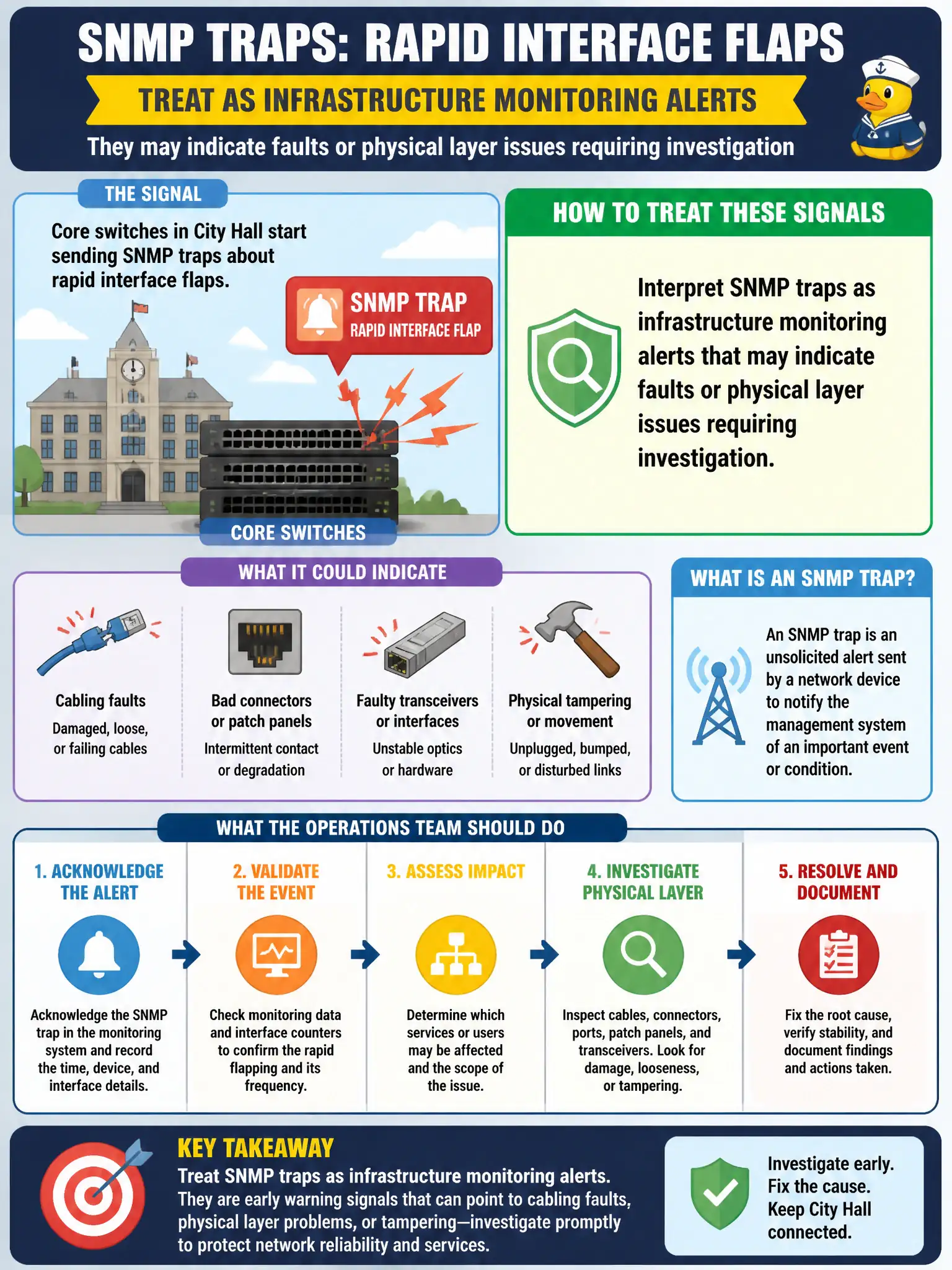
Short Explanation
When a switch port chatters up and down, SNMP traps are the device yelling "hey, something changed" to the NMS. That is how city hall learns about flaps that might be cable faults—or someone monkeying with links—not lobby surveys.
Full Explanation
SNMP traps are asynchronous notifications from network devices to a network-management system when defined events occur—such as interface operational status flipping up or down. City-hall switch port flapping naturally surfaces as SNMP traps or informs, giving network operations near-real-time infrastructure alerts that can indicate failing cabling, bad NICs, duplex mismatches, or someone tampering with physical links. That signal is the classic monitoring path CompTIA associates with device-reported status changes.
Citizen Wi-Fi satisfaction surveys measure perception of lobby connectivity, not interface state machines on distribution switches. Printed change tickets filed only after the next council meeting are delayed paperwork and cannot deliver sudden flap notifications. Disabling SNMP so flaps never generate noise removes the alert source instead of fixing the underlying instability or investigating possible tampering.
Exam caveat: SNMP credential hygiene matters—prefer SNMPv3 with authPriv over clear-text communities. Traps require a reachable NMS and correct trap destinations; pure polling can miss short flaps between intervals, so many municipal designs combine both.
Operational check: verify access and distribution switches send linkUp/linkDown traps to the monitored NMS, alert on flapping thresholds per interface, correlate with MAC address-table changes, and dispatch cabling or physical-security checks for unexpected layer-1 events at city hall.