
After baseline hardening of city IoT cameras and water-plant ICS devices, what ongoing practice should accompany those controls?
Select an answer to reveal the explanation.
Short Explanation
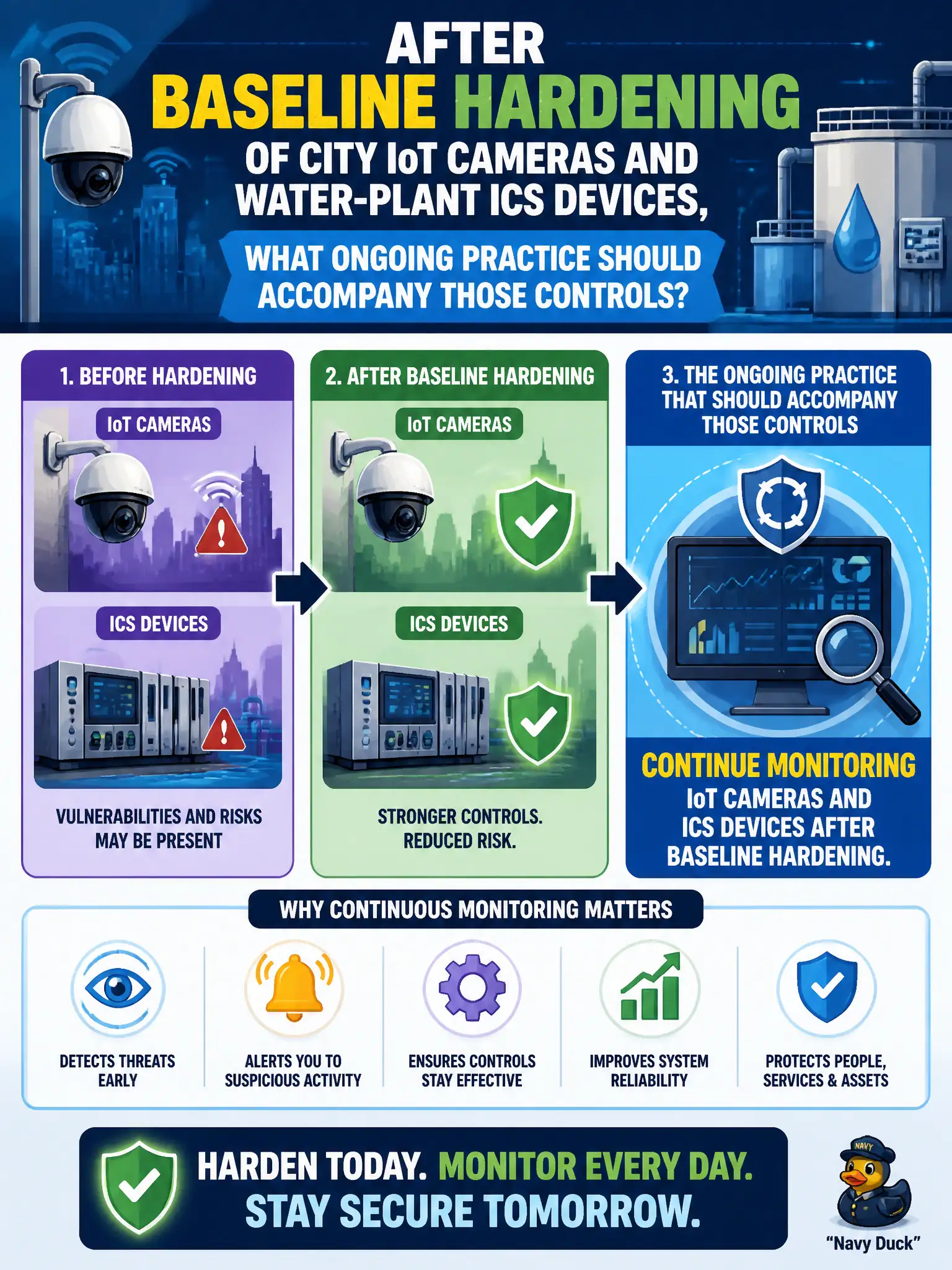
Hardening gets the cameras and plant controllers into a safer starting stance—but you still watch them. Monitoring catches drift, weird traffic, and failures after the baseline is set. Set-and-forget is how quiet problems grow.
Full Explanation
IoT cameras and industrial control devices in city facilities benefit from baseline hardening, yet hardening is a starting stance rather than a permanent finish line. Configurations drift, firmware vulnerabilities emerge, and anomalous traffic appears after commissioning. Continued monitoring—availability, authentication failures, unusual protocols, and configuration change—detects compromise and decay that a one-time lock-down will not. Segmentation and hardened defaults still matter; they do not eliminate the need to watch constrained devices over time. Never monitoring again because hardening is permanent mistakes a snapshot for ongoing assurance. Exposing ICS management interfaces directly to the Internet for vendor convenience creates a well-known attack path into plant and building systems. Removing network segmentation so cameras and ICS share the clerk VLAN collapses trust boundaries and lets a compromised camera or controller threaten workstation domains that handle citizen records. Exam caveat: for IoT/ICS, exam content pairs hardening with monitoring and segmentation—do not treat any single step as sufficient forever. Operational check: keep cameras and ICS on segmented networks, alert on management-plane access anomalies, and periodically re-validate baselines against the monitored inventory.