
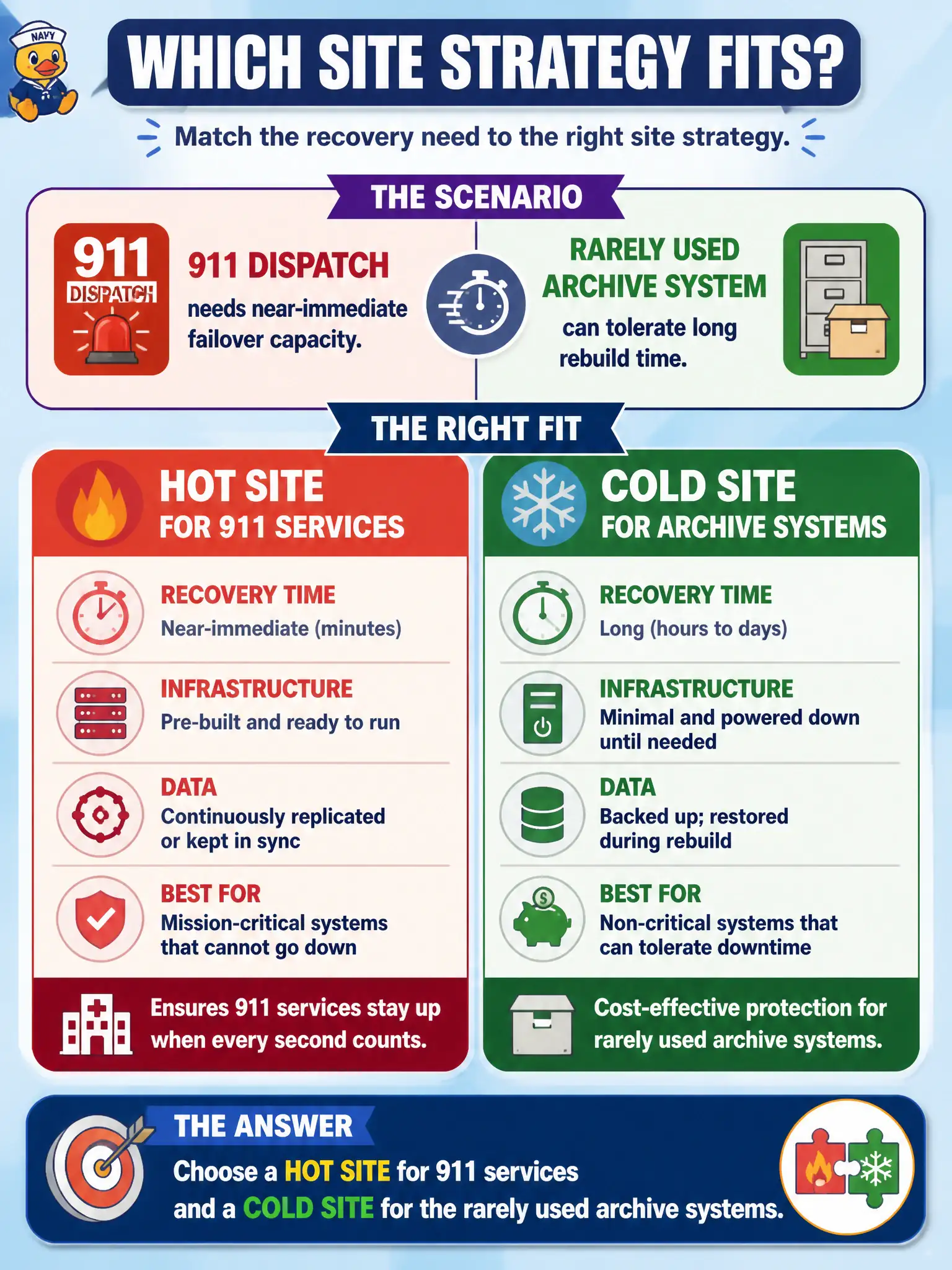
911 dispatch needs near-immediate failover capacity, while a rarely used archive system can tolerate long rebuild time. Which site strategy fits?
Select an answer to reveal the explanation.
Short Explanation
911 can’t wait for someone to unpack servers from crates—that’s hot-site territory. Dusty archives can wake up slowly in a cold site. Swapping those priorities saves the wrong dollars.
Full Explanation
Alternate-site strategy must match recovery time needs. Emergency 911 services require near-immediate continuity—hot sites with pre-positioned systems, data replication, and rapid failover. Rarely used archive systems can tolerate longer restoration from a cold site where space and power exist but equipment and data are brought up after the event.
Using a cold site for 911 and a hot site for archives spends scarce money on the low-urgency workload and leaves life-safety services waiting on hardware delivery. Eliminating alternate sites because cloud marketing promises zero downtime ignores validation, architecture, and residual risk. Parking both workloads on a single generator without geographic alternatives fails regional disasters that take out the primary facility.
Exam caveat: hot, warm, and cold describe readiness and cost, not marketing labels. Match RTO/RPO to each municipal service; one site tier rarely fits every system on the civic portfolio.
Operational check: document RTO for 911 versus archives, confirm hot-site replication and failover tests for emergency systems, keep cold-site contracts and restore runbooks current for archives, and avoid swapping tiers solely for short-term budget optics.