
A city moves to a cloud-first model where remote staff access SaaS and municipal apps from many locations. Leadership wants networking and security services delivered together near the user. Which concept describes that approach?
Select an answer to reveal the explanation.
Short Explanation
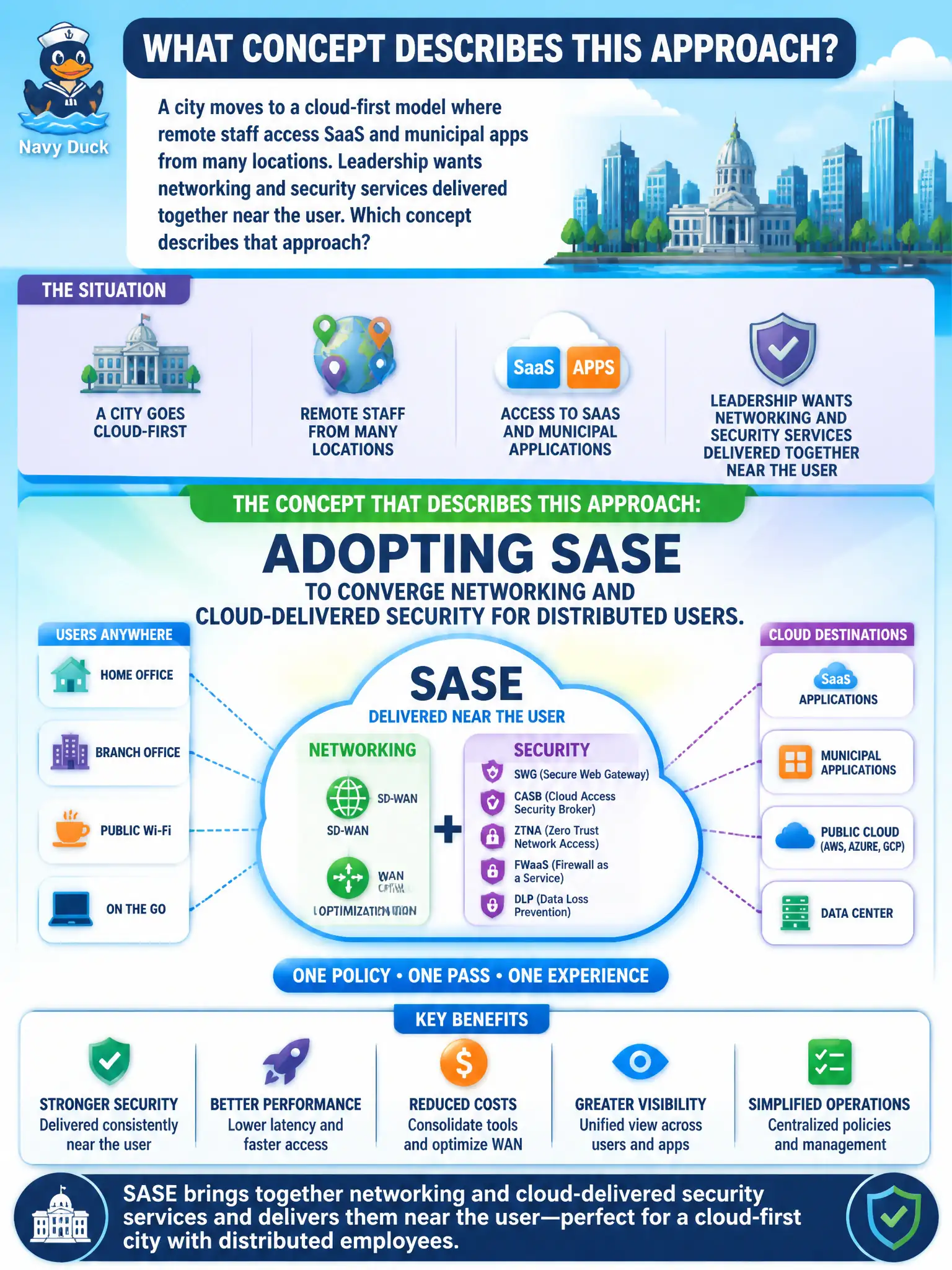
Picture security riding shotgun with the network right where remote workers live—not backhauled through one dusty basement firewall. That combo of edge networking plus cloud security services is the SASE idea. Hairpinning everything home fights the cloud-first model.
Full Explanation
Secure Access Service Edge converges networking and cloud-delivered security so distributed municipal users reach SaaS and Internet resources under consistent identity, posture, and threat controls close to where they work. For a city workforce that lives in cloud applications rather than a single basement data center, SASE aligns policy enforcement with the traffic path instead of forcing every session home first.
Air-gapping every laptop so remote staff never reach cloud services breaks the business model the municipality already adopted; isolation is not a substitute for cloud-aware access architecture. Hairpinning all SaaS through one on-premises-only firewall creates latency, single points of failure, and capacity bottlenecks that fight a cloud-first design. Guest Wi-Fi vouchers are temporary network admission for visitors; they are not a remote-access security control for employees handling city systems.
Exam caveat: SASE is not merely “VPN in the cloud.” It bundles edge networking with cloud security services (for example secure web gateway, CASB/ZTNA-style access, and related controls). Choosing SASE does not mean abandoning identity or device posture—those remain part of the policy story.
Operational check: map critical SaaS and admin paths, verify users are steered through the SASE edge with MFA and posture where required, measure that traffic is no longer forced through obsolete hairpin choke points, and ensure guest Wi-Fi remains segmented from production remote access.