
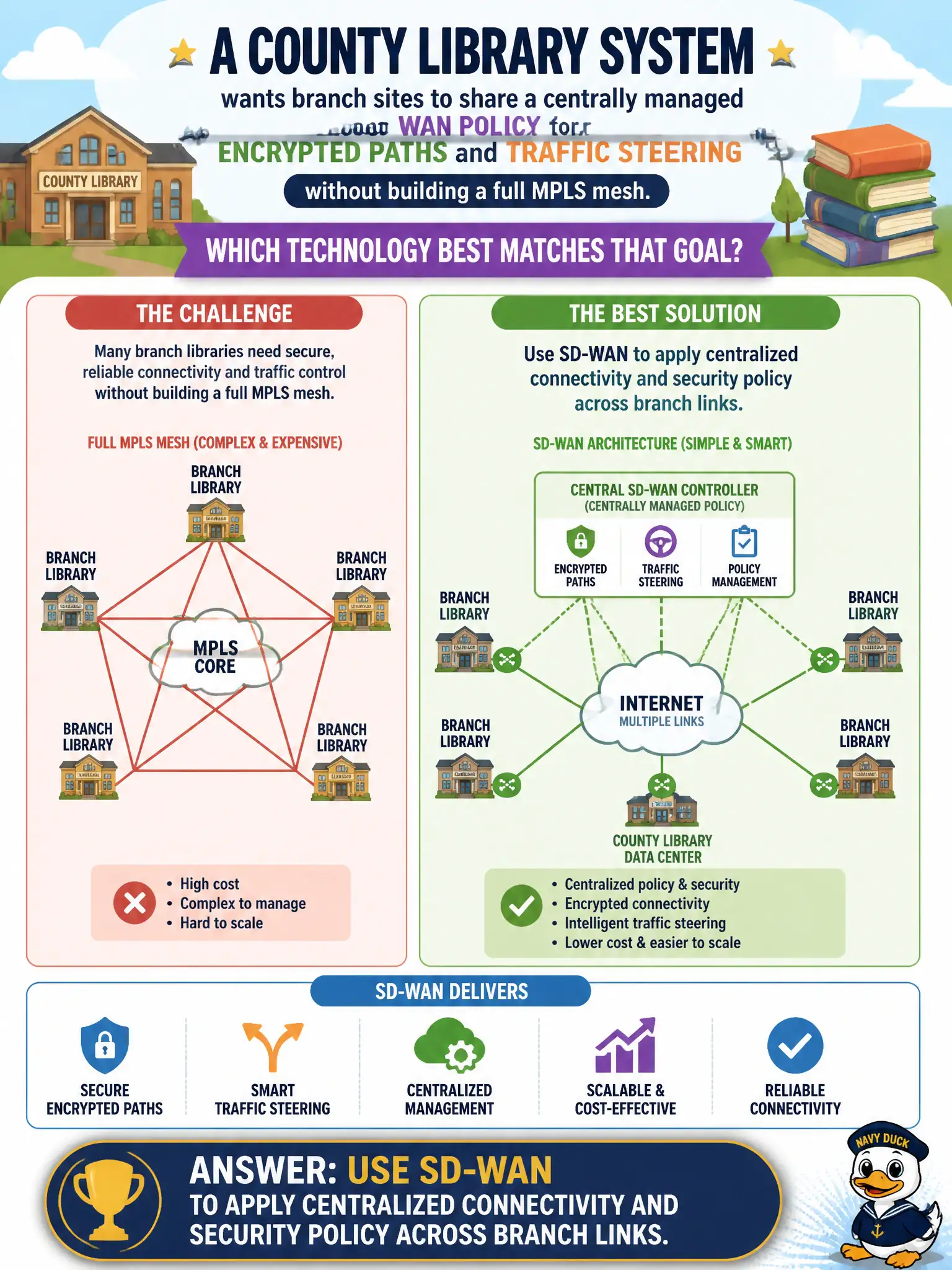
A county library system wants branch sites to share a centrally managed WAN policy for encrypted paths and traffic steering without building a full MPLS mesh. Which technology best matches that goal?
Select an answer to reveal the explanation.
Short Explanation
Think of SD-WAN like a smart traffic controller for the library branches—HQ sets the rules once, and each site’s links follow them. You get policy-driven paths and security posture without reinventing a private MPLS spiderweb. Plain consumer routers alone leave you without that central security steering.
Full Explanation
Software-defined WAN gives a municipal library network a single control plane for how branch circuits encrypt, prefer, and steer traffic. Controllers push connectivity and security policy to edge appliances so every branch follows the same encrypted-path and application-aware rules without the county needing to provision a classical full-mesh MPLS fabric. That is the architectural fit when distributed civic sites must share HQ-defined WAN behavior on commodity or hybrid underlays.
Unmanaged consumer broadband routers leave each branch as an island: no centralized policy, inconsistent encryption posture, and no reliable steering across diverse last-mile links. A consumer Wi-Fi mesh that only extends Layer 2 solves wireless coverage, not WAN security or path policy; it does not replace branch firewalls with centrally governed secure connectivity. Dial-up modem fallback without encryption or policy control may keep a thin out-of-band path alive, but it fails confidentiality and governance requirements for library systems that move patron and staff traffic.
Exam caveat: SD-WAN is about policy-driven WAN overlays and orchestration; do not confuse it with simply buying faster ISP circuits or with campus Wi-Fi mesh. Availability of underlay bandwidth does not equal centralized security control.
Operational check: confirm the SD-WAN fabric enforces encryption on branch overlays, that HQ can change steering and security profiles once and see them apply system-wide, and that break-glass local access still exists if the controller path fails—without reverting branches to unmanaged consumer gear.