
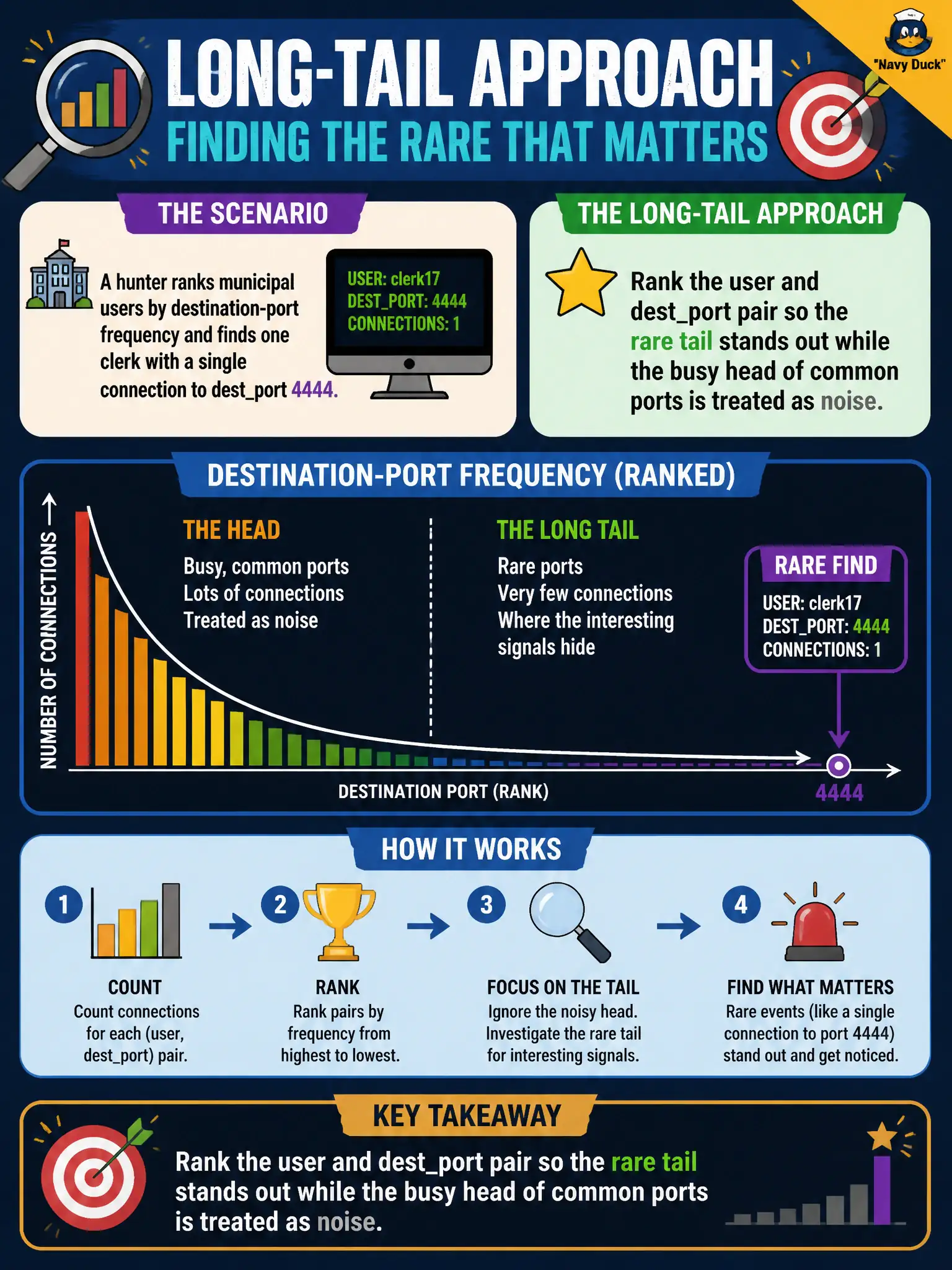
A hunter ranks municipal users by destination-port frequency and finds one clerk with a single connection to dest_port 4444. What long-tail approach does this illustrate?
Select an answer to reveal the explanation.
Short Explanation
Common ports are the busy front door; dest_port 4444 on one clerk is the side alley. Rank user plus dest_port and the tail lights up. The head of that list is noise you already expected.
Full Explanation
Long-tail hunts can rank a pair of CIM fields—such as user and dest_port—so rarity is computed on the combination rather than on a single noisy field. Ranking municipal users by destination-port frequency and finding one clerk with a single connection to dest_port 4444 illustrates that approach: the rare user-and-port pair stands out in the tail while the busy head of common ports such as 443 and 80 is treated as noise. Alerting on every TCP session because all ports are equally rare destroys the frequency ranking and creates unusable volume. Exporting the entire proxy index to a spreadsheet and sorting alphabetically is not a Splunk long-tail method and loses efficient aggregation. Ignoring dest_port and hunting only file hashes from the clerk workstation switches to indicator hunting and abandons the port-rarity technique the stem describes. Exam caveat: long-tail analysis may be single-field or multi-field; pairing identity with dest_port is a valid way to surface rare civic egress. Operational check: aggregate by user and dest_port, identify pairs with count near one (including 4444), pivot the clerk's 4444 session to destination and process context, and document whether the rare pair warrants a detection or risk rule.