
The water SCADA historian is reachable from the business VLAN because a jump host is dual-homed. What enabling vector should the analyst report?
Select an answer to reveal the explanation.
Short Explanation
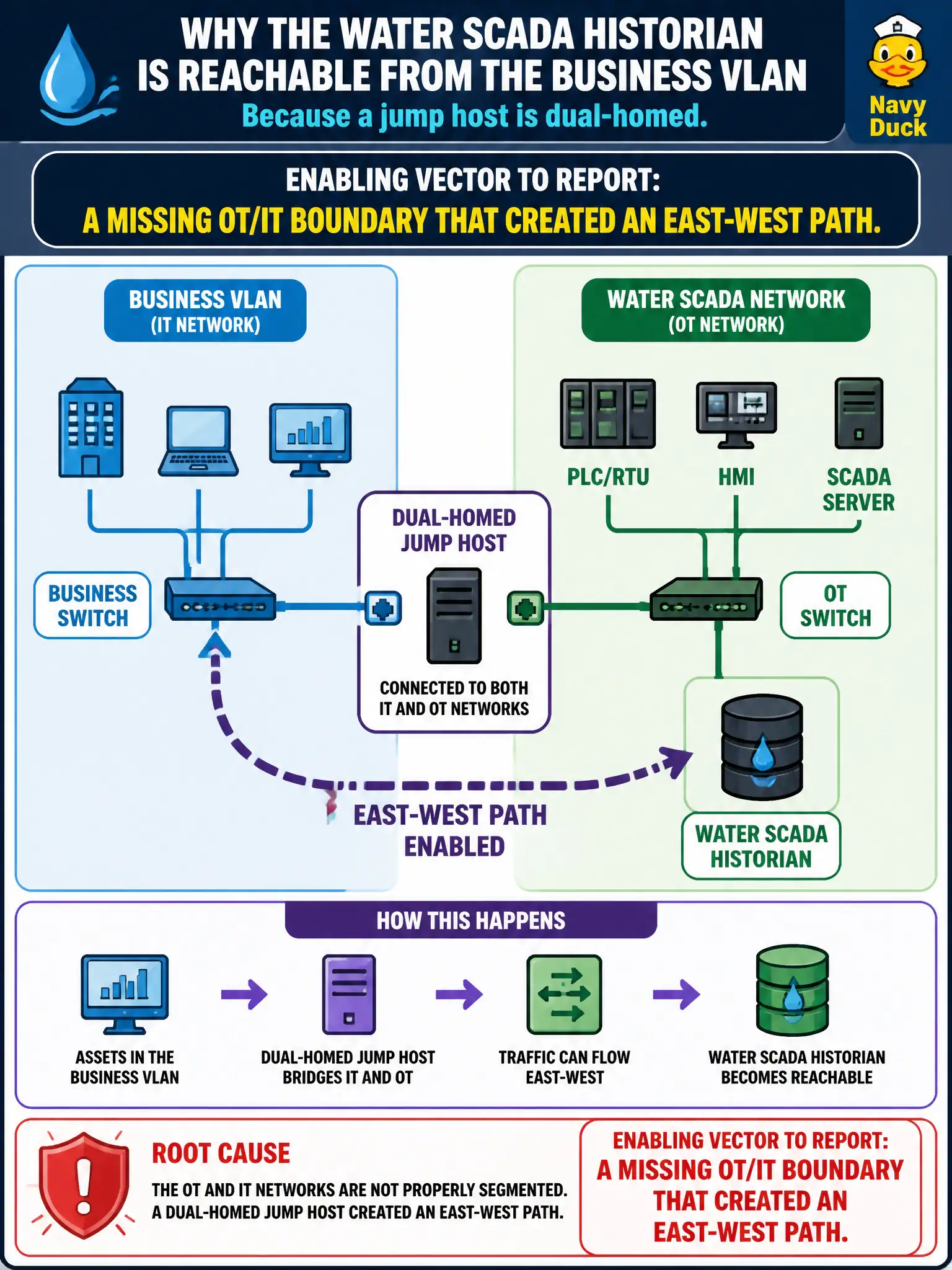
The jump box has a foot in the office network and a foot in SCADA, so the historian is just down the hall. That is a segmentation failure, not a phish or a parking-meter update. The missing OT/IT wall is the vector that enabled east-west reach.
Full Explanation
When the water SCADA historian is reachable from the business VLAN because a jump host is dual-homed, the enabling vector is a missing OT/IT boundary that created an east-west path. The jump box has a foot in the office network and a foot in SCADA, so the historian is effectively down the hall. Civic water security reports should name segmentation failure as the enabler, not invent a phish or parking-meter update the stem does not describe.
Calling it a phishing lure in municipal email fails by concept: email delivery is not the enabling path given. Calling it a trojanized parking-meter vendor update fails by concept: supply-chain meter software is unrelated to historian reachability. Calling it MFA fatigue against city benefits enrollment fails by concept: identity prompt fatigue is not why the historian is reachable from the business VLAN.
Exam caveat: Dual-homed jump hosts bridging business and OT equal a missing OT/IT boundary or east-west path—classic segmentation finding on the blueprint.
Operational check: Document the dual-homed path, restrict or redesign jump access with proper brokers and monitoring, alert on business-VLAN to historian connections in ES, and brief water leadership that reachability itself is the vulnerability.