
Housing-authority SOC is investigating suspected ransomware on file servers. How should the analyst use a Splunk Lantern ransomware-investigation article?
Select an answer to reveal the explanation.
Short Explanation
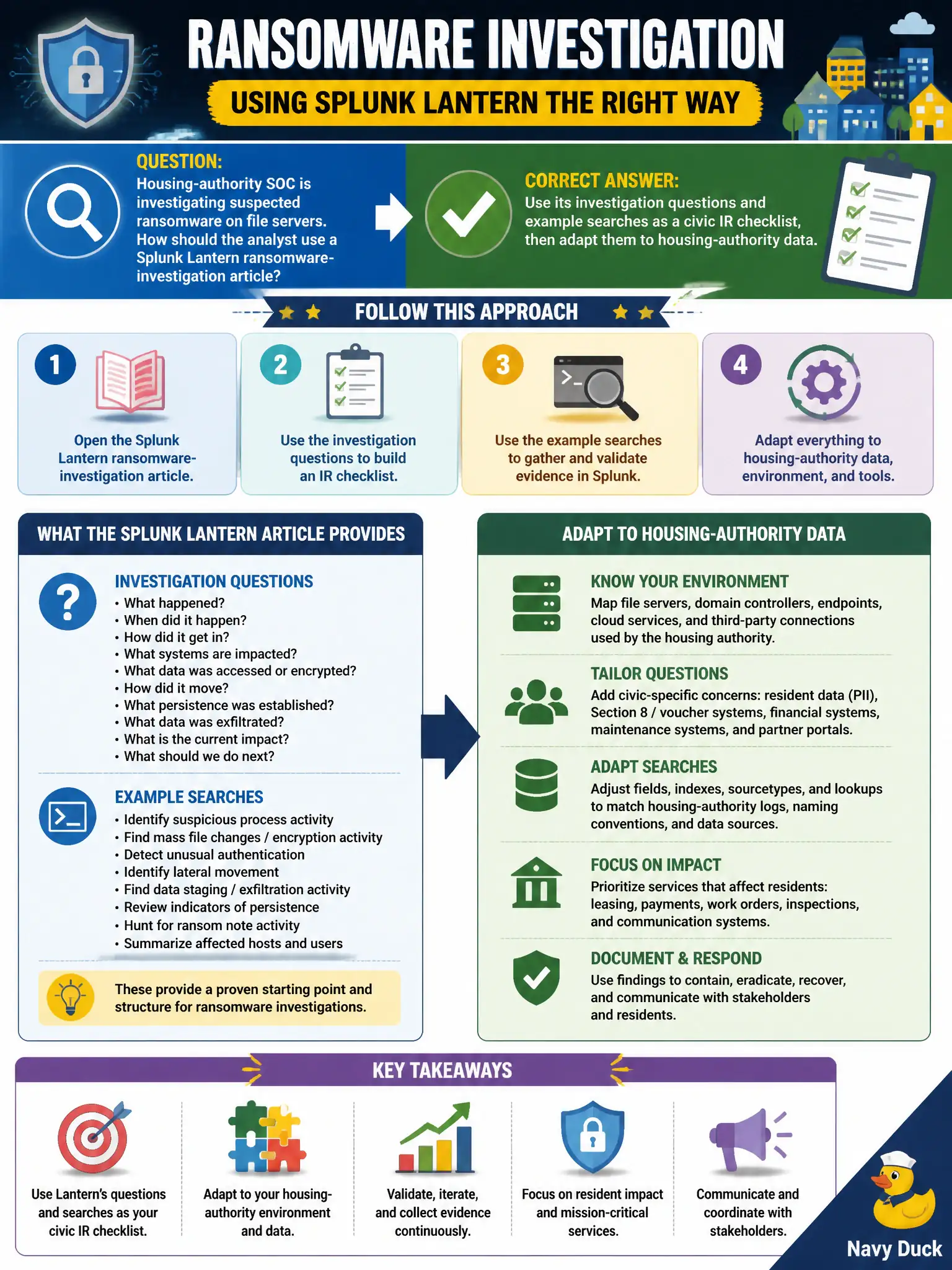
Lantern's ransomware articles are a checklist: shadow copies deleted, unusual SMB, and the searches that test those questions. Use that structure on housing-authority servers. It is not a dump of exam stems and it is not sample data to inject.
Full Explanation
Splunk Lantern ransomware-investigation articles are structured investigation aids: they name the questions an analyst should ask—such as whether volume shadow copies were deleted or whether unusual SMB activity appeared—and they supply example searches that test those questions against real telemetry. For a housing-authority SOC chasing suspected ransomware on file servers, the correct use is to treat that article as a civic incident-response checklist, then adapt the sample SPL to housing-authority indexes, sourcetypes, and Asset and Identity context rather than copying sample events wholesale. That approach keeps the hunt grounded in the authority's own Windows and file-server data while still following a proven investigation sequence from Splunk's official content library. Copying the article's sample events into production indexes as fake notables pollutes live Incident Review and invents evidence that never occurred on civic hosts. Treating Lantern as a brain-dump of live exam questions to memorize confuses enablement material with unauthorized exam content and does not produce a reproducible hunt. Ignoring Lantern until a malware hash appears abandons the article's behavioral focus—shadow-copy deletion and anomalous SMB often precede or accompany ransomware even when a hash is not yet known. Exam caveat: Lantern and SSE are in-scope analyst resources for investigation structure, not substitutes for validating hits against local civic telemetry before disposition. Operational check: open the Lantern ransomware article, list the investigation questions it recommends, map each to a housing-authority data source, run one adapted search for shadow-copy or SMB anomalies, and confirm results before promoting any pattern into a correlation search.